Execution Models
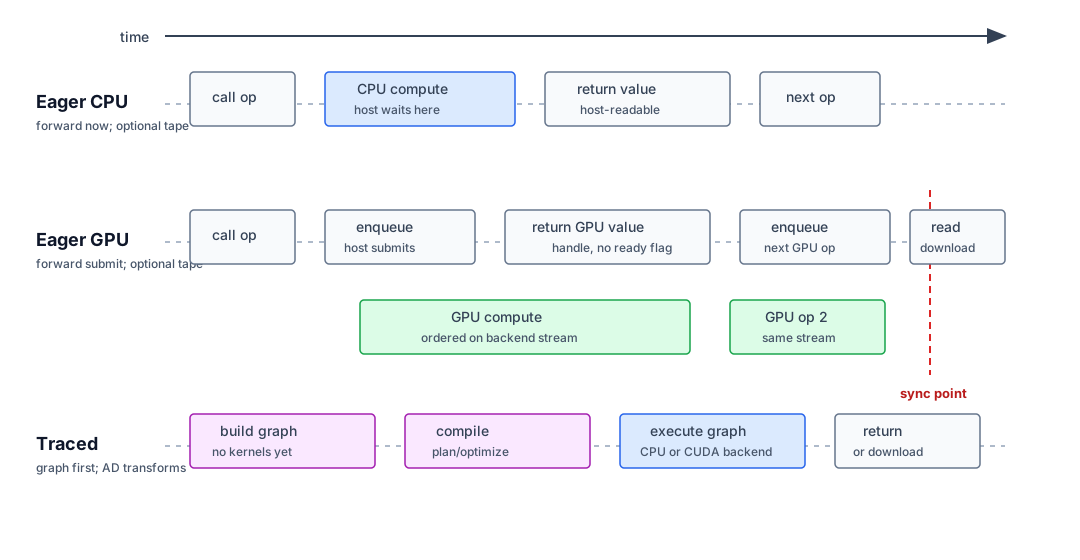
tenferro supports direct execution, PyTorch-like eager execution with optional stateful and functional AD, and JAX-like traced graph execution on the same dense tensor stack. The key distinction is when work is submitted and when the host waits for results.
Eager CPU
Direct CPU tensor operations and eager CPU operations run immediately. A call enters the CPU backend, the CPU work completes, and the returned value is host-readable.
This is the easiest model for debugging and for ordinary numeric code without autodiff. Use TypedTensor<T, R> or Tensor when no gradient state is needed. TypedTensor<T, R> carries the scalar type in Rust; Tensor stores dtype at runtime. Use EagerTensor when you want immediate forward execution through an EagerRuntime. Make tensors tracked for PyTorch-style backward() on scalar losses, or call the runtime functional APIs (grad, vjp, jvp) when the derivative should be returned as another eager tensor.
Eager GPU
Eager GPU work is immediate at the Rust API boundary, but it is not a ready flag API and it does not imply host synchronization after every kernel. An op submits work to the CUDA backend and returns a CUDA-resident Tensor handle. Subsequent CUDA ops can consume that handle on the same backend stream.
The host waits when values are downloaded or otherwise need host inspection. Some library-backed operations also synchronize internally when they must read device-side status. Call EagerRuntime::synchronize() when a workflow needs an explicit host-side barrier without downloading tensor values.
Traced Mode
Traced mode records operations into a graph first. It is similar to JAX’s tracing and jit workflow: build the expression, compile it, then run the compiled program through Runtime::run_compiled.
Use traced mode for symbolic inputs, graph optimization, repeated execution, and compiled grad, vjp, jvp, and HVP workflows. The executor backend decides whether the compiled program runs on CPU or CUDA for supported operations.
Dynamic Shapes in Traced Mode
Traced programs can carry shape metadata whose exact size is resolved at execution time. That lets operations such as truncated SVD return a rank chosen from the input values and still feed later traced operations without re-tracing or padding to a fixed rank.
This is the main difference from shape-specialized compilation systems such as JAX/XLA. Static-shape workloads can benefit from aggressive specialization; runtime-rank workflows need a representation that keeps exact, upper-bound, or unknown extents in the program until dispatch. See Dynamic and Symbolic Shape Metadata for the implementation contract.
Why Support Both?
Eager and traced serve different workflows on the same tensor stack.
| Need | Better fit |
|---|---|
| Inspect intermediate values while developing | Eager CPU or eager GPU with explicit download |
| Immediate forward execution through one runtime | EagerTensor |
| Reverse-mode AD on scalar losses with gradient accumulation | tracked EagerTensor variables + backward() |
Functional eager grad, vjp, jvp, or HVP composition |
EagerRuntime functional APIs |
Compiled grad, vjp, jvp, and higher-order AD |
TracedTensor |
| Reuse the same computation many times | GraphCompiler + Runtime::run_compiled |
| Keep code without autodiff simple | TypedTensor<T, R> or Tensor |