tenferro
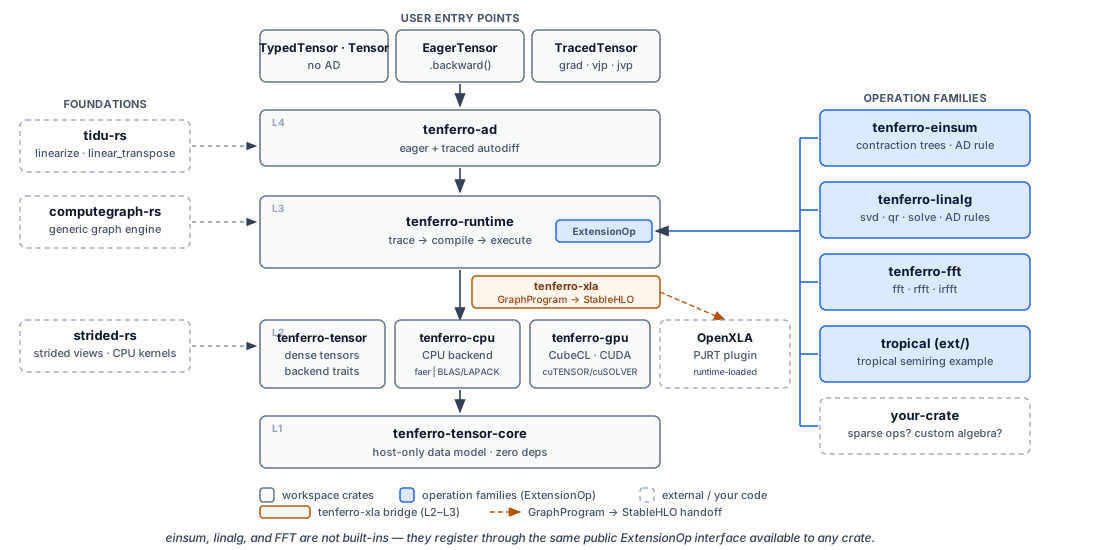
tenferro is a Rust-native tensor computation stack with opt-in autodiff for scientific workloads: typed tensors, dynamic tensors, PyTorch-style immediate execution with backward() and EagerRuntime functional grad, vjp, and jvp, JAX-style traced graphs, einsum, linear algebra, FFT, and explicit CPU, CUDA, and experimental WebGPU backend control.
The project covers both ordinary tensor computation and autodiff workflows. Start with the smallest API that solves your problem, then add autodiff, graph compilation, CUDA, or experimental WebGPU only when the workflow needs them.
Where To Start
| Workflow | Start with |
|---|---|
| First setup and a checked CPU program | Getting Started |
| Coming from ndarray, nalgebra, or ndarray-linalg | ndarray / nalgebra Mapping |
| Core terms and the three main choices | Core Concepts |
| Step-by-step runnable examples | Tutorials |
Choosing between TypedTensor, Tensor, EagerTensor, and TracedTensor |
Choosing a Tensor API |
| Understanding direct, eager, and traced execution | Execution Models |
| Column-major storage and row-major import/export | Memory Order |
| CPU, CUDA, and experimental WebGPU behavior; NVIDIA library compatibility | Devices and GPU |
| CPU affinity, NUMA placement, faer, and external BLAS behavior | CPU Execution and NUMA Placement |
| Static-shaped StableHLO and PJRT plugin loading | XLA and PJRT |
| Runtime-dependent dimensions in traced graphs | Dynamic and symbolic shapes |
| API documentation for every crate | API Reference |
First Direct Tensor Example
use tenferro_cpu::CpuBackend;
use tenferro_linalg::prelude::*;
use tenferro_runtime::prelude::*;

fn assert_close(actual: &[f64], expected: &[f64]) {
    assert_eq!(actual.len(), expected.len());
    for (index, (actual, expected)) in actual.iter().zip(expected).enumerate() {
        let error = (actual - expected).abs();
        assert!(
            error < 1.0e-12,
            "value {index}: actual={actual}, expected={expected}, error={error}"
        );
    }
}

fn main() -> Result<(), Box<dyn std::error::Error>> {
    let mut backend = CpuBackend::new();

    let a = TypedTensor::<f64>::from_vec_col_major(vec![2, 2], vec![3.0, 0.0, 0.0, 1.0])?;
    let identity = TypedTensor::<f64>::from_vec_col_major(vec![2, 2], vec![1.0, 0.0, 0.0, 1.0])?;
    let rhs = TypedTensor::<f64>::from_vec_col_major(vec![2, 1], vec![6.0, 2.0])?;

    let (product, solution, singular_values) = backend.with_backend_session(|session| {
        let product = a.matmul(&identity, session)?;
        let solution = product.solve(&rhs, session)?;
        let singular_values = product.svdvals(session)?;
        Ok::<_, tenferro_runtime::Error>((product, solution, singular_values))
    })??;
    assert_eq!(product.shape(), &[2, 2]);
    assert_close(product.host_data()?, &[3.0, 0.0, 0.0, 1.0]);
    assert_close(solution.as_slice()?, &[2.0, 2.0]);
    assert_close(singular_values.as_slice()?, &[3.0, 1.0]);

    Ok(())
}
Dependency Footprint
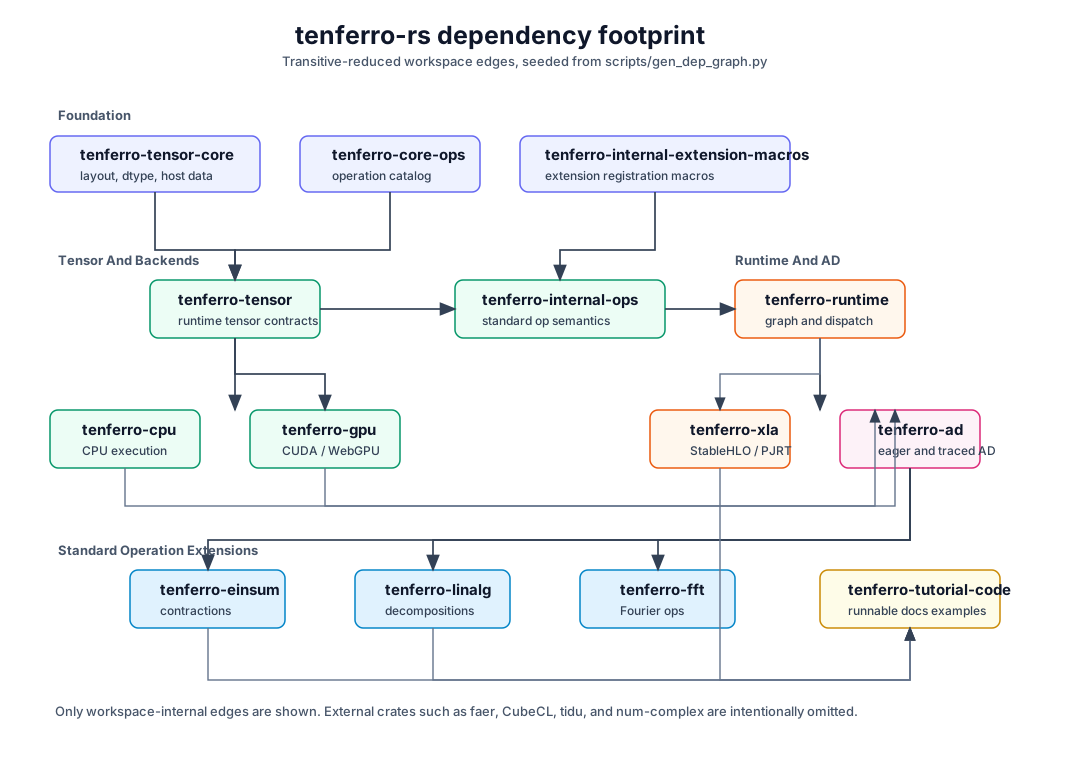
The checked-in diagram is rendered by Graphviz from the transitive-reduced workspace graph produced by scripts/gen_dep_graph.py; node positions and arrow attachment points are not maintained by hand. Regenerate it with:
python3 scripts/gen_dep_graph.py --format svg --output docs/assets/dependency-footprint.svgGraphviz is needed only for regeneration. The semantic node and edge inventory can be checked without rerendering:
python3 scripts/gen_dep_graph.py --check-svg docs/assets/dependency-footprint.svgMental Model
tenferro has three independent choices. GPU providers, eager execution, and traced graphs are not competing APIs; they answer different questions.
| Choice | Question | Options |
|---|---|---|
| Tensor API | What kind of value do I pass around? | TypedTensor<T>, Tensor, EagerTensor, TracedTensor |
| Execution timing | When does computation run? | Direct backend call, immediate eager execution, traced compile/run |
| Backend/device | Where does computation run? | CPU, CUDA, or experimental WebGPU backend, with explicit transfer |
Most code without autodiff starts with TypedTensor<T> when the scalar type is known at compile time, or Tensor when dtype must be selected at runtime. EagerTensor adds immediate execution through an EagerRuntime, optional stateful backward() on scalar losses, and functional eager grad, vjp, and jvp transforms. TracedTensor adds graph compilation, grad, vjp, and jvp on traced graphs, symbolic inputs, and reuse.
Get In Touch
Questions, design discussions, and contributor coordination for tenferro happen in the tenferro Matrix room:
Matrix is an open, federated chat protocol. You can join from a Matrix client such as Element, or through the browser flow opened by the link above.
Use GitHub issues for bug reports, feature requests, and decisions that need tracking; use Matrix for lightweight discussion before filing or implementing changes.