Choosing a Tensor API
This page is about choosing the tensor API that matches your workflow. tenferro separates the value you pass around, when computation runs, and which backend or device executes the work.
Start Here
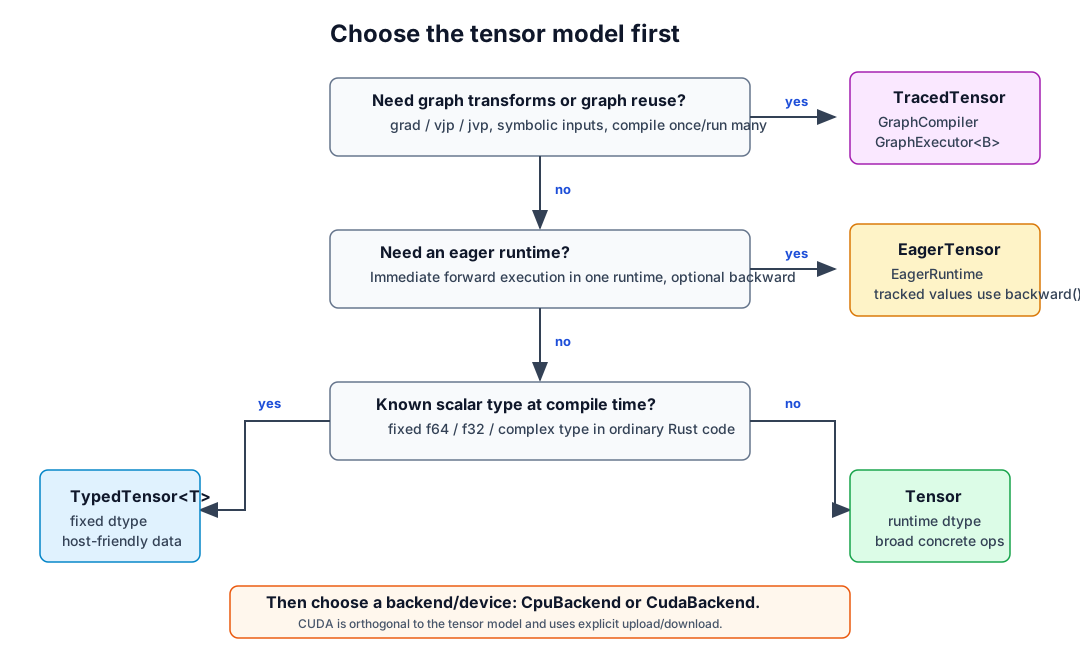
For most projects without autodiff, TypedTensor<T, R> or Tensor should come first. Move to EagerTensor when you want immediate execution under an EagerRuntime; make tensors tracked when the workflow needs backward() on scalar losses or functional eager grad, vjp, jvp, and HVP composition. Move to TracedTensor when the workflow needs those transforms on compiled graphs.
Quick reference:
| If your project needs | Start with |
|---|---|
| No autodiff, scalar type known at compile time | TypedTensor<T, R> |
| No autodiff, dtype selected at runtime | Tensor |
Immediate forward execution in one runtime, optionally backward() or functional grad/vjp/jvp |
EagerTensor + EagerRuntime |
grad, vjp, jvp, HVP via composition, graph reuse |
TracedTensor + GraphCompiler + Runtime::run_compiled |
Import Style
Use direct imports when a small module should make its dependencies explicit: use tenferro_runtime::{Tensor, TensorSessionOpsExt}; and use tenferro_linalg::TensorLinalgExt;. For tutorials or modules using several operation traits, the equivalent crate-local preludes are use tenferro_runtime::prelude::*; and use tenferro_linalg::prelude::*;. There is no facade prelude: keep each operation family imported from its own crate. The prelude imports extension traits and common associated types; it does not change backend selection or execution semantics.
Tensor Types
TypedTensor<T, R = DynRank> owns runtime tensor data with a compile-time scalar type and optional compile-time rank marker. Owned values use tenferro’s column-major layout. Strided views use TypedTensorView and TypedTensorViewMut.
Tensor owns the same kind of dense data, but wraps supported scalar types in a runtime dtype enum and remains dynamic-rank. Use it when dtype must be selected dynamically, when you want the broad concrete tensor operation API, or when you need to pass CPU or CUDA tensors through backend dispatch.
tenferro-tensor-core is lower-level: it owns rank/layout metadata, dtype tags and scalar promotion facts. The tensor types live in tenferro-tensor; plain host data, including a custom scalar type, is TypedTensor<T, R, Host>.
EagerTensor is concrete eager execution. It wraps Tensor values in an EagerRuntime, so each operation computes a concrete result immediately. Untracked eager tensors are forward-only. Tracked eager tensors additionally record reverse-mode state for backward() on scalar losses and can feed EagerRuntime functional grad, vjp, and jvp transforms.
TracedTensor is a graph-building handle. It is the graph and compilation API, not the default concrete tensor type.
Execution Model
| Model | Similar to | What happens on each op |
|---|---|---|
| Direct tensor execution | NumPy-style explicit backend calls | The backend runs the op immediately and returns a concrete Tensor |
| Eager execution | PyTorch eager/autograd | The op runs immediately; tracked values record enough state for backward() and functional eager transforms |
| Traced execution | JAX tracing/jit/grad | The op records graph structure; compute runs after compile/execute |
See Execution Models for the time-axis diagram, including the difference between Eager CPU, Eager GPU, and Traced mode.
Device And Backend
CPU and CUDA are backend choices. They do not decide whether your program is typed, eager, or traced.
CUDA support is provided by the feature-gated CUDA backend for concrete, eager, and traced workflows. CPU/GPU transfer is explicit:
- upload CPU tensors before CUDA backend operations,
- keep intermediate tensors on CUDA while doing CUDA work,
- download only when the host must inspect values,
- do not expect an unsupported CUDA operation to silently fall back to CPU.
Operations that require compact storage may copy a view into compact storage on the same device. They do not silently upload CPU tensors or download CUDA tensors.
The current CUDA operation and dtype table is in Devices and GPU.
Operation Entry Points
Choose the tensor API first, then choose the operation family. CUDA is not a separate operation entry point; it is a backend/device choice for supported operations.
| Need | Without autodiff | Eager path | Traced path |
|---|---|---|---|
| Everyday tensor ops | Receiver methods with the session last: x.gather(&idx, cfg, session) via TensorSessionOpsExt (all core ops) / TypedTensorSessionOpsExt (elementwise, reductions, dot, scaling; indexing and structural ops on Tensor) |
session.gather(&x, &idx, cfg) on a borrowed EagerSession |
TracedTensor methods / associated functions |
| Einsum | [&a, &b].einsum(...) via TensorEinsumExt / TypedTensorEinsumExt; TensorReadEinsumExt / TypedTensorReadEinsumExt for views; ConcreteEinsumPlan for repeated fixed metadata |
session.einsum(&[&a, &b], ...) via EagerSessionEinsumExt |
trace.einsum(...) via TraceContextEinsumExt plus extension_module |
| FFT | x.fft(...) via TensorFftExt; read.fft_read(...) via TensorReadFftExt |
session.fft(&x, ...) via EagerSessionFftExt with autodiff (EagerTensorFftExt only for consuming in-place FFT) |
x.fft(...) via TracedTensorFftExt plus extension_module |
| Tensordot sugar | Use matmul or dot_general directly |
session.tensordot(&a, &b, axes) via EagerSessionEinsumExt |
a.tensordot(&b, axes) via TracedTensorEinsumExt |
| Linear algebra | TensorLinalgExt session methods via with_backend_session |
EagerTensorLinalgExt methods with autodiff |
TracedTensorLinalgExt methods |
| Automatic differentiation | Not applicable | backward() plus EagerRuntime functional grad, vjp, jvp, HVP via composition |
grad, vjp, jvp, HVP via composition |
| External operations | Extension-defined concrete hooks | Extension-defined eager hooks and optional AD rules | Extension-defined graph hooks and optional AD rules |
Use CPU or CUDA with these paths according to backend coverage. CUDA tensors must be moved explicitly with upload/download helpers, and unsupported CUDA operations do not silently fall back to CPU.
Extension Model
Automatic differentiation is externally extensible. An extension crate can add operations, eager/traced execution hooks, and AD rules without forcing the core crate to grow application-specific APIs. FFT (extension) is the example extension package: it adds Fourier transform operations and registers AD rules for supported transforms.