tenferro-rs Crate Architecture
Repo: tenferro-rs Parent: ../index.md Related: computegraph.md, primitive-ad.md, semantic-ad.md, ../spec/backend-contract.md, ../spec/primitive-catalog.md, ../spec/extension-op.md
I. Purpose
This document records the current workspace crate split and dependency boundaries. The workspace intentionally has no root tenferro facade crate: users import the crates that own the layer or operation family they need.
The design goal is to keep these concerns separate:
- rank/layout and scalar metadata
- concrete runtime tensors and backend traits
- CPU/GPU backend implementations
- traced graph construction and execution
- eager and traced AD APIs
- experimental XLA/PJRT lowering for static traced programs
- first-class operation families such as einsum, linalg, and FFT
- internal graph operation vocabulary and primitive metadata
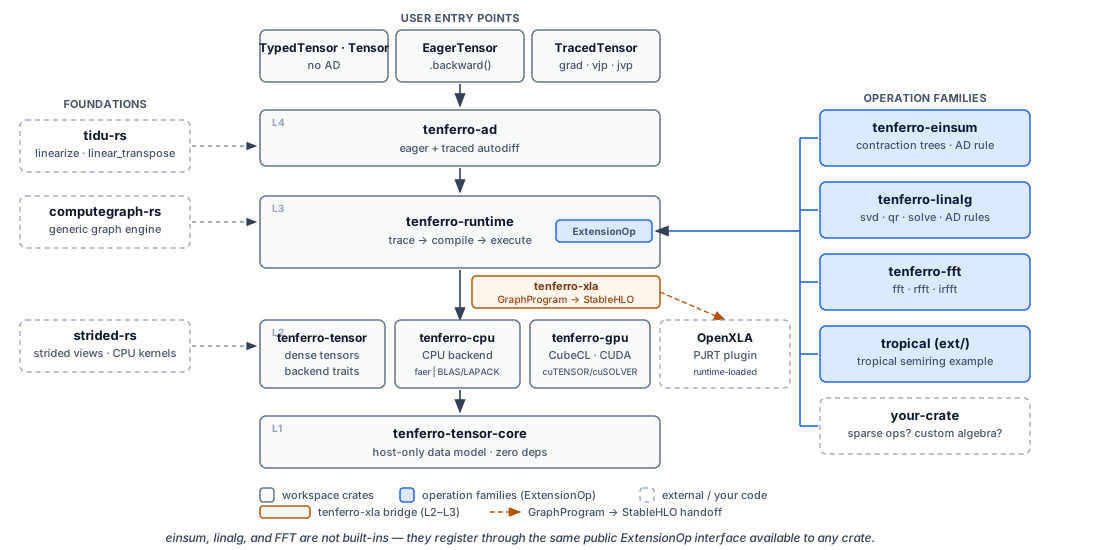
The overview diagram focuses on the native CPU/GPU runtime and extension stack. tenferro-xla is a peer executor over compiled static programs, not a TensorBackend inside that stack.
II. Current Workspace Crates
| Crate | Role |
|---|---|
tenferro-tensor-core |
Rank/layout metadata, dtype tags, scalar promotion facts, and layout validation; no tensor-storage family |
tenferro-tensor |
Runtime TypedTensor<T, R, D> (Host/Gpu/Dynamic) and Tensor values, typed views, the host container (HostTensor, DefaultScalars, ScalarSet, ErasedHostTensor), backend traits, and backend-independent contracts |
tenferro-cpu |
Public CPU backend, CPU execution sessions, CPU execution context, provider selection, thread policy, public resource-pool controls, and the CPU runtime-registration preparation/execution adapter |
tenferro-cpu-basic |
Shared CPU buffer pool, full-overwrite destination guard, and host strided-storage adapters used by CPU kernel families |
tenferro-cpu-fused |
Internal CPU runtime-DAG fused elementwise adapter; delegates traversal to the fused strided kernel |
tenferro-gpu |
CubeCL/CUDA backend and GPU transfer helpers |
tenferro-runtime |
Concrete tensor helpers, traced tensors, graph compilation/execution, immutable runtime snapshots, preparation SPI/cache substrate, runtime-owned compiled-graph execution, scheduled-graph staging, extension runtime registration, and extension cache storage |
tenferro-xla |
Experimental StableHLO lowering and runtime-loaded PJRT plugin support for static-shaped traced programs |
tenferro-ad |
Eager runtime, eager tensors, and traced AD extension traits |
tenferro-einsum |
Subscripts, contraction planning, concrete/traced/eager einsum APIs, extension runtime, and AD rule |
tenferro-linalg |
Linear algebra traced APIs, eager helpers, extension runtime, and optional linalg AD rules |
tenferro-fft |
FFT extension runtime and public concrete/traced FFT APIs |
tenferro-core-ops |
Internal core primitive operation catalog used by graph, runtime, and backend dispatch |
tenferro-internal-cpu-kernels |
Internal ordinary dtype-dispatch CPU kernels, pool-aware one-shot read-into replay, and scalar-agnostic caller-destination entry points |
tenferro-internal-ops |
Graph op vocabulary and AD rule implementations |
tenferro-internal-extension-macros |
Procedural macros for extension-op registration |
The public user-facing crates are tenferro-tensor-core, tenferro-tensor, tenferro-cpu, tenferro-gpu, tenferro-runtime, tenferro-ad, tenferro-xla, tenferro-einsum, tenferro-linalg, and tenferro-fft. Crates with internal in their name are implementation crates and should not be presented as user-facing API surfaces.
Non-workspace source-provider packages
third_party/t4a-tblis-src is stored in this repository but is not a tenferro workspace crate. It is a self-contained, independently versioned source-build and native-link provider prepared for a future, separate crates.io release. Until that package is released, the root workspace excludes it and does not publish any crate that depends on it.
tenferro-cpu does not depend on tblis-ffi or t4a-tblis-src. The unpublished ext/tenferro-cpu-tblis crate is the external-provider example: it depends on tblis-ffi, optionally depends on the local ../../third_party/t4a-tblis-src path for source-build, and installs only a general-contraction provider. All other CPU operations remain delegated to the selected tenferro-cpu base provider. The unpublished ext/tenferro-cpu-tprims crate likewise depends on tprims-rs by git commit (and repeats the workspace strided-rs pin) and installs GEMM and general-contraction providers that run on the context’s Rayon pool (CpuExecutionContext::rayon_pool); tenferro-cpu has no tprims or linalg dependency. tenferro-linalg takes its built-in CPU kernels from the extracted tlinalg (faer) and tlinalg-blas (LAPACK/BLAS) crates of the tlinalg-rs workspace, pinned by git revision.
III. Layering
Layer 4: tenferro-ad
         eager runtime, eager tensors, traced AD extension traits

Layer 3: tenferro-runtime
         concrete tensor helpers, traced tensors, graph compilation/execution,
         extension runtime registration, extension cache storage

         tenferro-xla
         experimental StableHLO/PJRT peer executor for static programs

         tenferro-einsum / tenferro-linalg / tenferro-fft
         first-class operation-family crates

Layer 2: tenferro-tensor
         runtime TypedTensor<T, R>/Tensor values, typed views,
         backend traits, backend-independent contracts

         tenferro-cpu
         public CPU backend and execution sessions

         tenferro-cpu-basic
         shared CPU pool, overwrite guard and host strided adapters

         tenferro-internal-cpu-kernels
         ordinary dtype-dispatch and read-into kernels

         tenferro-cpu-fused
         runtime-DAG fused elementwise adapter

         tenferro-gpu
         CubeCL/CUDA backend and GPU transfer helpers

Layer 1: tenferro-tensor-core
         rank/layout metadata, dtype tags, scalar tags
         and promotion facts, layout validation

Internal: tenferro-core-ops
          core primitive operation catalog

          tenferro-internal-ops
          graph op vocabulary and AD rule implementations

          tenferro-internal-extension-macros
          extension-op registration macros
IV. Dependency Direction
The dependency direction is deliberately one-way. Arrows below mean “depends on”. The CPU-to-runtime line records the implemented runtime registration adapters: Phase 4 preparation metadata and the Phase 5 runtime-owned execution bridge. It is not a runtime-to-CPU dependency:
tenferro-tensor           -> tenferro-tensor-core, tenferro-core-ops
tenferro-cpu-basic        -> tenferro-tensor, strided-basic
tenferro-internal-cpu-kernels
                           -> tenferro-tensor, tenferro-tensor-core,
                              tenferro-cpu-basic, strided-kernel
tenferro-cpu-fused        -> tenferro-tensor, tenferro-cpu-basic,
                              strided-basic, strided-fused
tenferro-cpu              -> tenferro-runtime
tenferro-cpu              -> tenferro-tensor, tenferro-core-ops,
                              tenferro-cpu-basic, tenferro-cpu-fused,
                              tenferro-internal-cpu-kernels
tenferro-gpu              -> tenferro-tensor, tenferro-core-ops,
                              tenferro-cpu, tenferro-runtime
tenferro-internal-ops     -> tenferro-tensor, tenferro-core-ops,
                              tenferro-internal-extension-macros
tenferro-runtime          -> tenferro-tensor, tenferro-core-ops,
                              tenferro-internal-ops,
                              tenferro-internal-extension-macros
tenferro-xla              -> tenferro-runtime, tenferro-internal-ops,
                              tenferro-tensor
tenferro-ad               -> tenferro-runtime, tenferro-internal-ops,
                              tenferro-tensor, tenferro-cpu

tenferro-einsum           -> tenferro-runtime, tenferro-internal-ops,
                              tenferro-tensor, tenferro-cpu,
                              tenferro-internal-extension-macros
tenferro-linalg           -> tenferro-runtime, tenferro-internal-ops,
                              tenferro-tensor, tenferro-cpu,
                              tenferro-internal-extension-macros
tenferro-fft              -> tenferro-runtime, tenferro-internal-ops,
                              tenferro-tensor, tenferro-cpu,
                              tenferro-internal-extension-macros
Additional internal dependencies:
tenferro-runtime,tenferro-tensor,tenferro-gpu, andtenferro-internal-opsusetenferro-core-opsfor primitive metadata.- The production
tenferro-cputotenferro-runtimeedge is approved solely for engine-registration adapters: direct core preparation capability registration, runtime cache-owner registration, and the erased tensor backend execution bridge. The preparation/execution substrate is implemented intenferro-runtime; any CPU dependency in the opposite direction remains dev/test-only and is not a production edge. tenferro-runtimedepends ontenferro-internal-extension-macrosonly to re-export the supported out-of-tree authoring macro; the proc-macro crate emits runtime paths and does not depend back ontenferro-runtime.tenferro-einsum,tenferro-linalg, andtenferro-fftdepend ontenferro-runtimefor extension application and runtime registration.tenferro-xladepends ontenferro-runtimeto read compiled programs and owns its own runtime-loaded PJRT boundary. It must not make XLA/PJRT a compile-time dependency oftenferro-runtime.- Operation-family AD support depends on
tenferro-adonly when the crate’sautodifffeature is enabled. - CUDA support flows through explicit
cudafeatures andtenferro-gpu.
Rules:
tenferro-tensor-coremust remain backend-independent and must not depend on GPU, BLAS/LAPACK provider crates, backend buffers, runtime caches, or AD.tenferro-tensor-coremust not expose publicTypedTensoraliases. Backend-capable typed tensors are owned bytenferro-tensor.tenferro-tensor-coremust not own a tensor-storage family. There is one public tensor family, intenferro-tensor: host data is the canonicalTypedTensor<T, R, Host>/TypedTensorView<'a, T, R, Host>, and the default scalar set (DefaultScalars), the scalar-set trait and its declaration macro, and the dtype-erased external value (ErasedHostTensor) are built on it rather than on a second host container (#1946 F8). Core keeps the scalar tags and their promotion facts (DType,TensorScalar,define_scalar_tag!,MemberKind,MemberSpec,promote_specs,promote_in_set) and the rank/layout metadata and validation.define_scalar_set!expands$crate::TypedTensor<_, $crate::DynRank, $crate::Host>fromtenferro-tensor, so a crate that declares its own scalar set depends ontenferro-tensor(not onlytenferro-tensor-core).tenferro-tensorowns concrete runtime tensor values, arbitrary-stride typed views, backend traits, and backend-independent contracts. ItsTensorElementwise::elementwise_read_intohook is required at backend implementations; tensor itself does not instantiate a CPU strided kernel.tenferro-cpuownsCpuBackend,CpuContext, CPU execution sessions, CPU provider selection, thread policy, public resource-pool controls, and its narrow runtime-registration adapters for preparation metadata and runtime-owned execution.tenferro-cpu-basicowns the shared CPU buffer pool, full-overwrite guard, and host strided-storage adapters. It has no dependency on ordinary or fused CPU kernel families.tenferro-internal-cpu-kernelsowns ordinary dtype-dispatch elementwise kernels and pool-aware one-shot read-into replay. It depends on basic but does not own fused execution.tenferro-cpu-fusedowns runtime-DAG fused elementwise execution and depends on basic plusstrided-fused; it does not depend on ordinary kernel code. Both families receive the enclosing CPU context and pool.tenferro-gpuowns GPU backend implementation and transfer helpers.tenferro-runtimeowns graph construction, compilation, execution, immutable runtime snapshots/reconfiguration, preparation SPI/cache substrate, scheduled-graph staging, runtime-owned compiled-graph execution, extension runtime registration, and extension cache ownership.tenferro-xlaowns StableHLO lowering, explicit host-layout conversion at the XLA boundary, and runtime PJRT plugin loading.tenferro-adowns eager AD surfaces and traced AD helper APIs. Primitive AD rule implementations remain intenferro-internal-ops/src/ad/.- Device, placement, and error concepts are owned by the crate that uses them:
tenferro-tensorowns backend-independent tensor contracts,tenferro-gpuowns GPU backend details, and each operation-family crate owns operation-specific parse/planning errors. - Standard operation families stay in direct crates. Do not add a root
tenferrofacade path for them.
V. Extension Boundary
Operation families are first-class crates, not modules hidden behind a facade.
tenferro-einsum, tenferro-linalg, and tenferro-fft own their public operation APIs, extension payloads, shape/dtype inference, runtime registration, and operation-specific tests. When they support AD, they register AD rules for their extension families instead of adding those rules to a monolithic tensor type.
Custom external crates follow the same pattern:
- Implement an extension operation payload.
- Expose a small Rust API around it.
- Register an extension runtime with
tenferro-runtimewhen execution needs family-specific runtime state or caches. - Register AD rules through
tenferro-adwhen gradients are supported.
See ../guides/custom-operations.md and ../spec/extension-op.md.
VI. AD Boundary
tenferro-ad owns the current SemanticProgram -> SemanticProgram AD transforms. tenferro-internal-ops still owns the primitive rule vocabulary used to implement those transforms, while operation-family semantic rules live with the crate that owns the operation semantics.
This is the current split:
tenferro-internal-ops  primitive rule vocabulary
tenferro-ad            semantic transforms and public eager/traced AD APIs
operation crates       optional extension-family semantic rules
VII. Documentation Notes
Historical files under docs/plans/ may describe older crate names and should not be treated as current architecture. This file, REPOSITORY_RULES.md, AGENTS.md, and the crate Cargo.toml files should agree on the live crate split.