Definite Integrals
After a QTT has been built on a physical interval, it can approximate an integral by summing its grid values and multiplying by the grid spacing. For a smooth function this is a compact way to keep the sampled values and an integral estimate together.
Runnable source: docs/tutorial-code/src/bin/qtt_integral.rs
Key API Pieces
integral() is available when the QTT was built from a DiscretizedGrid.
This example uses the same target function as the interval tutorial,
f(x) = x^2 on [-1, 2].
fn main() -> anyhow::Result<()> {
use tensor4all_quanticstci::{
    pointwise_coordinate_batch,quanticscrossinterpolate_batch, DiscretizedGrid, QtciOptions};
let grid = DiscretizedGrid::builder(&[7])
    .with_lower_bound(&[-1.0])
    .with_upper_bound(&[2.0])
    .include_endpoint(true)
    .build()?;

let f = |coords: &[f64]| -> f64 {
    let x = coords[0];
    x.powi(2)
};
let options = QtciOptions::default()
    .with_verbosity(0);
let (qtt, _ranks, _errors) = quanticscrossinterpolate_batch(&grid, pointwise_coordinate_batch(f), None, options)?;

let integral = qtt.integral()?;
let exact = 3.0;
assert!((integral - exact).abs() < 8e-2);
Ok(())
}
For non-constant functions, compare the result against an analytic integral or a trusted high-resolution reference.
What It Computes
The tutorial builds the same interval QTT as before and calls integral() on
it. The plot below comes from the bit-depth sweep and shows how the integral
error changes as the grid is refined.
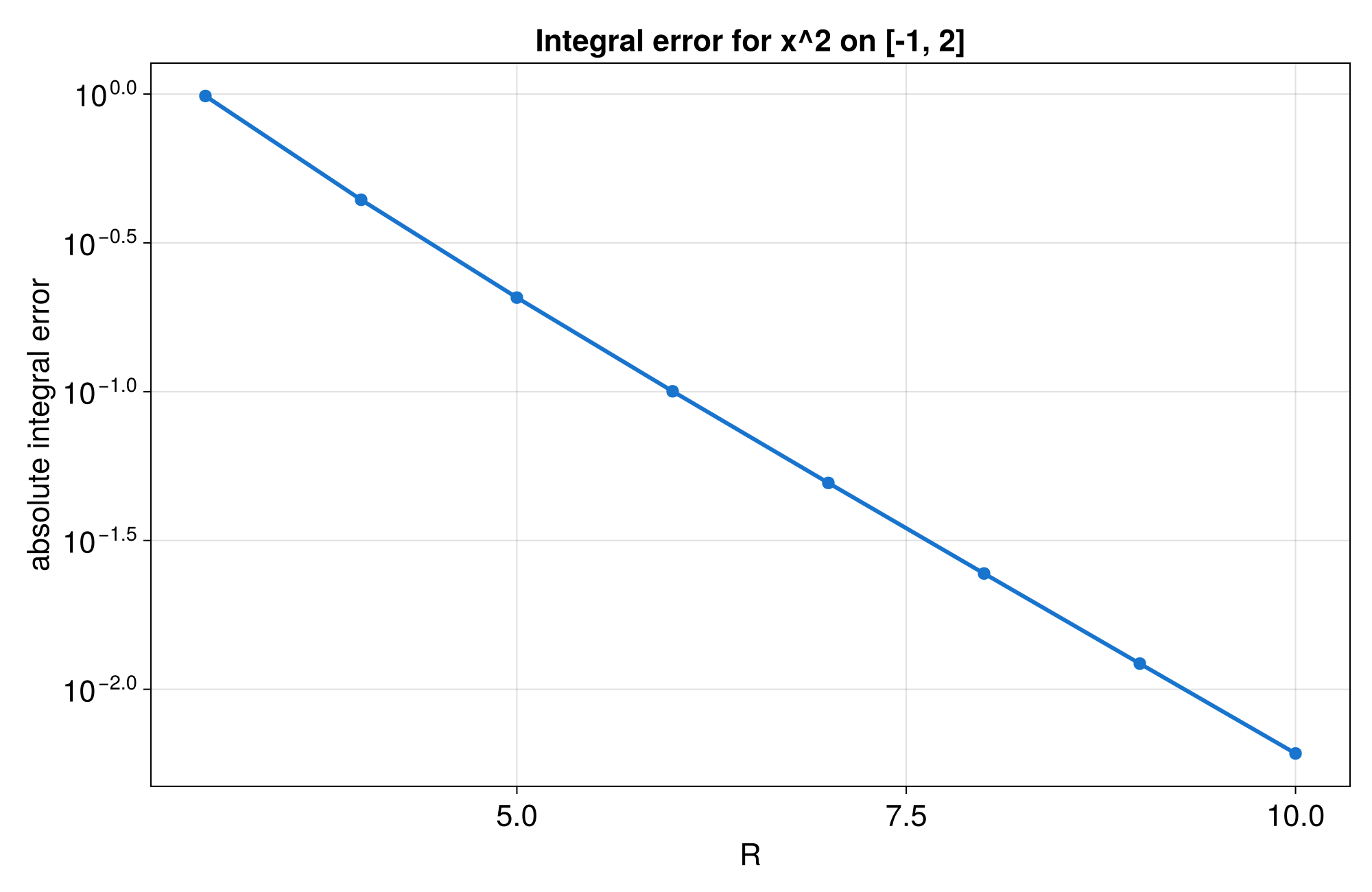
The integral is still a grid approximation. More bits give more grid points, but they can also increase the work needed to build the QTT.