tensor4all-rs
tensor4all-rs is a Rust implementation of tensor network algorithms, focused on:
- Tensor Cross Interpolation (TCI) — adaptive low-rank tensor approximation with TCI2 primary and TCI1 legacy algorithms
- Quantics Tensor Train (QTT) — representation of functions in exponentially fine grids
- Tree Tensor Networks (TreeTN) — tensor networks with arbitrary tree topology
The library is structured as a workspace of independent crates under crates/, designed for modular use and AI-agentic development workflows. Language bindings for Julia are provided through the C API layer.
Source code and issue tracker: github.com/tensor4all/tensor4all-rs
The repository root README.md stays intentionally concise. Longer runnable
examples live in this guide and the guide examples are exercised in CI.
Where to start
| I want to… | Go to |
|---|---|
| Understand tensor networks from scratch | Concepts |
| Install and run my first example | Getting Started |
| Understand the crate structure | Architecture & Crate Guide |
| Come from ITensors.jl and map types | Conventions |
| Browse the full API reference | rustdoc API reference |
| Use tensor4all-rs from Julia | Julia Bindings |
Feature highlights
- Dynamic Index/Tensor system inspired by ITensors.jl: indices carry semantic identity, tensor contraction aligns axes by index rather than position
- Tensor Cross Interpolation (TCI): approximates high-dimensional tensors from a small number of evaluations using cross-approximation; TCI2 is the primary algorithm and TCI1 is available for legacy parity
- Quantics Tensor Train (QTT): represents smooth functions on exponentially fine grids; includes transformation operators (affine, shift, sum)
- Tree Tensor Networks: arbitrary-topology TTN, not limited to chains (MPS/MPO); supports standard MPS/MPO as special cases with runtime topology checks
- C API (
tensor4all-capi): FFI surface for language bindings, currently used by Tensor4all.jl. This repository is early development with no backward-compatibility guarantee; the C ABI should not be treated as stable.
Not sure where you fit?
If you are new to the library, read Getting Started for a short working example, then consult Concepts for background on the data structures used throughout.
Getting Started
Prerequisites
You need the Rust toolchain. If you do not have it installed, follow the instructions at https://rustup.rs/.
Adding tensor4all-rs to Your Project
tensor4all-rs is a collection of crates. The crates are not published to crates.io yet, so use git dependencies from an external project:
[dependencies]
# Basic tensor train construction and manipulation
tensor4all-simplett = { git = "https://github.com/tensor4all/tensor4all-rs", package = "tensor4all-simplett" }

# Indexed tensors and ITensors-like TensorTrain/TT-SVD
tensor4all-core = { git = "https://github.com/tensor4all/tensor4all-rs", package = "tensor4all-core" }
tensor4all-itensorlike = { git = "https://github.com/tensor4all/tensor4all-rs", package = "tensor4all-itensorlike" }

# Tensor Cross Interpolation (TCI)
tensor4all-tensorci = { git = "https://github.com/tensor4all/tensor4all-rs", package = "tensor4all-tensorci" }

# Quantics TCI (combines quantics encoding with TCI)
tensor4all-quanticstci = { git = "https://github.com/tensor4all/tensor4all-rs", package = "tensor4all-quanticstci" }

# Tree tensor networks
tensor4all-treetn = { git = "https://github.com/tensor4all/tensor4all-rs", package = "tensor4all-treetn" }
You do not need to add all of them — only include the crates relevant to your use case.
When working from a local checkout, use path dependencies instead. Paths are
relative to your project’s Cargo.toml; adjust ../tensor4all-rs as needed:
[dependencies]
tensor4all-simplett = { path = "../tensor4all-rs/crates/tensor4all-simplett" }
tensor4all-core = { path = "../tensor4all-rs/crates/tensor4all-core" }
tensor4all-itensorlike = { path = "../tensor4all-rs/crates/tensor4all-itensorlike" }
tensor4all-tensorci = { path = "../tensor4all-rs/crates/tensor4all-tensorci" }
tensor4all-quanticstci = { path = "../tensor4all-rs/crates/tensor4all-quanticstci" }
tensor4all-treetn = { path = "../tensor4all-rs/crates/tensor4all-treetn" }
First Example: Tensor Trains
The following example uses tensor4all-simplett to create a constant tensor train, evaluate it at a specific index, and compress it.
use tensor4all_simplett::prelude::*;

fn main() {
    // Create a constant tensor train with local dimensions [2, 3, 4].
    // Every entry of the represented tensor equals 1.0.
    let tt = SimpleTensorTrain::<f64>::constant(&[2, 3, 4], 1.0);

    // Evaluate at a specific multi-index.
    let value = tt.evaluate(&[0, 1, 2]).unwrap();
    assert!((value - 1.0).abs() < 1e-12);

    // Sum over all indices (2 * 3 * 4 = 24 elements, all 1.0).
    let total = tt.sum();
    assert!((total - 24.0).abs() < 1e-12);

    // Compress with a truncation tolerance.
    let options = CompressionOptions {
        tolerance: 1e-10,
        max_bond_dim: Some(20),
        ..Default::default()
    };
    let compressed = tt.compressed(&options).unwrap();
    assert!((compressed.sum() - 24.0).abs() < 1e-10);

    println!("sum = {}", compressed.sum());
}
Run it with:
cargo run
Next Steps
- Concepts — learn about tensor trains, bond dimensions, and TCI before diving deeper.
- Dense Tensor to Tensor Train with TT-SVD — decompose an existing full indexed tensor with sequential SVD.
- Guides — step-by-step walkthroughs for tensor basics, TCI, quantics transforms, and tree tensor networks.
Concepts
This page introduces the core ideas behind tensor4all-rs in plain language. No deep mathematical background is assumed.
Tensor Train (TT / MPS)
A tensor train (TT) represents a high-dimensional tensor as a chain of
smaller, 3-index tensors. Instead of storing all entries of a size-d^N
tensor (which grows exponentially with N), a TT stores N tensors each of
modest size, multiplied together to reproduce any entry on demand. The size of
the shared “bond” indices between adjacent tensors is called the bond
dimension m; larger m means a more accurate approximation at the cost of
more memory and compute. In quantum physics the same structure is called a
Matrix Product State (MPS).
A[0] ---- A[1] ---- A[2] ---- ... ---- A[N-1]
  |          |          |                  |
 i_0        i_1        i_2             i_{N-1}
Vertical lines are site indices (also called physical indices) — one per tensor, labeling the dimension of the original tensor at that position. Horizontal lines are link indices (bond indices) — internal indices that connect neighboring tensors and whose size is the bond dimension.
Tensor Cross Interpolation (TCI)
Tensor Cross Interpolation approximates a high-dimensional function
f(i_0, i_1, ..., i_{N-1}) by evaluating it at an adaptively chosen subset of
points and fitting a tensor train. The idea generalises the CUR matrix
decomposition — which approximates a matrix using selected rows and columns —
to arbitrary numbers of dimensions. The algorithm automatically identifies the
most informative “pivots” (evaluation points), so it never needs to query the
function at every grid point. For smooth or structured functions, the number
of required evaluations can be orders of magnitude smaller than the full grid.
The output is a tensor train whose accuracy is controlled by a relative
tolerance threshold (rtol).
Quantics Tensor Train (QTT)
Quantics (also called quantized tensor train) is a technique for
representing functions of continuous variables with a tensor train. A function
f(x) sampled on a uniform grid of 2^R points in [0, 1) is reshaped into
an R-site tensor train where every site index has dimension 2. Each site
corresponds to one bit of the binary representation of the grid index. Smooth
functions have low bond dimension in this representation, giving exponential
compression relative to storing all 2^R values. Combining QTT with TCI
(“Quantics TCI”) allows efficient approximation of high-dimensional continuous
integrands without ever forming the full grid.
bit R-1        bit R-2                bit 0
  |              |          ...          |
 B[0] --------- B[1] ----- ... ------- B[R-1]
Each tensor B[k] has two physical legs of dimension 2 (one per variable
dimension in the multivariate case) and one or two bond legs.
Tree Tensor Network (TreeTN)
A Tree Tensor Network generalises the tensor train to tree-shaped graphs.
Each node of the tree holds a tensor, and each edge corresponds to a shared
(bond) index between the two tensors at its endpoints. Contracting along any
edge multiplies those two tensors and merges their free indices. The tensor
train is the special case where the tree is a simple path graph. Tree
structures can capture correlations that are not naturally captured by a chain,
making them useful for problems with hierarchical or multi-scale structure. In
tensor4all-rs, TreeTensorNetwork<V> (where V is a vertex label type) is the
primary data structure representing both TT/MPS and more general tree networks.
         T[root]
        /        \
    T[a]          T[b]
    /   \            \
T[c]   T[d]         T[e]
  |      |             |
 i_c    i_d           i_e
Vertical lines are site indices; lines along the tree edges are bond indices.
Key Terminology
| Term | Meaning |
|---|---|
| Bond dimension | The size of a link (bond) index shared between two adjacent tensors. Controls the accuracy vs. cost trade-off. |
| Site index | A physical or external index at a single tensor site, corresponding to one degree of freedom of the original tensor. |
| Link index | An internal index connecting two neighbouring tensors; its size is the bond dimension. |
Truncation tolerance (rtol) | Relative error threshold used during SVD-based compression. Singular values smaller than rtol * sigma_max are discarded. |
| MPS / MPO | Matrix Product State / Matrix Product Operator — physics names for TT with one or two site indices per tensor, respectively. |
| Pivot | In TCI, a selected multi-index at which the function is evaluated to refine the tensor train approximation. |
Architecture & Crate Guide
This page describes how tensor4all-rs is organised, what each crate does, how to choose the right crate for your use case, and the two-stack design that keeps the public API predictable.
Two stacks, no facade
The workspace is organised as two independent stacks. Each stack owns its
tensor-train representation and its algorithm crates. There is no facade
crate that wraps everything: tensor4all-capi is a C FFI layer, not a Rust
facade, and each crate can be used on its own.
                        tensor4all-core (Index, Tensor, contraction, SVD/QR)
                                      |
              +-----------------------+------------------------+
              |                                                |
   NETWORK STACK (tree-based)                     SIMPLETT STACK (positional)
              |                                                |
   tensor4all-treetn  (TreeTN)                    tensor4all-simplett (SimpleTensorTrain)
              |                                                |
   tensor4all-itensorlike (TensorTrain)           tensor4all-tensorci (TCI1/TCI2)
              |                                                |
   tensor4all-partitionedtreetn (TreeTN patches)    tensor4all-quanticstci
              |                                                |
   tensor4all-partitionedtt (deprecated)            tensor4all-quanticstransform
              |
   tensor4all-treetci

   tensor4all-capi  (C FFI for language bindings; depends on both stacks)
   tensor4all-hdf5  (MPS serialization, ITensors.jl-compatible)
The sanctioned crossing: treetn::simplett_bridge
The only sanctioned place where the two stacks convert into each other is
treetn::simplett_bridge:
tensor_train_to_treetn/tensor_train_to_treetn_with_names/tensor_train_to_treetn_with_names_and_site_indices: simplettSimpleTensorTrain-> networkTreeTN;treetn_to_tensor_train: networkTreeTN(linear chain) -> simplettSimpleTensorTrain;fix_and_remove_site_from_treetn_chain,insert_onehot_site_in_treetn_chain,weighted_remove_site_from_treetn_chain: chain-topology helpers.
Crates that need to cross stacks must route through this bridge. New ad hoc
bridges (hand-rolled conversion logic inside another crate) are rejected.
tensor4all-partitionedtt consumes simplett output (TCI2 results) only via
tensor_train_to_treetn; the TreeTN-native tensor4all-partitionedtreetn
operates directly on named TreeTN<IdxTensor, V> values and does not depend on
simplett, itensorlike, or TCI crates.
One deliberate exception exists: tensor4all-quanticstransform builds
TreeTN-based LinearOperators from simplett MPO data (two site indices
per node) via tensortrain_to_linear_operator. That is operator construction,
not a general stack conversion: the bridge stays MPS-shaped (one site index
per node), and the transform layer keeps the MPO-specific index bookkeeping.
No new ad hoc conversions may be added; MPO conversion belongs in the
transform layer, and MPS conversion belongs in the bridge.
Which stack does a new feature crate target?
- Application-level features (operators, evolution, DMRG, TDVP, algorithm
composition on a known topology) target the network stack by default
(
tensor4all-treetn, ortensor4all-itensorlikewhen ITensors.jl-style semantics are wanted). - Numerical-core features (cross interpolation, factorizations, quantics
kernels) target the simplett stack by default
(
tensor4all-simplett,tensor4all-tensorci; the formertensor4all-tcicorewas dissolved intotensor4all-core, #639). - A feature that must serve both stacks is implemented in the target stack
and exposed through
treetn::simplett_bridge; it is not duplicated in both.
Vocabulary conventions
Beyond the naming-policy suffixes (_mut, _into, _batched), the following
operation names are unified across crates:
- Inner product:
inner_producteverywhere. (dotwas retired intensor4all-simplett.) - Densification:
full_tensormaterializes a tensor train/MPO into a flat column-major buffer plus shape;to_densematerializes a single tensor into a denseIdxTensor. The distinction is intentional (whole-TT vs one-tensor). - Canonicalization:
treetnusescanonicalize/canonicalize_mut;itensorlikeusesorthogonalize(ITensors.jl-compatible vocabulary) for the same center-site normalization. Each stack keeps its standard term; do not introduce a third synonym. - Options: bond caps use
max_bond_dim: Option<usize>; truncation tolerances useSvdTruncationPolicy(rtol/cutoff); sweep counts usenfullsweeps/nsweeps(TreeTN) ornhalfsweeps(itensorlike) as documented in the skills guide.
TensorTrain naming resolution
Two different types are named TensorTrain-family, which is the historical
naming trap that PR 3 resolves:
| Type | Crate | Representation | Use when |
|---|---|---|---|
SimpleTensorTrain<T> | tensor4all-simplett | positional cores (Tensor3<T>), no named indices | lightweight create/evaluate/compress |
TensorTrain | tensor4all-itensorlike | TreeTN<IdxTensor, usize> wrapper with orthogonality tracking | ITensors.jl-style interface |
Rules:
tensor4all-simplett::SimpleTensorTrainis the positional chain type. Prefer it for numerical kernels.tensor4all-itensorlike::TensorTrainis the tree-based chain type with named indices, canonical forms, and orthogonality tracking.- There are no compatibility aliases:
TensorTrainalone always means the itensorlike type inside that crate, and simplett code must writeSimpleTensorTrain.
The corresponding errors follow the representation names:
| Error | Owner | Covers |
|---|---|---|
tensor4all_simplett::SimpleTensorTrainError | SimpleTensorTrain | positional shapes, flat indices, and MatrixCI failures |
tensor4all_itensorlike::TensorTrainError | itensorlike TensorTrain | named indices, TreeTN structure, orthogonality, and factorization |
They are deliberately separate because combining them would couple the two independent stacks. The distinct names prevent ambiguous imports.
Scalar capability boundaries
Scalar traits are layered capabilities rather than interchangeable numeric aliases:
| Capability | Purpose |
|---|---|
tensor4all_core::Scalar | common value arithmetic and conversion |
tensor4all_core::MatrixLuciScalar | core Scalar plus MatrixLUCI backend dispatch |
tensor4all_tensorbackend::TensorElement | supported Rust scalar ↔ native tensor conversion |
tensor4all_tensorbackend::StorageScalar | compact storage construction |
| tensorbackend matrix/linalg traits | individual backend kernel capabilities |
tensor4all_simplett::TTScalar | positional tensor-train arithmetic requirements |
| ACI/TreeACI scalar traits | sealed algorithm-supported types and algorithm-only operations |
tensor4all_core::AnyScalar is the only public AnyScalar; it may retain an
AD-tracked rank-0 tensor. The internal tensorbackend value is named BackendScalar
and is an untracked compact scalar. Do not replace these capability boundaries
with one all-purpose supertrait: that would force storage and algorithm
requirements onto unrelated generic code.
Layer descriptions
Foundation (internal)
| Crate | Description |
|---|---|
| tensorbackend | Internal. Compact f64/Complex64 storage, four-dtype eager tensor bridges, and tenferro-backed primitives. Users do not need to depend on this crate directly. |
| core | Foundation for everything else. Provides the Index system, dynamic-rank Tensor, contraction, and SVD/QR/LU factorizations. |
Network stack
| Crate | Description |
|---|---|
| treetn | Tree tensor networks with arbitrary graph topology. Supports canonicalization, truncation, contraction, DMRG/TDVP, and hosts the sanctioned simplett_bridge. |
| itensorlike | ITensors.jl-inspired TensorTrain (tree-based) with orthogonality tracking and multiple canonical forms. |
| partitionedtreetn | TreeTN-native eagerly masked subdomains, strict partition algebra, volume-budgeted adaptive patching, reconstruction against a fixed global L2 tolerance, and level-coupled merge-refine QFT scheduling. |
| partitionedtt | Deprecated partitioned tensor trains for subdomain decomposition. Builds on itensorlike and crosses to simplett via simplett_bridge; it remains buildable during migration. |
| treetci | Tree TCI: cross interpolation on tree-structured tensor networks. |
Simplett stack
| Crate | Description |
|---|---|
| simplett | Lightweight positional tensor train (SimpleTensorTrain) for numerical computation. |
| tensorci | Tensor Cross Interpolation. Contains TCI2 (primary algorithm) and TCI1 (legacy). |
| quanticstci | High-level Quantics TCI. Interpolates functions on discrete or continuous grids in the quantics format. |
Quantics & transforms
| Crate | Description |
|---|---|
| quanticstransform | Quantics transformation operators: shift, flip, Fourier, affine, and more. Consumes simplett-stack data; constructs TreeTN-based LinearOperators (see the bridge exception above). |
| interpolativeqtt | Interpolative QTT construction on a coarse grid (simplett stack). See the interpolative-QTT tutorial. |
Applications
| Crate | Description |
|---|---|
| aci | Alternating Cross Interpolation (ACI) for elementwise tensor-train operations. |
I/O & bindings
I/O & bindings
| Crate | Description |
|---|---|
| hdf5 | HDF5 serialization compatible with ITensors.jl/ITensorMPS.jl file formats. |
| capi | C FFI for language bindings (Julia, C, C++). Out of scope for this guide; see Julia Bindings. |
| tensor4all-py | PyO3 bindings for Python (prototype). Not a workspace member; see its README.md. |
Which crate should I use?
| Goal | Recommended crate |
|---|---|
| TCI on a black-box function (high level) | tensor4all-quanticstci |
| TCI with fine-grained control | tensor4all-tensorci |
| Tree TCI | tensor4all-treetci |
| Simple positional tensor train (create, evaluate, compress) | tensor4all-simplett (SimpleTensorTrain) |
| Tensor train with ITensors.jl-style interface | tensor4all-itensorlike (TensorTrain) |
| Tree tensor networks | tensor4all-treetn |
| Subdomain decomposition on named TreeTNs | tensor4all-partitionedtreetn |
| Reconstruct orthogonal patches or tensor products with a global L2 tolerance | tensor4all-partitionedtreetn::reconstruction |
| Legacy simple TT subdomain decomposition or adaptive TCI | tensor4all-partitionedtt (deprecated during migration) |
| Quantics transform operators | tensor4all-quanticstransform |
| HDF5 I/O compatible with Julia | tensor4all-hdf5 |
| Interpolative QTT on a coarse grid | tensor4all-interpolativeqtt |
| Elementwise TT ops via ACI | tensor4all-aci |
Error remedies
Public error types use thiserror, preserve the source error, carry
structured fields, and name an actionable remedy in the rustdoc when one is
documented. Recurring cases avoid opaque string payloads. cargo clippy is
configured with -D clippy::missing_errors_doc -D clippy::missing_panics_doc
so every fallible or panicking public function documents its failure modes.
Internal crates
tensor4all-tensorbackend is an implementation detail. The former
tensor4all-tcicore crate was dissolved into tensor4all-core (#639): the
matrix CI / LUCI / rrLU algorithms, CachedFunction, and MultiIndex now
live in core. These are still not part of the application-facing public API
surface and their interfaces may change without notice.
Tensor Basics
This guide covers the tensor4all-core crate, which provides the foundation for
all tensor operations: indices, tensors, contraction, and factorization.
If you have not set up a dependency yet, add tensor4all-core to your
Cargo.toml. Use a git dependency from an external project:
[dependencies]
tensor4all-core = { git = "https://github.com/tensor4all/tensor4all-rs", package = "tensor4all-core" }
Or use a path dependency when working from a local checkout:
[dependencies]
tensor4all-core = { path = "../tensor4all-rs/crates/tensor4all-core" }
Index
Every tensor axis is identified by an Index. Indices carry a unique identity
(so two indices with the same dimension are still distinct), an optional tag, and
an optional prime level.
#![allow(unused)]
fn main() {
use tensor4all_core::index::{Index, DynId};
use tensor4all_core::IndexLike; // needed for .dim() and .plev()

// Simplest form: just give a dimension.
let i = Index::new_dyn(3);   // dimension 3, auto-generated ID, no tags
let j = Index::new_dyn(4);

// A tag names the index (useful for debugging and tag-based operations).
let site = Index::new_dyn_with_tag(2, "Site").unwrap();
assert_eq!(site.dim(), 2);

// Two indices created independently are always distinct, even with the same dim.
let a = Index::new_dyn(3);
let b = Index::new_dyn(3);
assert_ne!(a, b);

// Prime levels distinguish related indices (e.g. ket vs bra in quantum physics).
let bra = site.prime();       // plev 0 -> 1
let ket = site.noprime();     // always plev 0
assert_ne!(bra, ket);

// Inspect properties.
assert_eq!(site.dim(), 2);
assert_eq!(site.plev(), 0);
assert_eq!(bra.plev(), 1);
}
Tensor (IdxTensor)
IdxTensor is a dynamic-rank tensor parameterized by a list of Index
values and backed by compact storage that may be dense, diagonal, or explicitly
structured. Each index uniquely identifies an axis; there is no fixed axis
ordering in the abstract sense — operations match axes by index identity.
Creating tensors
#![allow(unused)]
fn main() {
use tensor4all_core::{IdxTensor, Index};
use tensor4all_core::index::DynId;

let i = Index::new_dyn(2);
let j = Index::new_dyn(3);

// From explicit column-major data (2×3 tensor, 6 elements).
let data = vec![1.0_f64, 2.0, 3.0, 4.0, 5.0, 6.0];
let t = IdxTensor::from_dense(vec![i.clone(), j.clone()], data).unwrap();
assert_eq!(t.dims(), vec![2, 3]);

// All-zeros tensor.
let zeros = IdxTensor::zeros::<f64>(vec![i.clone(), j.clone()]).unwrap();

// Random tensor (standard normal).
use rand::SeedableRng;
use rand_chacha::ChaCha8Rng;
let mut rng = ChaCha8Rng::seed_from_u64(42);
let rand_t: IdxTensor =
    IdxTensor::random::<f64, _>(&mut rng, vec![i.clone(), j.clone()]).unwrap();
assert_eq!(rand_t.dims(), vec![2, 3]);
}
Extracting data
#![allow(unused)]
fn main() {
use tensor4all_core::{IdxTensor, Index};
use tensor4all_core::index::DynId;

let i = Index::new_dyn(2);
let data = vec![10.0_f64, 20.0];
let t = IdxTensor::from_dense(vec![i], data).unwrap();

// Extract all elements in column-major order.
let out: Vec<f64> = t.to_vec().unwrap();
assert_eq!(out, vec![10.0, 20.0]);

// Sum all elements.
let s = t.sum().unwrap();
assert_eq!(s.real(), 30.0);
}
Contraction
Contraction sums over all shared (common) indices between two or more tensors. Think of it as a generalization of matrix multiplication.
Pairwise contraction
#![allow(unused)]
fn main() {
use tensor4all_core::{IdxTensor, Index, contract};
use tensor4all_core::index::DynId;

// A[i,j] and B[j,k] — contracting over j gives C[i,k].
let i = Index::new_dyn(2);
let j = Index::new_dyn(3);
let k = Index::new_dyn(4);

let a = IdxTensor::zeros::<f64>(vec![i.clone(), j.clone()]).unwrap();
let b = IdxTensor::zeros::<f64>(vec![j.clone(), k.clone()]).unwrap();

let c = contract(&[&a, &b]).unwrap();
assert_eq!(c.dims(), vec![2, 4]);  // j is summed away
}
Multi-tensor contraction
contract contracts a connected list of tensors. Disconnected inputs are an
error; use outer_product explicitly when a tensor product of disconnected
pieces is intended.
#![allow(unused)]
fn main() {
use tensor4all_core::{
    IdxTensor, Index, contract, outer_product,
};
use tensor4all_core::index::DynId;

let i = Index::new_dyn(2);
let j = Index::new_dyn(3);
let k = Index::new_dyn(4);
let l = Index::new_dyn(5);

let mut rng = {
    use rand::SeedableRng;
    rand_chacha::ChaCha8Rng::seed_from_u64(0)
};
let a: IdxTensor =
    IdxTensor::random::<f64, _>(&mut rng, vec![i.clone(), j.clone()]).unwrap();
let b: IdxTensor =
    IdxTensor::random::<f64, _>(&mut rng, vec![j.clone(), k.clone()]).unwrap();
let c: IdxTensor =
    IdxTensor::random::<f64, _>(&mut rng, vec![k.clone(), l.clone()]).unwrap();

// Contract A(i,j) * B(j,k) * C(k,l) -> result(i,l)
let result = contract(&[&a, &b, &c]).unwrap();
assert_eq!(result.dims().iter().product::<usize>(), 2 * 5); // i * l

// Disconnected products are explicit.
let product = outer_product(&a, &c).unwrap();
assert_eq!(product.dims().iter().product::<usize>(), 2 * 3 * 4 * 5);
}
Repeated contraction with a prepared plan
When repeated operands keep exactly the same ordered indices, dimensions, and axis classes, prepare the index matching and label assignment once. Values, dtypes, and gradient-tracking state may change; fresh index identities require a new plan.
#![allow(unused)]
fn main() {
use tensor4all_core::{ContractionOptions, IdxTensor, Index, PreparedContraction};

let i = Index::new_dyn(2);
let j = Index::new_dyn(2);
let k = Index::new_dyn(2);
let a = IdxTensor::from_dense(
    vec![i.clone(), k.clone()],
    vec![1.0, 2.0, 3.0, 4.0],
).unwrap();
let b = IdxTensor::from_dense(
    vec![k, j.clone()],
    vec![5.0, 6.0, 7.0, 8.0],
).unwrap();
let c = IdxTensor::from_dense(vec![j], vec![1.0, 2.0]).unwrap();

let plan = PreparedContraction::new(&[&a, &b, &c], ContractionOptions::new()).unwrap();
let result = plan.execute(&[&a, &b, &c]).unwrap();
assert_eq!(result.indices(), &[i]);
assert_eq!(result.to_vec::<f64>().unwrap(), vec![85.0, 126.0]);
}
Factorization
The unified factorize() function dispatches to SVD, QR, LU, or CI based on
FactorizeOptions. The result splits the input tensor into a left and right
factor connected by a new bond index.
SVD with truncation
#![allow(unused)]
fn main() {
use tensor4all_core::{IdxTensor, Index, factorize, FactorizeOptions, SvdTruncationPolicy};
use tensor4all_core::index::DynId;

let i = Index::new_dyn(4);
let j = Index::new_dyn(6);

let mut rng = {
    use rand::SeedableRng;
    rand_chacha::ChaCha8Rng::seed_from_u64(1)
};
let t: IdxTensor =
    IdxTensor::random::<f64, _>(&mut rng, vec![i.clone(), j.clone()]).unwrap();

// SVD: split along i | j, discarding singular values below the chosen policy threshold.
let opts = FactorizeOptions::svd().with_svd_policy(SvdTruncationPolicy::new(1e-10));
let result = factorize(&t, &[i.clone()], &opts).unwrap();

// result.left  has indices [i, bond]
// result.right has indices [bond, j]
// result.left * result.right ≈ t  (within tolerance)
let bond_dim = result.rank;
println!("bond dimension after SVD: {bond_dim}");

// Limit bond dimension explicitly.
let opts_capped = FactorizeOptions::svd().with_max_bond_dim(2);
let result_capped = factorize(&t, &[i], &opts_capped).unwrap();
assert!(result_capped.rank <= 2);
}
QR decomposition
#![allow(unused)]
fn main() {
use tensor4all_core::{IdxTensor, Index, factorize, FactorizeOptions};
use tensor4all_core::index::DynId;

let i = Index::new_dyn(4);
let j = Index::new_dyn(6);

let mut rng = {
    use rand::SeedableRng;
    rand_chacha::ChaCha8Rng::seed_from_u64(2)
};
let t: IdxTensor =
    IdxTensor::random::<f64, _>(&mut rng, vec![i.clone(), j.clone()]).unwrap();

// QR: left factor is orthogonal (Q), right factor is upper-triangular (R).
let opts = FactorizeOptions::qr();
let result = factorize(&t, &[i], &opts).unwrap();
// result.left  = Q  (orthogonal columns)
// result.right = R  (upper triangular)
}
Both FactorizeOptions::svd() and FactorizeOptions::qr() return builder
structs. Use .with_svd_policy(policy) for SVD and .with_qr_rtol(tol) for
QR-specific rank control. with_max_bond_dim(n) remains available as an
algorithm-independent hard cap. For SVD, result.singular_values holds the
retained singular values.
Tensor Train
A Tensor Train (TT), also known as a Matrix Product State (MPS), represents a high-dimensional tensor as a chain of low-rank cores. tensor4all-rs provides two complementary implementations:
| Crate | Best for |
|---|---|
tensor4all-simplett | Lightweight numerical work with raw arrays |
tensor4all-itensorlike | ITensors.jl-like Index semantics, orthogonality tracking, canonical forms |
When to choose which:
Use tensor4all-simplett when you want fast numerics with minimal boilerplate
(no named indices needed). Use tensor4all-itensorlike when you need named
indices, automatic orthogonality tracking, or ITensors.jl compatibility.
If you already have a full IdxTensor, follow Dense Tensor to Tensor Train
with TT-SVD.
SimpleTT
The tensor4all-simplett crate offers a minimal, efficient TT implementation.
It works with plain f64 and Complex64 scalars and does not require you to
manage named indices.
Creating a tensor train
fn main() -> anyhow::Result<()> {
use tensor4all_simplett::prelude::*;

// Constant TT: all entries equal to 1.0, physical dimensions [2, 3, 4]
let tt = SimpleTensorTrain::<f64>::constant(&[2, 3, 4], 1.0);
assert_eq!(tt.len(), 3);
assert_eq!(tt.site_dims(), vec![2, 3, 4]);
assert_eq!(tt.link_dims(), vec![1, 1]); // bond dim = 1 for a constant

// Zero TT: all entries are zero
let zero_tt = SimpleTensorTrain::<f64>::zeros(&[2, 3, 4]);
assert!((zero_tt.sum()).abs() < 1e-14);
Ok(())
}
Evaluating and summing
fn main() -> anyhow::Result<()> {
use tensor4all_simplett::prelude::*;
let tt = SimpleTensorTrain::<f64>::constant(&[2, 3, 4], 1.0);
// Evaluate the tensor at a specific multi-index
let value = tt.evaluate(&[0, 1, 2])?;
assert!((value - 1.0).abs() < 1e-12);

// Sum over all multi-indices (equivalent to contracting with all-ones vectors)
let total = tt.sum();
// For the constant TT: sum = 1.0 * 2 * 3 * 4 = 24.0
assert!((total - 24.0).abs() < 1e-10);
Ok(())
}
Compressing
CompressionOptions controls the accuracy–cost trade-off:
fn main() -> anyhow::Result<()> {
use tensor4all_simplett::prelude::*;
// Build a TT with artificially inflated bond dimension by adding two constants
let a = SimpleTensorTrain::<f64>::constant(&[2, 3, 4], 1.0);
let b = SimpleTensorTrain::<f64>::constant(&[2, 3, 4], 2.0);
let big = a.add(&b)?; // bond dim = 2, but rank-1 would suffice
assert_eq!(big.rank(), 2);

let options = CompressionOptions {
    tolerance: 1e-10,
    max_bond_dim: Some(20),
    ..Default::default()
};
let compressed = big.compressed(&options)?;

// Compression found the optimal rank
assert_eq!(compressed.rank(), 1);
// Values are preserved: 1.0 + 2.0 = 3.0
assert!((compressed.evaluate(&[0, 1, 2])? - 3.0).abs() < 1e-10);
Ok(())
}
The compression reduces bond dimensions while keeping the approximation error
below tolerance (relative truncation threshold), up to max_bond_dim.
Tolerance guidance:
1e-12(default): near machine precision, almost lossless.1e-8to1e-6: good for most scientific applications.- Tighter tolerances produce larger bond dimensions and slower evaluation.
End-to-end workflow
This example shows the complete lifecycle: create, add, compress, evaluate, and verify.
fn main() -> anyhow::Result<()> {
use tensor4all_simplett::prelude::*;

// Step 1: Create two constant TTs
let a = SimpleTensorTrain::<f64>::constant(&[4, 4, 4], 1.0);
let b = SimpleTensorTrain::<f64>::constant(&[4, 4, 4], 2.0);

// Step 2: Add them (bond dim doubles)
let sum = a.add(&b)?;
assert_eq!(sum.rank(), 2);

// Step 3: Compress
let compressed = sum.compressed(&CompressionOptions::default())?;
assert_eq!(compressed.rank(), 1);

// Step 4: Evaluate and verify
for i in 0..4 {
    for j in 0..4 {
        let val = compressed.evaluate(&[i, j, 0])?;
        assert!((val - 3.0).abs() < 1e-10);
    }
}

// Step 5: Check norm
// norm^2 = 3^2 * 4^3 = 576, norm = 24
assert!((compressed.norm() - 24.0).abs() < 1e-10);
Ok(())
}
ITensorLike TensorTrain
The tensor4all-itensorlike crate provides a higher-level API modelled after
ITensorMPS.jl. Each tensor carries
named DynIndex objects so that contractions are unambiguous regardless of axis
ordering.
Key conventions
- Sites are 0-indexed (Julia uses 1-indexed).
IdxTensor::from_denseexpects data in column-major (Fortran) order.inner()computes<self|other>with complex conjugation onself.
Creating and orthogonalizing
fn main() -> anyhow::Result<()> {
use tensor4all_itensorlike::prelude::*;

// Site and bond indices
let s0 = DynIndex::new_dyn(2);
let s1 = DynIndex::new_dyn(2);
let s2 = DynIndex::new_dyn(2);
let b01 = DynIndex::new_bond(2)?;
let b12 = DynIndex::new_bond(2)?;

// Build site tensors (column-major data)
let t0 = IdxTensor::from_dense(
    vec![s0.clone(), b01.clone()],
    vec![1.0_f64, 0.0, 0.0, 1.0],
)?;
let t1 = IdxTensor::from_dense(
    vec![b01.clone(), s1.clone(), b12.clone()],
    vec![1.0, 0.0, 0.0, 1.0, 0.0, 1.0, 1.0, 0.0],
)?;
let t2 = IdxTensor::from_dense(
    vec![b12.clone(), s2.clone()],
    vec![1.0, 0.0, 0.0, 1.0],
)?;

// Assemble and orthogonalize with center at site 1
let mut tt = TensorTrain::new(vec![t0, t1, t2])?;
let norm_before = tt.norm()?;
tt.orthogonalize(1)?;

assert!(tt.is_ortho());
assert_eq!(tt.ortho_center(), Some(1));

// Orthogonalization preserves the tensor train value
assert!((tt.norm()? - norm_before).abs() < 1e-10);
Ok(())
}
Truncating
After orthogonalization you can truncate bond dimensions by SVD:
fn main() -> anyhow::Result<()> {
use tensor4all_itensorlike::prelude::*;
let s0 = DynIndex::new_dyn(2);
let s1 = DynIndex::new_dyn(2);
let s2 = DynIndex::new_dyn(2);
let b01 = DynIndex::new_bond(4)?;
let b12 = DynIndex::new_bond(4)?;
let t0 = IdxTensor::from_dense(
    vec![s0, b01.clone()],
    (0..8).map(|i| i as f64).collect(),
)?;
let t1 = IdxTensor::from_dense(
    vec![b01, s1, b12.clone()],
    (0..32).map(|i| i as f64).collect(),
)?;
let t2 = IdxTensor::from_dense(
    vec![b12, s2],
    (0..8).map(|i| i as f64).collect(),
)?;
let mut tt = TensorTrain::new(vec![t0, t1, t2])?;
tt.orthogonalize(1)?;
tt.truncate(
    &TruncateOptions::svd()
        .with_svd_policy(tensor4all_core::SvdTruncationPolicy::new(1e-10))
        .with_max_bond_dim(2),
)?;
assert!(tt.max_bond_dim() <= 2);
Ok(())
}
SvdTruncationPolicy::new(threshold) uses the default relative per-value rule.
To emulate ITensor-style discarded-weight cutoffs, use
.with_squared_values().with_discarded_tail_sum().
Norm and inner product
fn main() -> anyhow::Result<()> {
use tensor4all_itensorlike::prelude::*;
let s0 = DynIndex::new_dyn(2);
let s1 = DynIndex::new_dyn(2);
let b = DynIndex::new_bond(2)?;
let t0 = IdxTensor::from_dense(
    vec![s0, b.clone()],
    vec![1.0_f64, 0.0, 0.0, 1.0],
)?;
let t1 = IdxTensor::from_dense(
    vec![b, s1],
    vec![1.0, 0.0, 0.0, 1.0],
)?;
let tt = TensorTrain::new(vec![t0, t1])?;
let norm = tt.norm()?;
assert!(norm.is_finite());

// <tt|tt> = ||tt||^2
let inner = tt.inner(&tt)?;
assert!((inner.real() - norm * norm).abs() < 1e-10);
Ok(())
}
Complex scalars
The same API works with Complex64:
fn main() -> anyhow::Result<()> {
use num_complex::Complex64;
use tensor4all_itensorlike::prelude::*;

let s0 = DynIndex::new_dyn(2);
let s1 = DynIndex::new_dyn(2);
let b  = DynIndex::new_bond(2)?;

let t0 = IdxTensor::from_dense(
    vec![s0, b.clone()],
    vec![
        Complex64::new(1.0,  0.0), Complex64::new(0.0,  1.0),
        Complex64::new(0.0, -1.0), Complex64::new(1.0,  0.0),
    ],
)?;
let t1 = IdxTensor::from_dense(
    vec![b, s1],
    vec![
        Complex64::new(1.0, 0.0), Complex64::new(0.0, 0.0),
        Complex64::new(0.0, 0.0), Complex64::new(1.0, 0.0),
    ],
)?;

let tt = TensorTrain::new(vec![t0, t1])?;

// Norm is sqrt(<tt|tt>) = sqrt(conj(tt) * tt summed over all indices)
let norm = tt.norm()?;
assert!(norm > 0.0);

// For complex tensors, inner product uses complex conjugation on self
let inner = tt.inner(&tt)?;
assert!((inner.real() - norm * norm).abs() < 1e-10);
Ok(())
}
Differences from ITensorMPS.jl
| Feature | tensor4all-itensorlike | ITensorMPS.jl |
|---|---|---|
| Site indexing | 0-indexed | 1-indexed |
| Canonical forms | Unitary (QR), LU, CI | Unitary (SVD) |
| Conjugation | conj | dag (with QN direction flip) |
| Sweep counting | nhalfsweeps | nsweeps |
Dense Tensor to Tensor Train with TT-SVD
Use TensorTrain::from_dense when all values of an indexed tensor already fit
in memory and you want a sequential SVD decomposition. For sampled functions
whose full tensor does not fit in memory, use TCI instead.
Complete example
fn main() -> anyhow::Result<()> {
use tensor4all_core::{DynIndex, IdxTensor, SvdTruncationPolicy};
use tensor4all_itensorlike::{CanonicalForm, SvdOptions, TensorTrain};
let sites = [
    DynIndex::new_dyn(2),
    DynIndex::new_dyn(2),
    DynIndex::new_dyn(2),
];

// IdxTensor dense buffers are column-major: sites[0] varies fastest.
// These values are [1, 2] ⊗ [1, 3] ⊗ [1, 4].
let dense = IdxTensor::from_dense(
    sites.to_vec(),
    vec![1.0, 2.0, 3.0, 6.0, 4.0, 8.0, 12.0, 24.0],
)?;
let options = SvdOptions::new()
    .with_policy(SvdTruncationPolicy::new(1.0e-12))
    .with_max_bond_dim(16);
let train = TensorTrain::from_dense(&dense, &sites, &options)?;

let reconstructed = train.to_dense()?;
assert!(dense.distance(&reconstructed)? < 1.0e-12);
assert_eq!(train.bond_dims(), vec![1, 1]);
assert_eq!(train.ortho_center(), Some(2));
assert_eq!(train.canonical_form(), Some(CanonicalForm::Unitary));
Ok(())
}
The sites slice defines the tensor-train order. It must contain every full
DynIndex of the input exactly once, but it need not match the input tensor’s
axis order. Prime levels and tags are part of index identity.
Sweep and canonical form
TT-SVD splits from left to right. At each bond, U becomes the completed
left-canonical core and S Vᴴ is carried into the next split. The final core
therefore holds the remaining norm, and the returned train records the final
site as its orthogonality center.
Truncation
SvdOptions has two independent controls:
with_policy(...)chooses which singular-value tail is discarded at each bond;with_max_bond_dim(n)caps every retained bond atn.
For a discarded-Frobenius-weight rule, use squared singular values and a tail sum:
#![allow(unused)]
fn main() {
use tensor4all_core::SvdTruncationPolicy;
let local_policy = SvdTruncationPolicy::new(1.0e-10)
    .with_squared_values()
    .with_discarded_tail_sum();
assert_eq!(local_policy.threshold, 1.0e-10);
}
The policy is applied separately at each of the number_of_sites - 1 splits.
It is therefore not, by itself, a statement of the final global relative error.
When a global tolerance matters, allocate a tighter per-bond error budget and
verify the result with dense.distance(&train.to_dense()?), as in the example.
A hard max_bond_dim can force a larger error regardless of the policy.
Memory cost
This is an explicitly dense algorithm. The input already costs the product of all site dimensions, and SVD workspaces plus the carried tensor can require several times that storage. Do not use dense TT-SVD as a hidden compression path for data that cannot already be materialized. Use TCI for oracle-defined or otherwise non-materialized data.
Tensor Cross Interpolation
Tensor Cross Interpolation (TCI) approximates a high-dimensional function as a tensor train by sampling only a small fraction of its entries. This crate provides two levels of API:
tensor4all-tensorcifor low-level TCI directly on integer indices.tensor4all-quanticstcifor quantics interpolation on discrete or continuous grids.
Low-Level TCI (tensor4all-tensorci)
Use crossinterpolate2 when you already know the local dimensions and want direct control over the algorithm.
Defining the function
The function must accept a &Vec<usize> of 0-indexed multi-indices and return a scalar value. Here is a simple 2D example where f(i, j) = i + j + 1:
#![allow(unused)]
fn main() {
use tensor4all_simplett::prelude::*;
use tensor4all_tensorci::prelude::*;

let f = |idx: &Vec<usize>| (idx[0] + idx[1] + 1) as f64;
let local_dims = vec![4, 4];
let initial_pivots = vec![vec![3, 3]]; // pick where |f| is large

let result = crossinterpolate2::<f64, _, fn(&[Vec<usize>]) -> Vec<f64>>(
    f,
    None,
    local_dims,
    initial_pivots,
    TCI2Options {
        tolerance: 1e-10,
        seed: Some(42),
        ..Default::default()
    },
).unwrap();

assert_eq!(result.termination, TCI2Termination::Converged);

let tt = result.tci.to_tensor_train().unwrap();
let value = tt.evaluate(&[2, 3]).unwrap();
assert!((value - 6.0).abs() < 1e-10);
assert!(tt.rank() >= 1);
}
Choosing TCI2Options
The most important parameters:
| Parameter | Default | Guidance |
|---|---|---|
tolerance | 1e-8 | Relative convergence threshold. Use 1e-6 for quick exploration, 1e-12 for high accuracy. |
max_bond_dim | usize::MAX | Set to 50–500 for expensive functions to prevent runaway computation. |
max_iter | 20 | Increase to 50–100 for difficult functions that need more sweeps. |
seed | None | Set to Some(42) for reproducible results. |
normalize_error | true | When true, tolerance is relative to max |
Interpreting the results
crossinterpolate2 returns a TCI2OptimizationResult:
| Field | Type | Description |
|---|---|---|
tci | TensorCI2<T> | Completed TCI object; call .to_tensor_train() to get a SimpleTensorTrain. |
ranks | Vec<usize> | Bond dimensions after each sweep. |
errors | Vec<f64> | Error estimate after each sweep. |
termination | TCI2Termination | Whether the full criterion converged, the rank cap was reached, or iterations were exhausted. |
Do not infer convergence from errors.last() alone. Full convergence also
requires no recent global pivots and a stable rank history.
The default global pivot finder walks the residual |f - tt| from random
starts, retaining each maximizing coordinate for the next coordinate scan.
It repeats full sweeps until the residual stops increasing, exceeds ten times
the acceptance threshold, or reaches 100 sweeps. The acceptance threshold is
abs_tol * tol_margin_global_search, where abs_tol includes the configured
error normalization. Tensor-train evaluations use a shared cache and batches
of coordinate candidates.
Custom GlobalPivotFinder implementations return Result<Vec<MultiIndex>>
and require T: Scalar + TTScalar + EinsumScalar; use Ok(pivots) for a
successful search. optimize_with_finder propagates search failures. The
EinsumScalar bound also applies to crossinterpolate2, integrate, and
the adaptive interpolation entry points that call them.
Convergence diagnostics
The errors vector tracks the normalized bond error after each half-sweep. The algorithm converges when:
- The last
ncheck_history(default: 3) entries are all belowtolerance. - No global pivots were added in those iterations.
- The rank has stabilized.
If the errors plateau above your tolerance, try:
- Increasing
max_bond_dim(the function may need higher rank). - Increasing
max_iter(more sweeps may be needed). - Choosing better initial pivots (where
|f|is large).
Convert to a tensor train for further manipulation:
#![allow(unused)]
fn main() {
use tensor4all_simplett::prelude::*;
use tensor4all_tensorci::prelude::*;
let f = |idx: &Vec<usize>| (idx[0] + idx[1] + 1) as f64;
let tensor4all_tensorci::TCI2OptimizationResult { tci, ranks: _ranks, errors: _errors, .. } = crossinterpolate2::<f64, _, fn(&[Vec<usize>]) -> Vec<f64>>(
    f, None, vec![4, 4], vec![vec![3, 3]],
    TCI2Options { seed: Some(42), ..Default::default() },
).unwrap();
let tt = tci.to_tensor_train().unwrap();
assert!(tt.rank() >= 1);

// Evaluate the tensor train at specific indices
let val = tt.evaluate(&[1, 2]).unwrap();
assert!((val - 4.0).abs() < 1e-10); // f(1,2) = 1+2+1 = 4
}
Continuous vs discrete
crossinterpolate2 works on discrete integer indices. For functions on continuous domains, use the quantics representation provided by tensor4all-quanticstci (see below), which maps floating-point coordinates to binary tensor-train indices.
High-Level Quantics TCI (tensor4all-quanticstci)
The quantics representation encodes each grid index in binary and arranges the bits across tensor-train sites. This often yields much lower bond dimensions than a naive encoding.
Important conventions
- Indexing differs between the two APIs:
crossinterpolate2(low-level): indices and pivots are 0-indexed (0..local_dim)quanticscrossinterpolate_discrete_batch(high-level): grid indices are 0-indexed (0..grid_size)
- Equal dimensions:
quanticscrossinterpolate_discrete_batchrequires all dimensions to have the same number of points. - Power-of-2 grid sizes: all grid dimensions must be powers of 2 (4, 8, 16, 32, …).
Choosing between discrete and continuous APIs
| Scenario | Function to use |
|---|---|
| Function on integer grid (lattice, combinatorial) | quanticscrossinterpolate_discrete_batch |
Function on continuous interval [a, b) | quanticscrossinterpolate_batch with DiscretizedGrid |
| Grid points given as explicit coordinate arrays | quanticscrossinterpolate_from_arrays_batch |
| Vector/tensor-valued function | quanticscrossinterpolate_multicomponent |
Tip on n_random_init_pivot: The n_random_init_pivot option (default: 5) controls how many random initial pivot points are used to seed the TCI algorithm. For functions with multiple separated features or high-dimensional problems, increase this to 10–20 to improve robustness.
Discrete grid interpolation
Use quanticscrossinterpolate_discrete_batch when your function is naturally defined on an integer grid. Indices are passed as &[usize] and are 0-indexed.
fn main() -> anyhow::Result<()> {
use tensor4all_quanticstci::prelude::*;

let f = |idx: &[usize]| (idx[0] + idx[1]) as f64;
let sizes = vec![16, 16];

let (qtci, ranks, errors) = quanticscrossinterpolate_discrete_batch::<f64, _>(
    &sizes, pointwise_index_batch(f),
    None,
    QtciOptions::default().with_tolerance(1e-10))?;

assert!(*errors.last().unwrap() < 1e-10);
assert!(!ranks.is_empty());

let value = qtci.evaluate(&[5, 10])?;
assert!((value - 15.0).abs() < 1e-8);

// Sum of (i + j) for i, j in 0..16 = 2 * 16 * (15 * 16 / 2) = 3840
let total = qtci.sum()?;
assert!((total - 3840.0).abs() < 1e-6);
Ok(())
}
Continuous grid interpolation with DiscretizedGrid
For functions on continuous domains, build a DiscretizedGrid that maps grid indices to physical coordinates. The number of quantics bits per dimension is set via the builder.
fn main() -> anyhow::Result<()> {
use tensor4all_quanticstci::prelude::*;

// 2^4 = 16 grid points on [0, 1)
let grid = DiscretizedGrid::builder(&[4])
    .with_lower_bound(&[0.0])
    .with_upper_bound(&[1.0])
    .build()
    .unwrap();

let f = |x: &[f64]| x[0] * x[0];

let (qtci, _ranks, errors) = quanticscrossinterpolate_batch::<f64, _>(
    &grid, pointwise_coordinate_batch(f),
    None,
    QtciOptions::default())?;

assert!(*errors.last().unwrap() < 1e-8);

// Verify the interpolation at grid point 0 (x = 0.0)
let value = qtci.evaluate(&[0])?;
assert!((value - 0.0).abs() < 1e-10);
Ok(())
}
Integration
integral() computes a left Riemann sum:
integral ≈ Σ f(xᵢ) × Δx
This has O(h) convergence where h is the grid spacing. The result depends on whether include_endpoint is set on the DiscretizedGrid.
fn main() -> anyhow::Result<()> {
use tensor4all_quanticstci::prelude::*;
let grid = DiscretizedGrid::builder(&[4])
    .with_lower_bound(&[0.0])
    .with_upper_bound(&[1.0])
    .build()
    .unwrap();
let f = |x: &[f64]| x[0] * x[0];
let (qtci, _, _) = quanticscrossinterpolate_batch::<f64, _>(
    &grid, pointwise_coordinate_batch(f), None, QtciOptions::default(),
)?;
let integral = qtci.integral()?;
// Left Riemann sum of x^2 over [0, 1) with 16 points
assert!((integral - 1.0 / 3.0).abs() < 5e-2);

let sum = qtci.sum()?;
assert!((sum * grid.grid_step()[0] - integral).abs() < 1e-12);
Ok(())
}
For discrete grids created without a continuous domain, integral() returns the plain sum identical to sum().
Practical Example: Multi-scale 1D Function
This section corresponds to the Julia Quantics TCI of univariate function notebook.
The function below mixes several length scales:
f(x) = cos(x/B) * cos(x/(4*sqrt(5)*B)) * exp(-x^2) + 2*exp(-x)
with B = 2^-30 on [0, ln(20)) using R = 40 quantics bits.
fn main() -> anyhow::Result<()> {
use tensor4all_quanticstci::prelude::*;

// Use R = 10 bits (2^10 = 1024 points) for a fast doctest.
// In practice, set R = 40 for the full multi-scale resolution.
let r = 10;
let x_max = 20.0_f64.ln();
let grid = DiscretizedGrid::builder(&[r])
    .with_lower_bound(&[0.0])
    .with_upper_bound(&[x_max])
    .include_endpoint(false)
    .build()
    .unwrap();

// A smooth multi-scale function: f(x) = cos(10x) * exp(-x^2) + 2*exp(-x)
let f = move |coords: &[f64]| {
    let x = coords[0];
    (10.0 * x).cos() * (-x * x).exp() + 2.0 * (-x).exp()
};

let tol = 1e-8;
let (qtci, _ranks, errors) = quanticscrossinterpolate_batch::<f64, _>(
    &grid, pointwise_coordinate_batch(f),
    None,
    QtciOptions::default()
        .with_tolerance(tol)
        .with_max_bond_dim(64)
        .with_nrandominitpivot(8))?;

assert!(*errors.last().unwrap() < tol);

// Verify at several grid points across the domain
for &grid_idx in &[0usize, 99, 511, 1023] {
    let got = qtci.evaluate(&[grid_idx])?;
    assert!(got.is_finite(), "value at grid index {} should be finite", grid_idx);
}

// Check the integral is reasonable (positive, since f > 0 near x = 0)
let integral = qtci.integral()?;
assert!(integral > 1.0);
Ok(())
}
Multivariate (2D) Example
This section corresponds to the Julia Quantics TCI of multivariate function notebook.
fn main() -> anyhow::Result<()> {
use tensor4all_quanticstci::prelude::*;

// Use 64x64 for a faster doctest (256x256 in practice)
let sizes = vec![64, 64];
let f = |idx: &[usize]| {
    let x = idx[0] as f64;
    let y = idx[1] as f64;
    (x / 24.0).cos() + (y / 17.0).cos() + 0.1 * ((x + y) / 13.0).sin()
};

let (qtci, _ranks, errors) = quanticscrossinterpolate_discrete_batch::<f64, _>(
    &sizes, pointwise_index_batch(f),
    None,
    QtciOptions::default()
        .with_tolerance(1e-10)
        .with_max_bond_dim(64)
        .with_nrandominitpivot(8))?;

assert!(*errors.last().unwrap() < 1e-8);

for &(i, j) in &[(0usize, 0usize), (16, 32), (31, 49), (63, 63)] {
    let exact = (i as f64 / 24.0).cos()
        + (j as f64 / 17.0).cos()
        + 0.1 * (((i + j) as f64) / 13.0).sin();
    let got = qtci.evaluate(&[i, j])?;
    assert!((got - exact).abs() < 1e-6);
}
Ok(())
}
TCI Advanced Topics
This guide corresponds to the Julia Quantics TCI (advanced topics) notebook.
Direct crossinterpolate2 Usage
This path bypasses the high-level quantics wrapper and works directly with quantics bits. Use vec![2; R] as local_dims, because each site is binary.
#![allow(unused)]
fn main() {
use tensor4all_simplett::AbstractTensorTrain;
use tensor4all_tensorci::{crossinterpolate2, TCI2Options, TCI2Termination};

let r = 8;
let local_dims = vec![2; r];
let x_max = 1.0_f64;
let step = x_max / (1usize << r) as f64;

let f = move |idx: &Vec<usize>| {
    let q = idx.iter().fold(0usize, |acc, &bit| (acc << 1) | bit);
    let x = q as f64 * step;
    (-3.0 * x).exp()
};

let initial_pivots = vec![vec![0; r]];
let result = crossinterpolate2::<f64, _, fn(&[Vec<usize>]) -> Vec<f64>>(
    f,
    None,
    local_dims.clone(),
    initial_pivots,
    TCI2Options {
        tolerance: 1e-12,
        seed: Some(42),
        ..Default::default()
    },
).unwrap();

assert_eq!(result.termination, TCI2Termination::Converged);

let tt = result.tci.to_tensor_train().unwrap();
for bits in [
    vec![0, 0, 0, 0, 0, 0, 0, 0],
    vec![1, 0, 0, 0, 0, 0, 0, 0],
    vec![1, 1, 0, 0, 0, 0, 0, 0],
] {
    let q = bits.iter().fold(0usize, |acc, &bit| (acc << 1) | bit);
    let exact = (-3.0 * (q as f64 * step)).exp();
    let got = tt.evaluate(&bits).unwrap();
    assert!((got - exact).abs() < 1e-8);
}
}
Initial Pivot Selection
Choose an initial pivot where |f| is large. That usually helps the first local solve. You can use opt_first_pivot for automatic local search, or pick candidates manually:
#![allow(unused)]
fn main() {
let r = 8;
let x_max = 1.0_f64;
let step = x_max / (1usize << r) as f64;
let f = move |idx: &Vec<usize>| {
    let q = idx.iter().fold(0usize, |acc, &bit| (acc << 1) | bit);
    let x = q as f64 * step;
    (-3.0 * x).exp()
};
let candidates = vec![
    vec![0; r],
    vec![1; r],
    vec![0, 1, 0, 1, 0, 1, 0, 1],
    vec![1, 1, 1, 1, 1, 1, 1, 1],
];

let first_pivot = candidates
    .into_iter()
    .max_by(|a, b| {
        let va = f(a).abs();
        let vb = f(b).abs();
        va.partial_cmp(&vb).unwrap()
    })
    .unwrap();

// f(0,...,0) = exp(0) = 1.0 is the maximum of exp(-3x) on [0,1)
assert_eq!(first_pivot, vec![0; r]);
}
Alternatively, use opt_first_pivot to refine any starting guess:
#![allow(unused)]
fn main() {
use tensor4all_tensorci::opt_first_pivot;

let f = |idx: &Vec<usize>| (idx[0] as f64 + idx[1] as f64 + 1.0).powi(2);
let local_dims = vec![4, 4];
let start = vec![0, 0];

let pivot = opt_first_pivot::<f64, _>(&f, &local_dims, &start, 1000);
assert_eq!(pivot, vec![3, 3]); // f(3,3) = 49.0 is the maximum
}
CachedFunction
Wrap expensive evaluations with CachedFunction to avoid redundant calls. The cache is shared across all TCI sweeps.
#![allow(unused)]
fn main() {
use tensor4all_core::CachedFunction;
use tensor4all_simplett::AbstractTensorTrain;
use tensor4all_tensorci::{crossinterpolate2, TCI2Options};

let r = 8;
let local_dims = vec![2; r];
let x_max = 1.0_f64;
let step = x_max / (1usize << r) as f64;

let cf = CachedFunction::new(
    |idx: &[usize]| {
        let q = idx.iter().fold(0usize, |acc, &bit| (acc << 1) | bit);
        let x = q as f64 * step;
        (-3.0 * x).exp()
    },
    &local_dims,
).unwrap();

let cached_f = |idx: &Vec<usize>| cf.eval(idx).unwrap();
let tensor4all_tensorci::TCI2OptimizationResult { tci: tci_cached, ranks: _ranks, errors: _errors, .. } = crossinterpolate2::<f64, _, fn(&[Vec<usize>]) -> Vec<f64>>(
    cached_f,
    None,
    local_dims.clone(),
    vec![vec![0; r]],
    TCI2Options {
        tolerance: 1e-12,
        seed: Some(42),
        ..Default::default()
    },
).unwrap();

assert!(cf.cache_size() > 0);
assert!(tci_cached.rank() >= 1);

// The cache avoids recomputing values seen in previous sweeps
assert!(cf.num_cache_hits() > 0);
}MultiIndexCache: memoization when the target cannot be CachedFunction
CachedFunction owns its callback, so it requires Fn(&[I]) -> V + Send + Sync + 'static and cannot return Result. Use MultiIndexCache instead when
your target is fallible, borrows a value that is not Send (for example an
interpreter handle), or must never have a failed evaluation cached. It encodes
the same mixed-radix keys, but the caller looks points up, evaluates the
misses, and inserts the successful results.
#![allow(unused)]
fn main() {
use tensor4all_core::MultiIndexCache;

let mut cache: MultiIndexCache<f64> = MultiIndexCache::new(&[2, 2]).unwrap();
let target = |idx: &[usize]| Ok::<f64, String>((idx[0] * 2 + idx[1]) as f64);

fn evaluate(
    cache: &mut MultiIndexCache<f64>,
    target: impl Fn(&[usize]) -> Result<f64, String>,
    idx: &[usize],
) -> Result<f64, String> {
    match cache.get(idx).unwrap() {
        Some(value) => Ok(value),
        None => {
            let value = target(idx)?; // a failure is never cached
            cache.insert(idx, value).unwrap();
            Ok(value)
        }
    }
}

assert_eq!(evaluate(&mut cache, target, &[1, 1]).unwrap(), 3.0);
assert_eq!(evaluate(&mut cache, target, &[1, 1]).unwrap(), 3.0);
assert_eq!(cache.hits(), 1);
assert_eq!(cache.misses(), 1);
assert_eq!(cache.retained_bytes(), 8 + std::mem::size_of::<f64>());
}
Performance guidance
CachedFunctionis most useful when the function evaluation is expensive (e.g., solving a differential equation for each index).- For cheap functions (arithmetic, elementary functions), the caching overhead may not be worth it.
- The cache grows with the number of unique indices evaluated. For very high-dimensional problems, memory usage may become significant.
- The quantics TCI entry points now memoize their target this way, which removed
the record-only
HashMap<Vec<usize>, V>that used to sit on that path (issue #747).
Manual Integral
For a uniform half-open grid on [x_min, x_max), the quantics tensor train sum becomes a Riemann integral after multiplying by the cell width:
integral = tt.sum() * (x_max - x_min) / 2^R
#![allow(unused)]
fn main() {
use tensor4all_simplett::AbstractTensorTrain;
use tensor4all_tensorci::{crossinterpolate2, TCI2Options};
let r = 8;
let local_dims = vec![2; r];
let x_max = 1.0_f64;
let step = x_max / (1usize << r) as f64;
let f = move |idx: &Vec<usize>| {
    let q = idx.iter().fold(0usize, |acc, &bit| (acc << 1) | bit);
    let x = q as f64 * step;
    (-3.0 * x).exp()
};
let tensor4all_tensorci::TCI2OptimizationResult { tci, ranks: _ranks, errors: _errors, .. } = crossinterpolate2::<f64, _, fn(&[Vec<usize>]) -> Vec<f64>>(
    f, None, local_dims, vec![vec![0; r]],
    TCI2Options { tolerance: 1e-12, seed: Some(42), ..Default::default() },
).unwrap();
let tt = tci.to_tensor_train().unwrap();
let integral = tt.sum() * (x_max - 0.0) / (1usize << r) as f64;

// For f(x) = exp(-3x) on [0, 1): integral = (1 - e^{-3}) / 3
let exact_integral = (1.0 - (-3.0_f64).exp()) / 3.0;
// R=8 gives 256 grid points; Riemann sum error is O(h) ~ 1/256
assert!((integral - exact_integral).abs() < 1e-2);
}
Compressing Existing Data
This guide corresponds to the Julia Compressing existing data notebook.
Problem
The goal is to compress a large 3D array without materializing the full tensor in memory. Instead of allocating 128 x 128 x 128 values up front, define a function that computes the element on demand and let TCI discover the low-rank structure.
When compression works well: Functions with low-rank structure (sums of
separable terms, smooth functions, oscillatory functions). The example below
– cos(x) + cos(y) + cos(z) – is a sum of three single-variable functions
and has exact TT rank 2.
Tolerance selection: Start with 1e-12 (near machine precision). If the
resulting bond dimensions are too large for your application, relax to 1e-8
or 1e-6.
TCI Compression
fn main() -> anyhow::Result<()> {
use std::f64::consts::PI;
use tensor4all_simplett::prelude::*;
use tensor4all_tensorci::prelude::*;

let local_dims = vec![128, 128, 128];
let f = |idx: &Vec<usize>| {
    let x = 2.0 * PI * idx[0] as f64 / 128.0;
    let y = 2.0 * PI * idx[1] as f64 / 128.0;
    let z = 2.0 * PI * idx[2] as f64 / 128.0;
    x.cos() + y.cos() + z.cos()
};

let result = crossinterpolate2::<f64, _, fn(&[Vec<usize>]) -> Vec<f64>>(
    f,
    None,
    local_dims.clone(),
    vec![vec![0, 0, 0]],
    TCI2Options {
        tolerance: 1e-12,
        max_bond_dim: Some(64),
        ..Default::default()
    },
)?;

assert_eq!(result.termination, TCI2Termination::Converged);

let tt = result.tci.to_tensor_train()?;
for point in [
    vec![0, 0, 0],
    vec![1, 2, 3],
    vec![17, 33, 65],
    vec![127, 127, 127],
] {
    let x = 2.0 * PI * point[0] as f64 / 128.0;
    let y = 2.0 * PI * point[1] as f64 / 128.0;
    let z = 2.0 * PI * point[2] as f64 / 128.0;
    let exact = x.cos() + y.cos() + z.cos();
    let got = tt.evaluate(&point)?;
    assert!((got - exact).abs() < 1e-8);
}
Ok(())
}
Compression Quality
The quality of the compression is visible in the bond dimensions and the parameter count of the tensor train.
fn main() -> anyhow::Result<()> {
use std::f64::consts::PI;
use tensor4all_simplett::prelude::*;
use tensor4all_tensorci::prelude::*;
let local_dims = vec![128, 128, 128];
let f = |idx: &Vec<usize>| {
    let x = 2.0 * PI * idx[0] as f64 / 128.0;
    let y = 2.0 * PI * idx[1] as f64 / 128.0;
    let z = 2.0 * PI * idx[2] as f64 / 128.0;
    x.cos() + y.cos() + z.cos()
};
let tensor4all_tensorci::TCI2OptimizationResult { tci, .. } = crossinterpolate2::<f64, _, fn(&[Vec<usize>]) -> Vec<f64>>(
    f, None, local_dims.clone(), vec![vec![0, 0, 0]],
    TCI2Options { tolerance: 1e-12, max_bond_dim: Some(64), ..Default::default() },
)?;
let tt = tci.to_tensor_train()?;
let bond_dims = tt.link_dims();
assert!(!bond_dims.is_empty());

let full_size = local_dims.iter().product::<usize>();
let compressed_params: usize = (0..tt.len())
    .map(|i| {
        let tensor = tt.site_tensor(i);
        tensor.left_dim() * tensor.site_dim() * tensor.right_dim()
    })
    .sum();

let compression_ratio = full_size as f64 / compressed_params as f64;

assert!(compression_ratio > 10.0);
assert!(bond_dims.iter().copied().max().unwrap_or(0) <= 64);
Ok(())
}
Quantics Transform
The tensor4all-quanticstransform crate provides LinearOperator constructors for
applying transformations to functions represented as quantics tensor trains.
It is a Rust port of the transformation functionality from
Quantics.jl.
If you have not set up dependencies yet, add the transform and TreeTN crates to
your Cargo.toml. Use git dependencies from an external project:
[dependencies]
tensor4all-quanticstransform = { git = "https://github.com/tensor4all/tensor4all-rs", package = "tensor4all-quanticstransform" }
tensor4all-treetn = { git = "https://github.com/tensor4all/tensor4all-rs", package = "tensor4all-treetn" }
Or use path dependencies when working from a local checkout:
[dependencies]
tensor4all-quanticstransform = { path = "../tensor4all-rs/crates/tensor4all-quanticstransform" }
tensor4all-treetn = { path = "../tensor4all-rs/crates/tensor4all-treetn" }
Operator Overview
Every constructor returns a LinearOperator from tensor4all-treetn, so all
operators are applied in the same way regardless of their mathematical meaning.
| Operator | Mathematical effect | Constructor |
|---|---|---|
| Flip | f(x) = g(2^R - x) | flip_operator |
| Shift | f(x) = g(x + offset) mod 2^R | shift_operator |
| Phase Rotation | f(x) = exp(ithetax) * g(x) | phase_rotation_operator |
| Cumulative Sum | y_i = sum of x_j for j < i | cumsum_operator |
| Fourier Transform | Quantics Fourier Transform (QFT) | quantics_fourier_operator |
| Affine Transform | y = A*x + b (rational coefficients) | affine_operator |
The parameter r that appears in every constructor is the number of quantics
bits (sites) per variable. A single variable is discretized on 2^r grid
points.
Error Conditions
Constructors return Err for invalid inputs:
r == 0– no sites to operate onr == 1forcumsum_operator,triangle_operator,quantics_fourier_operator– requires at least 2 sitesr >= 64forshift_operator– would overflow a 64-bit integer- NaN or Inf
thetaforphase_rotation_operator– invalid rotation angle
Creating Operators
#![allow(unused)]
fn main() {
use tensor4all_quanticstransform::{
    flip_operator, shift_operator, phase_rotation_operator,
    cumsum_operator, quantics_fourier_operator,
    BoundaryCondition, FourierOptions,
};

// 8-bit quantics representation (2^8 = 256 grid points)
let r = 8;

// Flip: f(x) = g(2^R - x)
let flip_op = flip_operator(r, BoundaryCondition::Periodic).unwrap();
assert_eq!(flip_op.mpo().node_count(), r);

// Shift by 10: f(x) = g(x + 10) mod 2^R
let shift_op = shift_operator(r, 10, BoundaryCondition::Periodic).unwrap();
assert_eq!(shift_op.mpo().node_count(), r);

// Phase rotation: f(x) = exp(i*pi/4*x) * g(x)
let phase_op = phase_rotation_operator(r, std::f64::consts::PI / 4.0).unwrap();
assert_eq!(phase_op.mpo().node_count(), r);

// Cumulative sum
let cumsum_op = cumsum_operator(r).unwrap();
assert_eq!(cumsum_op.mpo().node_count(), r);

// Fourier transform (forward)
let ft_op = quantics_fourier_operator(r, FourierOptions::forward()).unwrap();
assert_eq!(ft_op.mpo().node_count(), r);
}
Affine Transform
For transformations of the form y = A*x + b with rational coefficients:
#![allow(unused)]
fn main() {
use tensor4all_quanticstransform::{affine_operator, AffineParams, BoundaryCondition};
use num_rational::Rational64;
let r = 4;
// A = [[1, 1], [1, -1]], b = [0, 0] (2 outputs, 2 inputs)
let a = vec![
Rational64::from_integer(1), Rational64::from_integer(1),
Rational64::from_integer(1), Rational64::from_integer(-1),
];
let b = vec![Rational64::from_integer(0), Rational64::from_integer(0)];
let params = AffineParams::new(a, b, 2, 2).unwrap();
let bc = vec![BoundaryCondition::Periodic; 2];
let affine_op = affine_operator(r, ¶ms, &bc).unwrap();
assert_eq!(affine_op.mpo().node_count(), r);
}Applying Operators to a Tensor Train
Index Mapping Flow
Operators define abstract input and output indices labeled 0, 1, ..., r-1.
To apply an operator, bind those abstract indices to the concrete site indices
of the target state, then call apply_linear_operator. When the target
TreeTN’s quantics sites are tagged as x=1, x=2, …, use
apply_linear_operator_to_numbered_tags; otherwise use explicit index binding
with apply_linear_operator_to_indices.
Original TreeTN          Operator            Result TreeTN
+----------------+    +----------------+    +----------------+
|  site_idx_0    |--->|  input_0       |    |  output_0      |
|  site_idx_1    |--->|  input_1       |--->|  output_1      |
|  site_idx_2    |--->|  input_2       |    |  output_2      |
|  other_idx     |    |                |    |  other_idx     |  (passes through)
+----------------+    +----------------+    +----------------+
apply_linear_operator:
- Contracts the operator’s tensors with the TreeTN.
- Replaces input indices with output indices.
- Leaves all unrelated indices unchanged.
Apply Method Selection
ApplyOptions controls how the operator-state contraction is performed.
Four methods are available, each with different tradeoffs:
| Method | Algorithm | When to use |
|---|---|---|
ApplyOptions::naive() | Local exact operator-state apply with product links | Small exact/debug cases; bond dimensions may grow as products |
ApplyOptions::zipup() | Single-sweep contraction with SVD truncation | Default choice; fast, good accuracy |
ApplyOptions::fit() | Iterative variational optimization | Best deterministic compression; use when bond dim must be small |
ApplyOptions::src() | Successive randomized compression with directed tree environments | Fast randomized compression; use a fixed seed for reproducible runs |
#![allow(unused)]
fn main() {
use tensor4all_core::SvdTruncationPolicy;
use tensor4all_treetn::{ApplyOptions, SrcOptions};

// Naive: local exact apply with no truncation or full dense materialization.
// Use for small exact/debug cases; output bond dimensions can grow as
// state/operator bond products.
let opts = ApplyOptions::naive();
assert_eq!(opts.max_bond_dim, None);

// ZipUp (default): single-pass, controllable truncation.
let opts = ApplyOptions::zipup()
    .with_max_bond_dim(64)
    .with_svd_policy(SvdTruncationPolicy::new(1e-10));
assert_eq!(opts.max_bond_dim, Some(64));

// Fit: iterative sweeps for best compression.
let opts = ApplyOptions::fit()
    .with_max_bond_dim(32)
    .with_nfullsweeps(3);
assert_eq!(opts.nfullsweeps, 3);

// SRC: randomized range finding with a deterministic probe stream.
let opts = ApplyOptions::src()
    .with_max_bond_dim(32)
    .with_src_options(SrcOptions::fixed().with_seed(7));
assert_eq!(opts.max_bond_dim, Some(32));
assert_eq!(opts.src_options.seed, 7);
}
SRC is implemented on the TreeTN contraction path and therefore also handles
non-chain operator/state topologies. Use ApplyOptions::with_src_options to
select adaptive tolerance control, rank increments, or the optional final SVD.
Steiner Tree Partial Apply
When applying an operator to a subset of sites in a tensor network
(e.g., Fourier-transforming only the x-variable of a 2D function),
apply_linear_operator automatically handles the non-contiguous case.
If the operator’s nodes are a subset of the state’s nodes, the algorithm constructs a Steiner tree – the minimal subtree connecting all operator nodes – and inserts identity tensors at intermediate nodes that are not covered by the operator. This means:
- You do not need to manually insert identity tensors.
- The operator can act on non-contiguous nodes (e.g., every other site in an interleaved encoding).
- Indices on nodes outside the Steiner tree pass through unchanged.
This feature is essential for multi-variable quantics, where variables are
interleaved: applying a 1D operator to variable x means acting on
sites {0, 2, 4, ...} while leaving {1, 3, 5, ...} (the y-variable)
untouched.
Bit Ordering and Encoding
Big-Endian Convention
All operators use big-endian bit ordering, matching Julia’s Quantics.jl:
- Site 0 = Most Significant Bit (MSB)
- Site R-1 = Least Significant Bit (LSB)
- Integer value: x = sum over n of x_n * 2^(R-1-n)
For example, with R = 3 sites the value 5 = 101 in binary is stored as:
| Site | Bit | Contribution |
|---|---|---|
| 0 | 1 | 2^2 = 4 |
| 1 | 0 | 0 |
| 2 | 1 | 2^0 = 1 |
Multi-Variable Encoding
The _multivar variants (flip_operator_multivar, shift_operator_multivar,
phase_rotation_operator_multivar) use interleaved bit encoding for
multiple variables. Each site simultaneously encodes one bit from each
variable:
site index s_n encodes: bit_var0 + 2 * bit_var1 + 4 * bit_var2 + ...
Each site’s local dimension is 2^num_vars. This interleaved layout is the
standard quantics multi-variable representation and is equivalent to
interleaving the bit planes of all variables.
Boundary Conditions
Two boundary conditions are supported for operators that wrap indices (flip, shift):
- Periodic – results wrap modulo 2^R.
- Open – indices that fall outside [0, 2^R) produce a zero vector.
#![allow(unused)]
fn main() {
use tensor4all_quanticstransform::{shift_operator, BoundaryCondition};

// Periodic: shift(7, 2) in 3-bit (mod 8) wraps to 1
let shift_periodic = shift_operator(3, 2, BoundaryCondition::Periodic).unwrap();
assert_eq!(shift_periodic.mpo().node_count(), 3);

// Open: shift(7, 2) in 3-bit goes to 9 >= 8, producing zero
let shift_open = shift_operator(3, 2, BoundaryCondition::Open).unwrap();
assert_eq!(shift_open.mpo().node_count(), 3);
}
Fourier Transform Convention
quantics_fourier_operator produces output in bit-reversed order. This is
inherent to the QFT algorithm: the output site ordering corresponds to the
bit-reversal of the frequency index. If you need natural frequency ordering,
apply a bit-reversal permutation after the transform.
#![allow(unused)]
fn main() {
use tensor4all_quanticstransform::{quantics_fourier_operator, FourierOptions};

let r = 4;

// Forward QFT (bit-reversed output)
let fwd = quantics_fourier_operator(r, FourierOptions::forward()).unwrap();
assert_eq!(fwd.mpo().node_count(), r);

// Inverse QFT
let inv = quantics_fourier_operator(r, FourierOptions::inverse()).unwrap();
assert_eq!(inv.mpo().node_count(), r);
}
Reference
- Quantics.jl – Julia implementation that this crate ports.
- J. Chen and M. Lindsey, “Direct Interpolative Construction of the Discrete Fourier Transform as a Matrix Product Operator”, arXiv:2404.03182 (2024) – QFT algorithm.
Quantum Fourier Transform
This guide demonstrates how to apply the quantics Fourier transform (QFT) operator to tensor trains. It corresponds to the Julia Quantum Fourier Transform notebook.
Background
The QFT operator converts a function from position space to frequency space (and vice versa) using a matrix product operator (MPO) construction due to Chen and Lindsey (arXiv:2404.03182). In quantics representation, the DFT of a function on 2^R grid points is expressed as a compact tensor train with small bond dimension.
Key properties:
- The output is in bit-reversed frequency order.
- Forward transform uses sign = -1 in the exponent; inverse uses +1.
- When
normalize = true(default), the transform is an isometry.
Simple QFT Example
Before working with TCI-constructed states, here is a minimal example that creates a QFT operator and verifies its structure.
#![allow(unused)]
fn main() {
use tensor4all_quanticstransform::{quantics_fourier_operator, FourierOptions, FTCore};

let r = 4;

// Create forward and inverse QFT operators
let ft = FTCore::new(r, FourierOptions::default()).unwrap();
let fwd = ft.forward().unwrap();
let bwd = ft.backward().unwrap();

// Each operator has r sites
assert_eq!(fwd.mpo().node_count(), r);
assert_eq!(bwd.mpo().node_count(), r);

// Both operators have input and output mappings for all sites
for i in 0..r {
    assert!(fwd.get_input_mapping(&i).is_some());
    assert!(fwd.get_output_mapping(&i).is_some());
    assert!(bwd.get_input_mapping(&i).is_some());
    assert!(bwd.get_output_mapping(&i).is_some());
}
}
1D QFT Application
This example applies the QFT to a product state |0> (the uniform function) and verifies that the result has uniform magnitude 1/sqrt(N) at all frequency components – a well-known property of the DFT.
#![allow(unused)]
fn main() {
use num_complex::Complex64;
use num_traits::{One, Zero};
use tensor4all_core::TensorIndex;
use tensor4all_simplett::{types::tensor3_zeros, AbstractTensorTrain, Tensor3Ops, SimpleTensorTrain};
use tensor4all_treetn::{apply_linear_operator, ApplyOptions, tensor_train_to_treetn};
use tensor4all_quanticstransform::{quantics_fourier_operator, FourierOptions};

let r = 3;
let n = 1usize << r; // 8

// Create the |0> product state as a SimpleTensorTrain
// |0> = |0> x |0> x ... x |0>  (all bits zero)
let mut tensors = Vec::new();
for _ in 0..r {
    let mut t = tensor3_zeros(1, 2, 1);
    t.set3(0, 0, 0, Complex64::one()); // bit = 0
    tensors.push(t);
}
let mps = SimpleTensorTrain::new(tensors).unwrap();

// Convert MPS to TreeTN
let (treetn, site_indices) = tensor_train_to_treetn(&mps).unwrap();

// Create the forward QFT operator
let qft_op = quantics_fourier_operator(r, FourierOptions::forward()).unwrap();

// Replace TreeTN site indices with operator input indices
let mut state = treetn;
for i in 0..r {
    let op_input = qft_op
        .get_input_mapping(&i)
        .unwrap()
        .true_index
        .clone();
    state = state.replaceind(&site_indices[i], &op_input).unwrap();
}

// Apply the QFT with local exact naive apply. This can grow bond dimensions as
// state/operator products, so use it for small exact/debug cases.
let result = apply_linear_operator(&qft_op, &state, ApplyOptions::naive()).unwrap();

// The result should exist and have the same number of nodes
assert_eq!(result.node_count(), r);

// This example is intentionally small, so dense verification is acceptable.
// For production-size networks, prefer scalable residual norms or sampled
// `evaluate()` checks rather than `contract_to_tensor()`.
let dense = result.contract_to_tensor().unwrap();
let data = dense.to_vec::<Complex64>().unwrap();

// For |0> input, all Fourier coefficients should have magnitude 1/sqrt(N)
let expected_mag = 1.0 / (n as f64).sqrt();
for val in &data {
    let mag = val.norm();
    assert!((mag - expected_mag).abs() < 1e-6,
        "Expected magnitude {}, got {}", expected_mag, mag);
}
}
Interpreting QFT Output
The QFT output represents the discrete Fourier transform of the input function. For a function f(x) on N = 2^R points, the k-th Fourier coefficient is:
F(k) = (1/sqrt(N)) * sum_{x=0}^{N-1} f(x) * exp(-2*pi*i*k*x/N)
The output is in bit-reversed frequency order: the output at site configuration (b_0, b_1, …, b_{R-1}) corresponds to frequency index k = b_{R-1} * 2^{R-1} + … + b_1 * 2 + b_0 (i.e., the bit-reversal of b_0 * 2^{R-1} + … + b_{R-1}).
2D QFT via Partial Apply
A dedicated multivar Fourier API is not yet available. This example shows how to use partial apply to perform a 2D transform by applying a 1D Fourier operator to non-contiguous sites.
For a 2D function in interleaved quantics encoding with R bits per variable,
the TreeTN has 2R sites: [x_1, y_1, x_2, y_2, ..., x_R, y_R] (node names
0, 1, 2, 3, ..., 2R-1).
Approach
To apply a 1D Fourier transform to the x-variable:
- Build the 1D Fourier operator (R sites, node names 0..R-1)
- Rename operator nodes to match x-variable sites: 0 -> 0, 1 -> 2, 2 -> 4, …
- Set input/output mappings from the state
- Call
apply_linear_operator– Steiner tree partial apply handles the gaps
The Steiner tree mechanism automatically inserts identity tensors at the y-variable sites (1, 3, 5) so the operator acts only on the x-variable. The same approach works for applying the Fourier transform to the y-variable (rename operator nodes to 1, 3, 5 instead).
#![allow(unused)]
fn main() {
use std::f64::consts::PI;
use tensor4all_quanticstci::{
    pointwise_index_batch,
    quanticscrossinterpolate_discrete_batch, QtciOptions, UnfoldingScheme,
};
use tensor4all_quanticstransform::{quantics_fourier_operator, FourierOptions};
use tensor4all_treetci::materialize::to_treetn;
use tensor4all_treetn::{apply_linear_operator, ApplyOptions};
use tensor4all_treetn::Operator;

let r = 3;
let n = 1usize << r; // 8

// f(x, y) = cos(2*pi*x/N), 0-indexed -- depends only on x
let f = move |idx: &[usize]| -> f64 {
    let x = idx[0] as f64;
    (2.0 * PI * x / n as f64).cos()
};

// Build QTT with interleaved encoding
let sizes = vec![n, n];
let (qtci, _ranks, errors) = quanticscrossinterpolate_discrete_batch::<f64, _>(
    &sizes, pointwise_index_batch(f), None,
    QtciOptions::default()
        .with_tolerance(1e-12)
        .with_unfoldingscheme(UnfoldingScheme::Interleaved)).unwrap();
assert!(*errors.last().unwrap() < 1e-10);

// Convert to TreeTN (6 sites: 0,1,2,3,4,5)
let tci_state = qtci.tci();
let grid = qtci.inherent_grid().unwrap().clone();
let batch_eval = move |batch: tensor4all_treetci::GlobalIndexBatch<'_>|
    -> anyhow::Result<Vec<f64>>
{
    let mut values = Vec::with_capacity(batch.n_points());
    let mut quantics = vec![0usize; batch.n_sites()];
    for p in 0..batch.n_points() {
        for (site, value) in quantics.iter_mut().enumerate() {
            *value = batch.get(site, p).unwrap();
        }
        let grid_idx = grid.quantics_to_grididx(&quantics)?;
        values.push((2.0 * PI * grid_idx[0] as f64 / n as f64).cos());
    }
    Ok(values)
};
let state = to_treetn(tci_state, batch_eval, Some(0)).unwrap();

// Build 1D Fourier operator (nodes 0,1,2)
let fourier_op = quantics_fourier_operator(
    r, FourierOptions { normalize: true, ..Default::default() },
).unwrap();

// Rename nodes to x-variable sites: 0->0, 1->2, 2->4
let x_site_mapping: Vec<_> = (0..r).map(|i| (i, 2 * i)).collect();
let mut fourier_op = fourier_op.rename_nodes(&x_site_mapping).unwrap();

// Match operator's true indices to state's site indices
fourier_op.set_input_space_from_state(&state).unwrap();
fourier_op.set_output_space_from_state(&state).unwrap();

// Apply -- Steiner tree inserts identity at y-sites {1, 3, 5}
let result = apply_linear_operator(
    &fourier_op, &state, ApplyOptions::default(),
).unwrap();
assert_eq!(result.node_count(), 2 * r);
}
Tree Tensor Networks
For eager subdomain decomposition and volume-budgeted adaptive patching on named TreeTNs, continue to the Partitioned TreeTNs guide.
The tensor4all-treetn crate provides a generic tree tensor network (TreeTN) that supports
arbitrary tree topologies — not just linear chains. This guide covers construction, canonicalization,
common operations, and the sweep-counting convention used by iterative algorithms.
Creating a TreeTN
Use TreeTN::from_tensors to build a network from individual tensors. The topology is inferred
automatically: two tensors are connected by an edge when they share a bond index (a DynIndex
that appears in both tensors). Physical (site) indices appear in exactly one tensor.
The example below builds a 3-site MPS chain t0 -- t1 -- t2:
#![allow(unused)]
fn main() {
use tensor4all_core::{DynIndex, IdxTensor, TensorLike};
use tensor4all_treetn::TreeTN;

// Site indices (appear in one tensor each)
let s0 = DynIndex::new_dyn(2);
let s1 = DynIndex::new_dyn(2);
let s2 = DynIndex::new_dyn(2);

// Bond indices (shared between adjacent tensors)
let b01 = DynIndex::new_dyn(3);
let b12 = DynIndex::new_dyn(3);

let t0 = IdxTensor::from_dense(vec![s0, b01.clone()], vec![1.0; 6]).unwrap();
let t1 = IdxTensor::from_dense(vec![b01, s1, b12.clone()], vec![1.0; 18]).unwrap();
let t2 = IdxTensor::from_dense(vec![b12, s2], vec![1.0; 6]).unwrap();

let ttn = TreeTN::<IdxTensor, usize>::from_tensors(
    vec![t0, t1, t2],
    vec![0, 1, 2],   // vertex labels
).unwrap();
assert_eq!(ttn.node_count(), 3);
assert_eq!(ttn.edge_count(), 2);
}
Each vertex is labelled by the user-supplied key (here usize). Any type that is Eq + Hash works.
The tensor at vertex v is retrieved with ttn[v].
Non-Chain Topologies
TreeTN is not limited to linear chains. Any tree structure works, including Y-shapes, stars,
and arbitrary branching topologies. Below is a Y-shaped tree with a central hub connected
to three leaves:
#![allow(unused)]
fn main() {
use tensor4all_core::{DynIndex, IdxTensor, TensorLike};
use tensor4all_treetn::TreeTN;

// Site indices for the four nodes
let s_hub = DynIndex::new_dyn(2);
let s_a   = DynIndex::new_dyn(2);
let s_b   = DynIndex::new_dyn(2);
let s_c   = DynIndex::new_dyn(2);

// Bond indices connecting hub to each leaf
let b_ha = DynIndex::new_dyn(3);
let b_hb = DynIndex::new_dyn(3);
let b_hc = DynIndex::new_dyn(3);

// Hub tensor has 1 site index + 3 bond indices (2 * 3 * 3 * 3 = 54 elements)
let t_hub = IdxTensor::from_dense(
    vec![s_hub, b_ha.clone(), b_hb.clone(), b_hc.clone()],
    vec![1.0_f64; 54],
).unwrap();

// Leaf tensors each have 1 site index + 1 bond index
let t_a = IdxTensor::from_dense(vec![b_ha, s_a], vec![1.0; 6]).unwrap();
let t_b = IdxTensor::from_dense(vec![b_hb, s_b], vec![1.0; 6]).unwrap();
let t_c = IdxTensor::from_dense(vec![b_hc, s_c], vec![1.0; 6]).unwrap();

let ttn = TreeTN::<_, String>::from_tensors(
    vec![t_hub, t_a, t_b, t_c],
    vec!["hub".into(), "A".into(), "B".into(), "C".into()],
).unwrap();

// Y-shape: 4 nodes, 3 edges
assert_eq!(ttn.node_count(), 4);
assert_eq!(ttn.edge_count(), 3);
}
Canonicalization
Canonicalization orthogonalizes the network toward a chosen root vertex, turning all tensors except the root into isometries. This puts the full norm information into the root tensor and is a prerequisite for efficient norm computation and truncation.
#![allow(unused)]
fn main() {
use tensor4all_core::{DynIndex, IdxTensor, TensorLike};
use tensor4all_treetn::{TreeTN, CanonicalizationOptions, TruncationOptions};

let s0 = DynIndex::new_dyn(2);
let bond = DynIndex::new_dyn(3);
let s1 = DynIndex::new_dyn(2);

let t0 = IdxTensor::from_dense(
    vec![s0, bond.clone()], vec![1.0_f64, 2.0, 3.0, 4.0, 5.0, 6.0],
).unwrap();
let t1 = IdxTensor::from_dense(
    vec![bond, s1], vec![1.0_f64, 2.0, 3.0, 4.0, 5.0, 6.0],
).unwrap();

let ttn = TreeTN::<_, i32>::from_tensors(vec![t0, t1], vec![0, 1]).unwrap();

// Canonicalize toward vertex 0
let ttn = ttn.canonicalize([0], CanonicalizationOptions::default()).unwrap();
assert!(ttn.is_canonicalized());

// Truncate bond dimensions after canonicalization
let ttn = ttn.truncate([0], TruncationOptions::default().with_max_bond_dim(2)).unwrap();
assert_eq!(ttn.node_count(), 2);
}
TruncationOptions supports both a maximum rank (with_max_bond_dim) and a relative tolerance
(with_rtol). Truncation discards small singular values on each bond, reducing memory and
contraction cost at the expense of a controlled approximation error.
Operations
Norm Computation
norm() returns the Frobenius norm of the tensor represented by the network. It canonicalizes
internally so the result is always exact (up to floating-point precision).
#![allow(unused)]
fn main() {
use tensor4all_core::prelude::*;
use tensor4all_treetn::prelude::*;

let s = DynIndex::new_dyn(2);
let t = IdxTensor::from_dense(vec![s], vec![3.0_f64, 4.0]).unwrap();
let mut ttn = TreeTN::<_, i32>::from_tensors(vec![t], vec![0]).unwrap();

let norm = ttn.norm().unwrap();
// ||[3, 4]|| = 5
assert!((norm - 5.0).abs() < 1e-10);
}
Dense Conversion
to_dense() contracts all bond indices and returns a single IdxTensor whose indices are the
physical (site) indices of the network. For large networks this can be expensive — use it mainly
for testing or small examples.
#![allow(unused)]
fn main() {
use tensor4all_core::{DynIndex, IdxTensor, TensorIndex, TensorLike};
use tensor4all_treetn::TreeTN;

let s0 = DynIndex::new_dyn(2);
let bond = DynIndex::new_dyn(2);
let s1 = DynIndex::new_dyn(2);

let t0 = IdxTensor::from_dense(
    vec![s0, bond.clone()], vec![1.0_f64, 0.0, 0.0, 1.0],
).unwrap();
let t1 = IdxTensor::from_dense(
    vec![bond, s1], vec![1.0_f64, 0.0, 0.0, 1.0],
).unwrap();

let ttn = TreeTN::<_, i32>::from_tensors(vec![t0, t1], vec![0, 1]).unwrap();
let dense = ttn.to_dense().unwrap();
assert_eq!(dense.num_external_indices(), 2);
}
Addition
Two TreeTNs with the same topology and matching site indices can be added with add. The
result has the same tree structure, but each bond dimension is the sum of the two input bond
dimensions (direct-sum construction).
#![allow(unused)]
fn main() {
use tensor4all_core::prelude::*;
use tensor4all_treetn::prelude::*;

let s = DynIndex::new_dyn(2);
let t = IdxTensor::from_dense(vec![s.clone()], vec![1.0_f64, 2.0]).unwrap();
let ttn = TreeTN::<_, usize>::from_tensors(vec![t], vec![0]).unwrap();

// sum represents ttn + ttn
let sum = ttn.add(&ttn).unwrap();
let dense = sum.to_dense().unwrap();
let expected = IdxTensor::from_dense(vec![s], vec![2.0, 4.0]).unwrap();
assert!(dense.distance(&expected).unwrap() < 1e-12);
}
After addition the bond dimensions grow, so it is common to follow up with truncate to keep them
manageable.
Contraction
A TreeTN can be fully contracted to a scalar or dense tensor via to_dense(). For
network-to-network contractions (e.g., computing inner products or applying operators), use the
higher-level contraction APIs provided by tensor4all-treetn. Refer to the crate documentation for
variational (fit) contraction, which avoids the exponential cost of naive full contraction.
SimpleTT vs TreeTN
tensor4all-simplett provides a simpler SimpleTensorTrain type optimized for linear chains.
Choose based on your needs:
| Feature | SimpleTensorTrain (simplett) | TreeTN (treetn) |
|---|---|---|
| Topology | Linear chain only | Any tree |
| Storage | Vec<Tensor3> (3-leg tensors) | Named graph of arbitrary-rank tensors |
| Performance | Lower overhead for chains | General but slightly more overhead |
| Use case | MPS, simple 1D | Branching geometries, general TTN |
Rule of thumb: If your tensor network is a linear chain and you want maximum performance,
use SimpleTensorTrain. If you need branching structure, named nodes, or plan to compose multiple
operators on a tree, use TreeTN. You can convert between them using
tensor_train_to_treetn from the simplett_bridge module.
Sweep Counting
Iterative algorithms (DMRG-like local updates, fitting) sweep through the network edges multiple
times. tensor4all-treetn uses the nfullsweeps convention:
| Term | Meaning |
|---|---|
| Half sweep | Visit each edge once in a single direction (used in tensor4all-itensorlike) |
| Full sweep | Visit each edge twice — forward and backward (Euler tour) |
The relationship is nfullsweeps = nhalfsweeps / 2.
Concretely:
nfullsweeps = 1— each edge is updated twice (once per direction).nfullsweeps = 2— each edge is updated four times total.
When interoperating with code that uses nhalfsweeps, divide by two before passing the value to
tensor4all-treetn APIs.
MPO-MPO Contraction: Cost Analysis
This guide derives the floating-point cost (FLOPs) of contracting two MPOs on a
tensor train and compares four strategies: the naive product followed by
compression, the zip-up algorithm, the variational fit algorithm, and
successive randomized compression (SRC). It follows
the reference implementations in tensor4all-treetn:
- zip-up:
crates/tensor4all-treetn/src/treetn/contraction.rs(contract_zipup_chain) - fit:
crates/tensor4all-treetn/src/treetn/fit.rs(two-site updates only, with the sweep plan built withnsite=2inlocalupdate.rs) - SRC:
crates/tensor4all-treetn/src/treetn/contraction.rs(ContractionMethod::Src)
The treetn crate handles general tree topologies. Here we specialize to a chain (tensor train) so that the counting stays explicit.
1. Setup and notation
Consider two MPOs \(A\) and \(B\) of length \(L\) and their compressed product \(C \approx AB\):
- physical (local) dimension: \(d\); each MPO carries two physical legs of dimension \(d\) per site,
- bond dimension of both inputs \(A\) and \(B\): \(\chi\),
- bond dimension of the output \(C\): truncated to \(\chi\),
- we assume the typical regime \(\chi \ge d^2\), which decides which side of each matrix factorization is the short one.
Site tensors and leg names:

We write \(A_n[a,\sigma,\tau,a’]\) and \(B_n[b,\tau,\omega,b’]\), and the shared physical leg \(\tau\) of dimension \(d\) is contracted. The exact product has bond dimension \(\chi^2\); compressing it back to \(\chi\) is the whole problem.
How we count FLOPs
- One multiply plus one add counts as 2 FLOPs.
- Every contraction is reduced to a GEMM: an \((m \times k)(k \times n)\) matrix product costs \(2mkn\) FLOPs, that is, “number of output elements times the product of the contracted dimensions times 2”.
- Householder QR of an \(m \times n\) matrix with \(m \ge n\): \(2mn^2 - \tfrac{2}{3}n^3 \approx 2mn^2\) FLOPs.
- Thin SVD of an \(m \times n\) matrix with \(m \le n\): \(O(m^2 n)\) FLOPs. The constant is implementation dependent, so we use only the order.
2. Reference: naive contraction plus compression
As a baseline, form the exact product first and compress afterwards.
Per-site product (contract \(\tau\); the output carries \((ab), \sigma, \omega, (a’b’)\), that is \(d^2\chi^4\) elements):
\[ 2 \cdot d^2\chi^4 \cdot d = 2d^3\chi^4 \ \text{FLOPs/site} \]
Compression: canonicalize the MPO of bond dimension \(D = \chi^2\), then truncate. The QR in the orthogonalization sweep acts on \((d^2\chi^2) \times (\chi^2)\) matrices, so
\[ 2 (d^2\chi^2)(\chi^2)^2 = 2d^2\chi^6 \ \text{FLOPs/site} \]
This term dominates, giving the total
\[ T_{\text{naive}} \approx 2Ld^2\chi^6 . \]
Memory is heavy as well: the intermediate MPO stores \(d^2\chi^4\) elements per tensor. Reducing the \(\chi^6\) scaling to \(\chi^4\) is exactly what zip-up and fit are for.
3. Zip-up
Zip-up sweeps once from left to right, contracting and truncating at every site
(Stoudenmire and White, New J. Phys. 12, 055026 (2010), appendix). The
remainder tensor of contract_zipup_chain is the carry \(T\) below.
Step Z0: preprocessing of the operands (QR canonicalization)
The treetn implementation first QR-canonicalizes \(A\) and \(B\) towards the sweep start site, which keeps the remainder well conditioned. A TT QR sweep factorizes a \((d^2\chi) \times \chi\) matrix at each site, so
\[ 2 (d^2\chi) \chi^2 = 2d^2\chi^3 \]
FLOPs per site and per operand,
subleading by a factor \(1/\chi\) relative to the \(\chi^4\) steps below. Multiplying the \(R\) factor into the neighboring site is of the same \(O(d^2\chi^3)\) order.
Invariant
Before processing site \(n\) we hold a carry \(T_{n-1}[\mu, a, b]\), where \(\mu\) is the already truncated new bond (\(\le \chi\)) and \(a\), \(b\) are the unprocessed bonds of \(A\) and \(B\) (each of dimension \(\chi\)). The initial carry is the \(1\times1\times1\) scalar one.

One full step, where Z1 and Z2 form the contraction and Z3 is the truncated factorization:

Step Z1: absorb \(A_n\) into the carry (contract \(a\))
\[ W_1[\mu,\sigma,\tau,a’,b] = \sum_a T[\mu,a,b], A_n[a,\sigma,\tau,a’] \]
GEMM shape: \((\mu b) \times a \times (\sigma\tau a’) = \chi^2 \times \chi \times d^2\chi\).
\[ \text{FLOPs}_{Z1} = 2 d^2 \chi^4 , \quad \text{output size } d^2\chi^3 \]
Step Z2: absorb \(B_n\) (contract \(\tau\) and \(b\) together)
\[ W_2[\mu,\sigma,\omega,a’,b’] = \sum_{\tau,b} W_1[\mu,\sigma,\tau,a’,b], B_n[b,\tau,\omega,b’] \]
GEMM shape: \((\mu\sigma a’) \times (\tau b) \times (\omega b’) = d\chi^2 \times d\chi \times d\chi\).
\[ \text{FLOPs}_{Z2} = 2 d^3 \chi^4 , \quad \text{output size } d^2\chi^3 \]
The contraction order matters. Absorbing \(B\) first costs the same
\(2d^3\chi^4\), but contracting \(T\), \(A_n\) and \(B_n\) as a single
ternary contraction costs \(2d^3\chi^5\), which is a loss. Splitting into two
GEMMs is the correct choice. The implementation passes
T::contract(&[remainder, tensor_a, tensor_b]) to the multi-tensor planner, and
the planner choosing this pairwise order is a precondition for the
\(\chi^4\) scaling.
Step Z3: truncate by QR and build the new carry
Reshape \(W_2\) into a matrix
\[ M[(\mu\sigma\omega),\ (a’b’)] , \quad m = d^2\chi \ \text{rows},
n = \chi^2 \ \text{columns} . \]
Since \(\chi \ge d^2\) we have \(m \le n\). The truncation to rank \(\chi\) is performed as “QR preprocessing plus a small SVD”:
- LQ decomposition (a QR of \(M^\dagger\)): \(M = \tilde{L} Q\) with \(Q\) a \(d^2\chi \times \chi^2\) row-orthonormal matrix. Cost \(\approx 2 n m^2 = 2\chi^2 (d^2\chi)^2 = 2d^4\chi^4\).
- Small SVD: factorize \(\tilde{L}\), of size \(d^2\chi \times d^2\chi\), and keep the leading \(\chi\) singular values. Cost \(O(d^6\chi^3)\), subleading for \(\chi \gg d\).
- Reshape the left factor \(U\) (\(d^2\chi \times \chi\)) into \(C_n[\mu,\sigma,\omega,\mu’]\), and carry the remainder \(\Sigma V^\dagger Q\) (\(\chi \times \chi^2\)) forward as \(T_n[\mu’,a’,b’]\). Forming that product costs \(2\chi (d^2\chi) \chi^2 = 2d^2\chi^4\).
\[ \text{FLOPs}_{Z3} \approx 2 d^4 \chi^4 \]
Applying a thin SVD directly to \(M\) has the same \(O(d^4\chi^4)\) order
but with a larger constant. Collapsing to a small square matrix by QR first and
only then running the SVD is exactly the two-stage construction above. In the
implementation this truncation is carried out by factorize
(FactorizeOptions with SVD and max_bond_dim; QR-flavored variants via
with_qr_rtol).
Zip-up total
Per site,
\[ 2\left(d^4 + d^3 + 2d^2\right)\chi^4 \approx 2d^4\chi^4 , \]
dominated by the factorization (Z3). Over the whole chain,
\[ T_{\text{zip}} \approx 2Ld^4\chi^4 . \]
Peak memory is the \(d^2\chi^3\) elements of \(W_2\). The ratio to the naive method is \(T_{\text{naive}}/T_{\text{zip}} \approx \chi^2/d^2\), a large win for \(\chi \gg d\).
One caveat: at the moment of truncation the environment on the right has not been contracted yet, because the carry \(T\) still sits there, so the cut is not the optimal one in the canonical gauge. The error is therefore quasi-optimal, and when strict error control is needed the standard practice is to use the zip-up result as the initial guess for a fit.
4. Fit (variational)
Fit solves \(\min_C | C - AB |^2\) by ALS sweeps of DMRG type, updating \(C\) locally while keeping it in mixed canonical form. Thanks to the orthogonality of \(C\), each local update reduces to a projection through the environment tensors, with no normal equations to solve.
The treetn fit.rs uses two-site updates only: LocalUpdateSweepPlan is
generated with nsite=2 fixed and FitUpdater assumes nsite=2, which allows
adapting the bond dimension. The initial guess is the zip-up result, or a random
tensor train. Below we first derive the one-site version, whose cost structure is
easier to read off. That is a theoretical reference point only: treetn has no
one-site fit implementation. The two-site version, as implemented, follows.
Environment tensors
The left environment \(E^L_n[\mu, a, b]\) contracts sites \(1..n\) of
\(\bar{C}\), \(A\) and \(B\); the right environment
\(E^R_n[\nu, a, b]\) is the mirror image. Here \(\mu\) and \(\nu\) are
bonds of \(C\), of dimension \(\le \chi\). In the implementation these are
the per-edge env[(from, to)] tensors of shape link_A by link_B by link_C.
Updating an environment by one site
Compute \(E^L_n = \sum \bar{C}n A_n B_n E^L{n-1}\) in this order.
Step E1: absorb \(\bar{C}n\) into \(E^L{n-1}\) (contract \(\mu\)). GEMM \((ab) \times \mu \times (\sigma\omega\mu’) = \chi^2 \times \chi \times d^2\chi\), so \(2d^2\chi^4\) FLOPs.
Step E2: absorb \(A_n\) (contract \(a\) and \(\sigma\)). GEMM \((\omega\mu’ b) \times (a\sigma) \times (\tau a’) = d\chi^2 \times d\chi \times d\chi\), so \(2d^3\chi^4\) FLOPs.
Step E3: absorb \(B_n\) (contract \(b\), \(\tau\) and \(\omega\)). GEMM \((\mu’ a’) \times (b\tau\omega) \times (b’) = \chi^2 \times d^2\chi \times \chi\), so \(2d^2\chi^4\) FLOPs.
Total per environment update: \(2(d^3 + 2d^2)\chi^4 \approx 2d^3\chi^4\).
Local update, one-site version
With the orthogonality center at site \(n\), the new tensor is exactly the projection sandwiched between the environments:
\[ C_n^{\text{new}}[\mu,\sigma,\omega,\nu] = \sum_{a,b,a’,b’,\tau} E^L_{n-1}[\mu,a,b], A_n[a,\sigma,\tau,a’], B_n[b,\tau,\omega,b’], E^R_{n+1}[\nu,a’,b’] \]
Step U1: \(E^L_{n-1} \times A_n\) (contract \(a\)). Same shape as zip-up Z1, so \(2d^2\chi^4\).
Step U2: \(\times B_n\) (contract \(\tau\) and \(b\)). Same shape as Z2, so \(2d^3\chi^4\). The output is \(Y[\mu,\sigma,\omega,a’,b’]\) of size \(d^2\chi^3\).
Step U3: \(\times E^R_{n+1}\) (contract \(a’\) and \(b’\)). GEMM \((\mu\sigma\omega) \times (a’b’) \times \nu = d^2\chi \times \chi^2 \times \chi\), so \(2d^2\chi^4\).
Total for the local update: \(2(d^3 + 2d^2)\chi^4 \approx 2d^3\chi^4\).
Moving the center: treat \(C_n^{\text{new}}\) as a \((d^2\chi) \times \chi\) matrix, QR it, fix \(Q\) as \(C_n\) and multiply \(R\) into the right neighbor. Cost \(2(d^2\chi)\chi^2 = 2d^2\chi^3\), subleading.
Savings from reuse
In a rightward sweep the output \(Y[\mu,\sigma,\omega,a’,b’]\) of U2 can be reused directly for the environment update:
\[ E^L_n[\mu’,a’,b’] = \sum_{\mu,\sigma,\omega} \bar{Q}_n[\mu,\sigma,\omega,\mu’], Y[\mu,\sigma,\omega,a’,b’] \]
This is a GEMM \(\mu’ \times (d^2\chi) \times \chi^2\) costing \(2d^2\chi^4\). E1 and E2 therefore never need to be redone independently, and one site of work, namely U1 plus U2 plus U3 plus the QR plus the environment assembly, costs
\[ 2\left(d^3 + 3d^2\right)\chi^4 + O(d^2\chi^3) \approx 2d^3\chi^4 \ \text{FLOPs/site} . \]
One-site total
One half sweep in a single direction costs \(\approx 2Ld^3\chi^4\). Building the initial environments once, that is all environments on one side, costs the same \(\approx 2Ld^3\chi^4\). With \(n_{\text{sw}}\) half sweeps,
\[ T_{\text{fit,1site}} \approx 2,(n_{\text{sw}}+1),L,d^3\chi^4 . \]
Two-site update (the treetn default)
The pair \((i, j = i{+}1)\) is updated at once:
\[ \Theta[\mu,\sigma_i,\omega_i,\sigma_j,\omega_j,\nu] = E^L_{i-1} \cdot A_i B_i \cdot A_j B_j \cdot E^R_{j+1} \]

The efficient order works from both ends toward the middle.
Step V1: \(Y = E^L_{i-1} A_i B_i\), identical to U1 plus U2, costing \(2(d^2{+}d^3)\chi^4\), with output \(Y[\mu,\sigma_i,\omega_i,a’,b’]\) of size \(d^2\chi^3\).
Step V2: \(Z = E^R_{j+1} A_j B_j\), the mirror image, costing \(2(d^2{+}d^3)\chi^4\), with output \(Z[\nu,\sigma_j,\omega_j,a’,b’]\). In a rightward sweep, \(Z\) has already been built once, at \(O(d^3\chi^4)\), from the per-edge environment cache created during initialization.
Step V3: \(\Theta = Y \cdot Z\) (contract \(a’\) and \(b’\)). GEMM
\[ (\mu\sigma_i\omega_i) \times (a’b’) \times (\nu\sigma_j\omega_j) = d^2\chi \times \chi^2 \times d^2\chi \]
so
\[ \text{FLOPs}_{V3} = 2d^4\chi^4 . \]
This is the dominant term of the two-site version. The central \(\chi^2\) is contracted while \(d^2\) physical legs are still carried on each side, which is what raises \(d^4\).
Step V4: SVD \(\Theta\) as a \((d^2\chi) \times (d^2\chi)\) matrix and cut at \(\chi\). Cost \(O(d^6\chi^3)\), subleading when \(\chi \ge d^2\). The left factor is fixed as \(C_i\) and the \(\Sigma V^\dagger\) side becomes \(C_j\).
Environment update: from \(Y\) and the fixed \(\bar{C}i\), \(E^L_i = \sum{\mu\sigma\omega} \bar{C}_i Y\), a GEMM \(\chi \times d^2\chi \times \chi^2\) costing \(2d^2\chi^4\).
One step costs \(\approx 2(d^4 + 2d^3 + \cdots)\chi^4\), and a half sweep has \(L{-}1\) steps, so
\[ T_{\text{fit,2site}} \approx 2,n_{\text{sw}},L,d^4\chi^4 \ (+\ 2Ld^3\chi^4 \ \text{for the initial environments}) . \]
In other words, one half sweep of two-site fit costs about the same as one zip-up pass, both leading with \(2Ld^4\chi^4\). The one-site version is cheaper by a factor of \(d\), but the two-site version is chosen for its bond dimension adaptation and for how much more easily it escapes local minima.
5. Successive randomized compression (SRC)
SRC compresses the exact local MPO-MPO product through a randomized range finder. At each directed tree edge, the implementation contracts the component on the far side of the edge into a set of Gaussian probe environments. The local product is sketched with those environments, QR-factorized, and projected onto the retained range before the result is passed to the next edge. A postorder pass constructs child-to-parent environments; a preorder pass adds the complementary parent-to-child environments, so a branch sees the complete tree context rather than only its local bond.
SrcOptions::fixed() uses a deterministic seeded Gaussian sketch at the
requested rank. SrcOptions::adaptive(rtol, max_rank) grows the sketch in
blocks and uses the triangular factor from QR to estimate the residual. The
estimate is used to stop at the requested relative tolerance, while
max_rank remains a hard safety cap. The optional final SVD is useful when the
SRC range is deliberately overcomplete; enable it with final_svd(true). When
final_svd is enabled together with an adaptive rtol and a final truncation
policy that carries its own tolerance, the sketch stopping test tightens to
one tenth of SrcOptions::rtol — the adaptive SRC tolerance the caller
supplied, not the final SVD truncation policy’s own threshold. The two
tolerances are independent and are not currently reconciled if a caller sets
them to different values, so keep them consistent by hand when tuning both.
The public placement is alongside naive, zip-up, and fit in
ContractionMethod. It is implemented in TreeTN first, which also covers a
chain, so SimpleTT does not maintain a second independent SRC implementation.
The itensorlike TensorTrain bridge and ApplyOptions expose the same method.
SRC has a different cost profile from the deterministic methods. Its leading
work is the cost of forming the directed environment sketches plus QR of the
local sketched products; for a chain this reduces to the two-sided environments
and successive local range finding described in the SRC reference. The exact
cost depends on the retained rank, sketch oversampling, and tree degrees, so a
single L d^p chi^q expression would hide the main trade-off. The Gaussian
probes are reproducible through SrcOptions::with_seed and should be held
fixed when comparing implementations.
Running SRC in an explicit execution context
contract_src_with_rng_in accepts a caller-owned execution context and runs
the same schedule against CUDA-resident trees: upload both inputs into one
CudaExecutionContext, validate them, and pass the matching
ExecutionContext::Cuda alongside a caller-seeded RNG. Every tensor the
algorithm creates stays resident; only bounded decision payloads (singular
values, norm vectors, stopping scalars) are read back explicitly, and the
result validates against the exact caller-owned context. Host trees built for
an explicit CPU context work the same way through ExecutionContext::Cpu.
The context-free contract/contract_src_with_rng entries keep the
CPU-global behavior for host inputs and reject resident inputs.
When timing CUDA SRC, report context setup, explicit input upload, probe/cap construction transfer, warm-up/JIT, synchronized steady-state, decision synchronization, and explicit result download separately: on small problems the transfers dominate and a single end-to-end number hides the steady-state cost. No CUDA performance claims are made here; the committed benchmark runner remains the CPU gate.
6. Summary and comparison
| method | FLOPs (leading) | passes | peak memory | truncation quality |
|---|---|---|---|---|
| SRC (TreeTN) | environment sketches plus QR | 1 postorder plus 1 preorder | directed probe environments | randomized, tolerance-controlled |
| naive plus SVD | \(2Ld^2\chi^6\) | 1 plus compression sweeps | \(d^2\chi^4\) per tensor | optimal (canonical gauge) |
| zip-up | \(2Ld^4\chi^4\) | 1 | \(d^2\chi^3\) | quasi-optimal (environment not contracted) |
| fit, one-site (theoretical reference) | \(2(n_{\text{sw}}+1)Ld^3\chi^4\) | \(n_{\text{sw}}\) | \(\chi^3\) (environments) | monotone improvement per sweep |
| fit, two-site (treetn implementation) | \(2n_{\text{sw}}Ld^4\chi^4\) | \(n_{\text{sw}}\) | \(d^2\chi^3\) | monotone improvement plus \(\chi\) adaptation |
- Naive versus zip-up: the ratio is \(\chi^2/d^2\). In the practical regime \(\chi \gg d\), zip-up wins by a wide margin.
- Zip-up versus fit: a one-site fit is cheaper per half sweep by a factor of \(d\). Its \(d^3\chi^4\) term comes from a contraction (U2), while its factorizations only reach the \(\chi^3\) level, whereas zip-up pays for a factorization of a \(d^2\chi \times \chi^2\) matrix (\(d^4\chi^4\)) at every site. The two-site fit raises \(d^4\chi^4\) in the central-bond contraction (V3) and thus costs the same as one zip-up pass.
- The treetn default pipeline is exactly the standard recipe: build an initial guess with zip-up, then run a few two-site fit sweeps. The total is \(\approx 2(n_{\text{sw}}+1)Ld^4\chi^4\), which never touches a \(\chi^6\) step yet delivers canonical-gauge quality truncation together with bond dimension adaptation.
- Where the powers of \(d\) come from, in one line: \(d^2\) is the “area” of the two physical legs, \(d^3\) adds the shared leg \(\tau\), and \(d^4\) appears when a block carrying \(d^2\) physical legs sits on both sides of a factorization (zip-up Z3) or of a contraction (two-site fit V3).
Appendix: assumptions and variants
- If \(\chi < d^2\), the matrix in Z3 becomes tall and the factorization cost changes to \(2(d^2\chi)\chi^4 = 2d^2\chi^5\), using the \(m > n\) branch of the QR formula.
- If the input and output bond dimensions are distinguished (\(\chi_A\), \(\chi_B\), output \(\chi_C\)), the counts generalize to \(2d^2\chi_C\chi_A^2\chi_B\) for Z1, \(2d^3\chi_C\chi_A\chi_B^2\) for Z2, \(2(d^2\chi_C)^2\chi_A\chi_B\) for Z3, and \(2d^3\chi_C\chi_A\chi_B\max(\chi_A,\chi_B)\) for the fit step U2. The main text is the specialization \(\chi_A = \chi_B = \chi_C = \chi\).
- Only multiply-adds are counted. The iterative part of the SVD and memory bandwidth are excluded. Since GEMM-friendly contractions dominate, in practice the low effective efficiency of the factorization steps (LAPACK) often makes zip-up look worse than the theoretical ratios suggest.
The figures are generated with Typst and cetz; the sources live in
docs/book/figures-src/mpo-contraction/.
Partitioned TreeTNs
tensor4all-partitionedtreetn stores TreeTN subdomains as eagerly masked
patches. It is the TreeTN-native successor to the deprecated
tensor4all-partitionedtt crate and supports named chains, branched trees, and
multiple site indices on one node.
This crate provides partition algebra and TreeTN-general adaptive patching. It does not provide adaptive interpolation or TCI.
Construct an eager patch
Projectors use zero-based coordinates and full index identity. Construction retains every site axis but masks values outside the selected coordinates:
use tensor4all_core::{DynIndex, IdxTensor};
use tensor4all_partitionedtreetn::{Projector, SubDomainTreeTN};
use tensor4all_treetn::TreeTN;
fn main() -> Result<(), Box<dyn std::error::Error>> {
let site = DynIndex::new_dyn(2);
let tensor = IdxTensor::from_dense(
    vec![site.clone()],
    vec![3.0_f64, 1.0e12],
)?;
let tree = TreeTN::from_tensors(vec![tensor], vec!["root".to_string()])?;
let patch = SubDomainTreeTN::new(
    tree,
    Projector::from_pairs([(site.clone(), 0)])?,
)?;

let node = patch.data().node_index(&"root".to_string()).ok_or("missing root")?;
assert_eq!(patch.data().tensor(node).ok_or("missing tensor")?.to_vec::<f64>()?,
           vec![3.0, 0.0]);
assert!((patch.norm_squared()? - 9.0).abs() < 1.0e-12);
Ok(())
}
Norms, inner products, contraction, truncation, and summation use this stored masked value directly. No projector is re-applied and no full network is densified.
Adaptive patching
Every truncating or contracting operation takes an explicit existing node name
as its center. add_with_patching first assigns absolute local discarded-weight
cutoffs proportional to logical patch volume
(cutoff * ||F||^2 * volume_p / total_volume), applies each whole threshold at
the patch’s local SVD truncations, then splits patches that remain above the
bond cap. The cutoff is best effort for the final whole-network error;
max_bond_dim is a hard cap. Inputs that share an equal projector key are
summed before patching:
use tensor4all_core::{DynIndex, IdxTensor};
use tensor4all_partitionedtreetn::{
    add_with_patching, PatchSplitStrategy, PatchingOptions, SubDomainTreeTN,
};
use tensor4all_treetn::TreeTN;
fn main() -> Result<(), Box<dyn std::error::Error>> {
let site0 = DynIndex::new_dyn(2);
let bond = DynIndex::new_dyn(2);
let site1 = DynIndex::new_dyn(2);
let left = IdxTensor::from_dense(
    vec![site0.clone(), bond.clone()],
    vec![1.0_f64, 0.0, 0.0, 1.0],
)?;
let right = IdxTensor::from_dense(
    vec![bond, site1],
    vec![1.0_f64, 0.0, 0.0, 1.0],
)?;
let patch = SubDomainTreeTN::from_treetn(
    TreeTN::from_tensors(vec![left, right], vec![0usize, 1])?,
)?;
let result = add_with_patching(
    vec![patch],
    &0,
    &PatchingOptions {
        cutoff: 0.0,
        max_bond_dim: Some(1),
        patch_order: vec![site0],
        split_strategy: PatchSplitStrategy::Sequential,
    },
)?;

assert_eq!(result.len(), 2);
assert!(result.values().all(|patch| patch.max_bond_dim() <= 1));
Ok(())
}
PatchSplitStrategy::Sequential follows patch_order. The default
ExactParameterGain forms and budget-truncates every candidate’s children,
then compares checked sums of logical local tensor element counts. Structured
storage payload length and AD state are not used as the metric.
Reconstruction with a fixed global L2 tolerance
Use reconstruction::reconstruct when approximation must be measured against
one immutable target, rather than the local discarded-weight cutoff used
above. ReconstructionTarget::from_partition validates and snapshots disjoint
patches and pins their combined L2 norm. ReconstructionTolerance { rtol, atol }
sets the fixed allowance max(atol, rtol * reference_scale).
The rank goal is soft: a split must improve rank, and a pairwise merge must
reduce the sum of operand ranks. Unprofitable sums remain as superposition
terms. The output’s regions are disjoint, but terms within a region can overlap.
Use regions() to consume them. into_partition() rejects a region containing
multiple terms; it never implicitly sums them.
This example is included directly from the checked executable source:
use tensor4all_core::{DynIndex, IdxTensor};
use tensor4all_partitionedtreetn::{reconstruction::*, PartitionedTreeTN, PatchSplitStrategy, SubDomainTreeTN, TreeTN};
fn main() -> Result<(), Box<dyn std::error::Error>> {
    let x = DynIndex::new_dyn(2);
    let y = DynIndex::new_dyn(2);
    let bond = DynIndex::new_dyn(2);
    // Column-major cores for T(x,y) = delta(x,y).
    let tree = TreeTN::from_tensors(
        vec![
            IdxTensor::from_dense(vec![x.clone(), bond.clone()], vec![1.0, 0.0, 0.0, 1.0])?,
            IdxTensor::from_dense(vec![bond, y], vec![1.0, 0.0, 0.0, 1.0])?,
        ],
        vec![0usize, 1],
    )?;
    let reference = tree.clone().to_dense()?; // Small reference example only.
    let partition = PartitionedTreeTN::from_subdomain(SubDomainTreeTN::from_treetn(tree)?)?;
    let target = ReconstructionTarget::from_partition(&partition)?;
    let output = reconstruct(
        &target,
        &0,
        ReconstructionTolerance {
            rtol: 1e-8,
            atol: 0.0,
        },
        &ReconstructionOptions {
            target_bond_dim: Some(1),
            patch_order: vec![x],
            split_strategy: PatchSplitStrategy::Sequential,
            ..Default::default()
        },
    )?;
    assert!((output.report().reference_scale - 2.0_f64.sqrt()).abs() < 1e-12);
    assert_eq!(output.report().region_count, 2);
    assert_eq!(output.report().max_bond_dim, 1);
    assert!(output.report().error_bound <= output.report().absolute_tolerance);
    // Conversion succeeds because each region has one retained term.
    let reconstructed = output.into_partition()?.to_treetn()?.to_dense()?;
    assert!(reconstructed.sub(&reference)?.maxabs()? < 1e-12);
Ok(())
}
ReconstructionTarget::from_tensor_products accepts pairs of patches on the
same named topology and independent site spaces. Their output node owns both
factors’ external indices. Each product norm is the product of its factor norms;
orthogonal product-patch norm squares are then added. Products remain factorized
until reconstruction begins. This is a tensor product, not an elementwise
product or an induced operator norm.
Each accepted compression is checked against its uncompressed local input by
an explicit difference-network norm. Residuals add within a region and combine
in quadrature across disjoint regions. The report is a numerical a posteriori
bound; it excludes floating-point roundoff. rtol = atol = 0 disables
approximate compression. Reaching max_regions retains higher rank without
relaxing the error allowance. A partial patch_order list constrains the
search independently of any future QFT-selected index subset.
Reconstruction reuses PatchSplitStrategy. Sequential tries only the first
unprojected nontrivial index in patch_order and stops that region on no gain
or insufficient region capacity, without trying later indices. The default
ExactParameterGain compares all permitted candidates by logical parameter
count. For contiguous QTT intervals, supply the bits MSB first and select
Sequential, even when the TT stores those bits in reverse order. An empty
order uses all external indices in deterministic identity order, not numeric
bit significance.
Applying a QFT to a subset of sites
ReconstructionTarget::from_subset_operator(&preimage, ¢er, &operator, &selection, &options) prepares the images of an existing linear operator acting
on an ordered subset of the target’s site indices. selection holds one full
site index per operator node, in the operator’s own node order; for a quantics
Fourier transform its node 0 is the most significant input bit. Build that
operator with tensor4all_quanticstransform::quantics_fourier_operator and the
crate stays free of a simplett-stack runtime dependency.
The selection may skip sites and spectators keep their identity, dimension, and node assignment. A spectator may share its node with a selected index. Several selected indices may share one node as well: the operator MPO nodes carrying them are fused into one multi-site node, which is exact and keeps the preimage node name. Only a group whose operator nodes are threaded through another owner’s node cannot be fused locally, and that selection is rejected with repair guidance.
The transformed output norm is never measured. SubsetOperatorOptions::unitary
selects the amplification factor: false (default) uses the selected-space
operator’s Frobenius norm, an upper bound on its induced amplification; true is
a caller guarantee that the operator preserves the L2 norm, giving factor one.
The preimage’s reference scale is multiplied by that factor, so successive
applications propagate the scale instead of recomputing an output norm. For a
general operator rtol is therefore relative to that scale, not to the actual
||A x||_2; pass unitary = true for a Fourier transform, whose construction
error is accounted separately from the reconstruction bound.
The operator is applied exactly and the images stay separate, so a global direct sum is never formed.
The transform stores frequency bit t at selected position t without an
output bit-reversal permutation. For contiguous output patches, supply
patch_order = [r1, ..., rR] with PatchSplitStrategy::Sequential.
Level-coupled merge-refine scheduling
reconstruction::schedule_merge_refine(&preimage, ¢er, &operator, &selection, &subset, tolerance, &MergeRefineOptions) instead runs the complementary
input-merge/output-refine trajectory of the patched Fourier algorithm. The
preimage must already be the dyadic input leaves of the d selected binary
indices, sharing identical spectator constraints. Each leaf fixes a contiguous
prefix of those indices, so leaf depths may differ as long as the leaves form a
prefix code; all 2^d coordinate assignments must be covered by default, or a sparse
subset with CoverageContract::ZeroForMissingLeaves, where every omitted assignment
contributes exactly zero. Level zero applies the
complete transform once per leaf. Level t merges the input siblings by removing
the constraint on k_(d-t+1) and refines the output by fixing r_t, restricting
every contribution to its output region before adding it, so no sum over the
whole output domain is ever assembled and each computed object is reused by its
descendants.
MergeRefineOptions::output_depth stops after that many levels; None (the
default) refines every selected bit. MergeRefineOptions::coordinate_groups supplies
several coordinate axes explicitly: each CoordinateGroup gives that axis’ selected
indices in input order and, separately, in output order, one level advances every
non-exhausted axis by one bit, and a two-axis level therefore combines four input
children and produces four output children. The default None treats selection as
one axis with the documented reversed placement. MergeRefineOptions::target_bond_dim is a
soft rank goal: None keeps the trajectory uniform and exact, while Some(goal)
makes it adaptive. An output region is then refined only when its retained terms
exceed the goal and refining lowers its maximum retained rank, a merged pair is
combined into one term only when combining pays off (otherwise both operands stay
as separate terms of the region’s superposition), and every truncation candidate
must fit the item’s share of the global allowance. An unaffordable or gainless
candidate is retained exactly rather than violating the accuracy contract, and
exceeding MergeRefineOptions::max_terms returns a resource-limit error.
MergeRefineOptions::apply_options opts into a truncating operator application.
The schedule then applies the operator with those options and exactly, measures
each leaf’s deviation, and charges that sum before any scheduling compression, so
an approximate application is never a silent error; a measured application error
already above the allowance is rejected. Every other entry point applies exactly. MergeRefineReport records the schedule shape
(level_count, applied_operator_count, additions, projections,
compression_attempts, compressions, work_items_per_level, peak_work_items,
refined_regions, stopped_regions) next to the pinned reference scale, the
allowance, and the measured error_bound. Every measured component — an application
error, a truncation residual, or a dropped norm — is recorded once, at the level and
region where it was measured: components of one level live in disjoint regions and
combine by the Euclidean norm, while components of different levels can be nested and
add by the triangle inequality. The bound therefore never exceeds the allowance and
does not grow with the number of refined regions. It excludes operator-construction
error and any error of a caller-approximated operator outside the charged application
deviation. Per-input-branch refinement depths with lazy reconciliation and benchmark
evidence in the intended patched-input regime remain follow-up work. The transform is
never padded and its length never changes: the operator’s input and output are the
same selected indices.
use std::collections::HashMap;
use tensor4all_core::{DynIndex, IdxTensor};
use tensor4all_partitionedtreetn::{reconstruction::*, PartitionedTreeTN, Projector, SubDomainTreeTN, TreeTN};
use tensor4all_treetn::{IndexMapping, LinearOperator};
fn main() -> Result<(), Box<dyn std::error::Error>> {
    let site = DynIndex::new_dyn(2);
    let tree = TreeTN::from_tensors(
        vec![IdxTensor::from_dense(vec![site.clone()], vec![3.0, 4.0])?],
        vec![0usize],
    )?;
    // The schedule consumes the 2^d dyadic input leaves of the selected sites.
    let full = SubDomainTreeTN::from_treetn(tree)?;
    let leaves = (0..2)
        .map(
            |value| -> Result<SubDomainTreeTN, Box<dyn std::error::Error>> {
                let projector = Projector::from_pairs([(site.clone(), value)])?;
                full.project(&projector)?.ok_or_else(|| "zero leaf".into())
            },
        )
        .collect::<Result<Vec<_>, _>>()?;
    let preimage =
        ReconstructionTarget::from_partition(&PartitionedTreeTN::from_subdomains(leaves)?)?;

    // A normalized Hadamard transform written as a one-node MPO.
    let (internal_input, internal_output) = (DynIndex::new_dyn(2), DynIndex::new_dyn(2));
    let scale = 1.0 / 2.0_f64.sqrt();
    let mpo = TreeTN::from_tensors(
        vec![IdxTensor::from_dense(
            vec![internal_input.clone(), internal_output.clone()],
            vec![scale, scale, scale, -scale],
        )?],
        vec![0usize],
    )?;
    let mut input_mapping = HashMap::new();
    input_mapping.insert(
        0usize,
        IndexMapping {
            true_index: site.clone(),
            internal_index: internal_input,
        },
    );
    let mut output_mapping = HashMap::new();
    output_mapping.insert(
        0usize,
        IndexMapping {
            true_index: site.clone(),
            internal_index: internal_output,
        },
    );

    let result = schedule_merge_refine(
        &preimage,
        &0,
        &LinearOperator::new(mpo, input_mapping, output_mapping),
        std::slice::from_ref(&site),
        &SubsetOperatorOptions { unitary: true },
        ReconstructionTolerance {
            rtol: 1e-12,
            atol: 0.0,
        },
        &MergeRefineOptions::default(),
    )?;

    // One complete transform per input leaf, one level, one addition per child.
    let report = result.report();
    assert_eq!(report.applied_operator_count, 2);
    assert_eq!(report.additions, 2);
    assert_eq!(report.work_items_per_level, vec![2, 2]);
    assert!((report.reference_scale - 5.0).abs() < 1e-12);

    // The fully refined result is one patch per output coordinate.
    let partition = result.into_partition()?;
    let region = |value: usize| -> Result<f64, Box<dyn std::error::Error>> {
        let patch = partition
            .values()
            .find(|patch| patch.projector().get(&site) == Some(value))
            .ok_or("missing output region")?;
        Ok(patch.norm()?)
    };
    assert!((region(0)? - 7.0 / 2.0_f64.sqrt()).abs() < 1e-12);
    assert!((region(1)? - 1.0 / 2.0_f64.sqrt()).abs() < 1e-12);
Ok(())
}
Dtype and topology
A partition is homogeneous: all patches must use the same IdxTensor scalar
dtype and the same named topology and site-index assignment. Both f64 and
Complex64 are supported. Topology is not restricted to a chain; a TreeTN
with a central named node and three named leaves is a valid partition input.
See the Tree Tensor Networks guide for constructing branched
networks and selecting contraction/truncation options.
Migration
Use this crate for new named TreeTN partition work. The old
tensor4all-partitionedtt crate remains buildable during migration and receives
correctness and security fixes only; no removal date has been set.
HDF5 Serialization
The tensor4all-hdf5 crate reads and writes tensor4all-rs data structures in
HDF5 files. Three storage schemas are supported:
| Type | Schema | Notes |
|---|---|---|
IdxTensor | ITensor | ITensors.jl compatible |
TensorTrain | MPS | ITensorMPS.jl compatible |
TreeTN | TreeTN (v1) | tensor4all-rs schema; no ITensorNetworks.jl equivalent exists |
TreeTN storage
A general tree tensor network is stored as one ITensor subgroup per node,
plus a node_count dataset:
<name>/
  @type = "TreeTN"
  @version = 1
  node_count: Int64
  node_1/ ... node_N/
    @node_name: VarLenUnicode
    (ITensor — same per-node schema as save_itensor)
Two design decisions keep the schema minimal:
- Edges are not stored explicitly. Bond connections are recovered on load
from shared
Indexidentity viaTreeTN::from_tensors, exactly as the tree was assembled originally. The per-node ITensor schema already preserves full index identity (id + prime level + tags), and every bond index appears in exactly the two nodes it connects, so reconstruction is exact. - Node names travel with each node as a
node_nameattribute. Unlike the topology, node names (TreeTN’sVtype) are not recoverable from the tensors, so they are stored explicitly. Any node name type that round-trips through strings works —Stringandusizeare the common cases.
Example
fn main() -> anyhow::Result<()> {
use tensor4all_core::{DynIndex, IdxTensor};
use tensor4all_hdf5::{load_treetn, save_treetn};
use tensor4all_treetn::TreeTN;

// A 3-site chain: t0 -- t1 -- t2
let s0 = DynIndex::new_dyn(2);
let s1 = DynIndex::new_dyn(2);
let s2 = DynIndex::new_dyn(2);
let b01 = DynIndex::new_dyn(4);
let b12 = DynIndex::new_dyn(4);

let t0 = IdxTensor::from_dense(vec![s0, b01.clone()], vec![1.0; 8])?;
let t1 = IdxTensor::from_dense(vec![b01, s1, b12.clone()], vec![2.0; 32])?;
let t2 = IdxTensor::from_dense(vec![b12, s2], vec![3.0; 8])?;

let tn = TreeTN::<IdxTensor, String>::from_tensors(
    vec![t0, t1, t2],
    vec!["left".to_string(), "center".to_string(), "right".to_string()],
)?;

let dir = tempfile::tempdir()?;
let path = dir.path().join("treetn.h5");
let path = path.to_str().unwrap();

save_treetn(path, "tn", &tn)?;
let loaded = load_treetn::<String>(path, "tn")?;

// Structure and node names survive the round trip.
assert_eq!(loaded.node_count(), 3);
assert_eq!(loaded.edge_count(), 2);
assert_eq!(loaded.node_names(), vec!["left".to_string(), "center".to_string(), "right".to_string()]);
Ok(())
}
When to use which schema
- Chains (MPS/MPO): use
save_mps/load_mpsfor ITensorMPS.jl compatibility, orsave_treetnwhen you want the orthogonality-center-free TreeTN representation. - General trees:
save_treetn/load_treetnis the only option — no upstream ITensorNetworks.jl format exists.
Thread safety
The HDF5 C library is not thread-safe, and tensor4all-hdf5 serializes every
public save_* / append_* / load_* call through one process-wide lock
(the hdf5 binding’s reentrant mutex), so the crate is safe to call
concurrently by construction — including on distinct files. The lock covers
the whole operation (open, write/read, close), not individual HDF5 calls.
In addition, the crate disables HDF5’s OS file locking by setting
HDF5_USE_FILE_LOCKING=FALSE once, before the first HDF5 call, unless you
already set that variable (your value wins). This is needed because a writer’s
exclusive OS file lock can outlive H5Fclose, so a serialized reopen of the
same path can otherwise still fail with errno = 35 (EAGAIN). The
environment variable is process-global: it also affects any other HDF5 usage
in the process. If you need cross-process write protection, set
HDF5_USE_FILE_LOCKING yourself (e.g. TRUE) — but then concurrent
same-path open-after-close within one process may fail again, so coordinate
access to shared paths.
Direct use of the re-exported low-level HDF5 passthroughs (hdf5-rt’s
hdf5_init etc.) bypasses the crate’s lock and is outside this guarantee.
QTT of a Scalar Function
This tutorial builds a quantics tensor train (QTT) for one scalar function on a
small binary grid. A QTT stores the values on 2^R grid points as R small
sites. The bond dimensions are the internal sizes between neighboring
sites; larger values can carry more information but cost more memory and time.
Runnable source: docs/tutorial-code/src/bin/qtt_function.rs
Key API Pieces
Use quanticscrossinterpolate_discrete_batch when the function is most naturally
written in terms of grid indices.
fn main() -> anyhow::Result<()> {
use tensor4all_quanticstci::{
    pointwise_index_batch,
    quanticscrossinterpolate_discrete_batch, QtciOptions, UnfoldingScheme,
};
let npoints = 128usize;
let sizes = [npoints];
let f = move |idx: &[usize]| -> f64 {
    let x = idx[0] as f64 / npoints as f64;
    x.cosh()
};
let options = QtciOptions::default()
    .with_unfoldingscheme(UnfoldingScheme::Interleaved)
    .with_verbosity(0);

let (qtt, ranks, _errors) =
    quanticscrossinterpolate_discrete_batch::<f64, _>(&sizes, pointwise_index_batch(f), None, options)?;

let x = 0.5_f64;
assert!((qtt.evaluate(&[64])? - x.cosh()).abs() < 1e-8);
assert!(!ranks.is_empty());
Ok(())
}
The tutorial binary uses the same target function, cosh(x), and adds CSV
output for plotting.
What It Computes
The example samples a smooth one-dimensional function, compresses the samples
with tensor cross interpolation, evaluates the QTT back on the grid, and writes
CSV data for the plots below. In this tutorial the function is cosh(x) on
x in [0, 1).
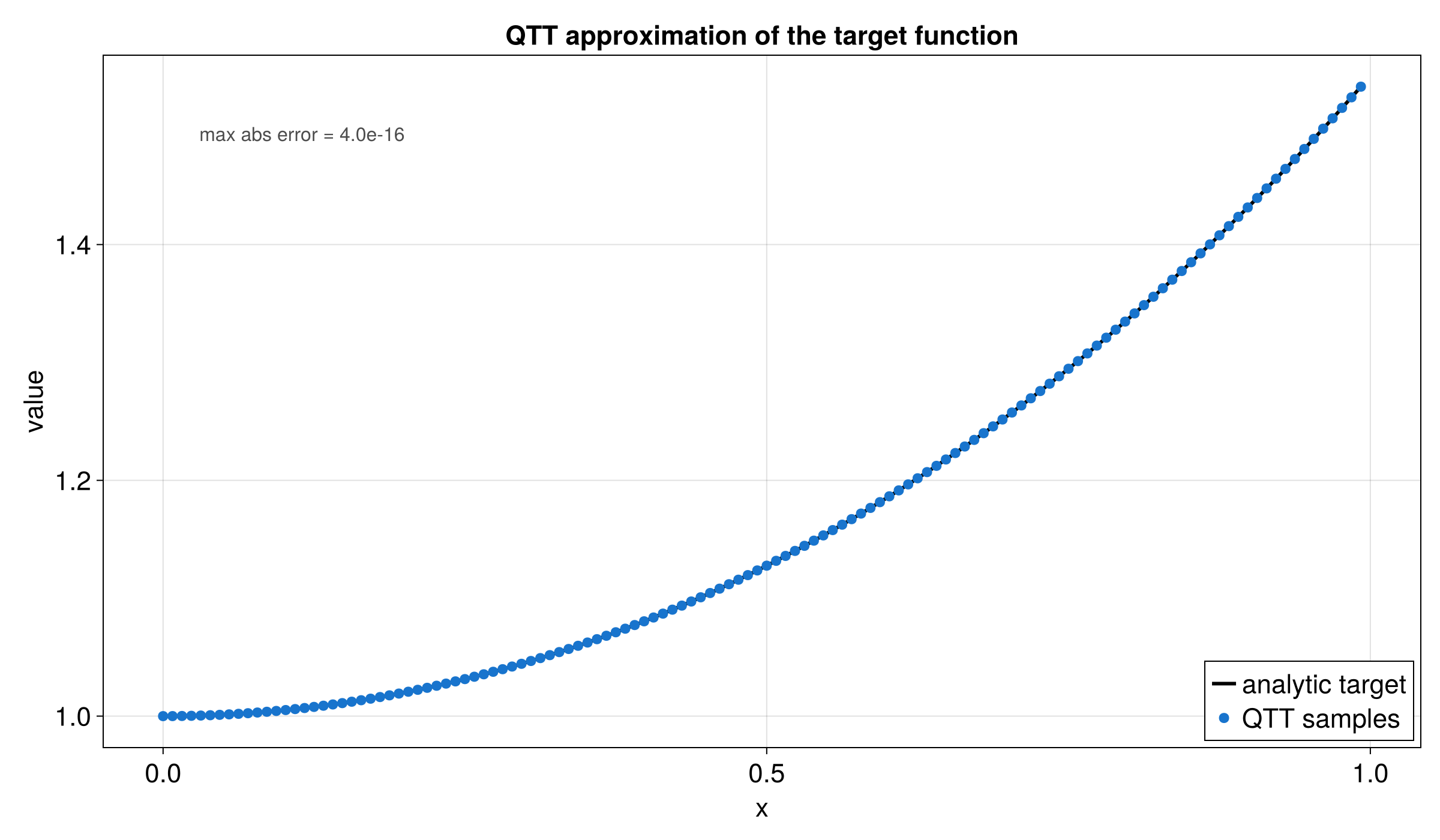
The points from the QTT lie on top of the direct function values. The next plot shows the bond dimensions along the QTT chain. In examples with a visible peak, that peak would mean that part of the grid needs more internal information than its neighbors.
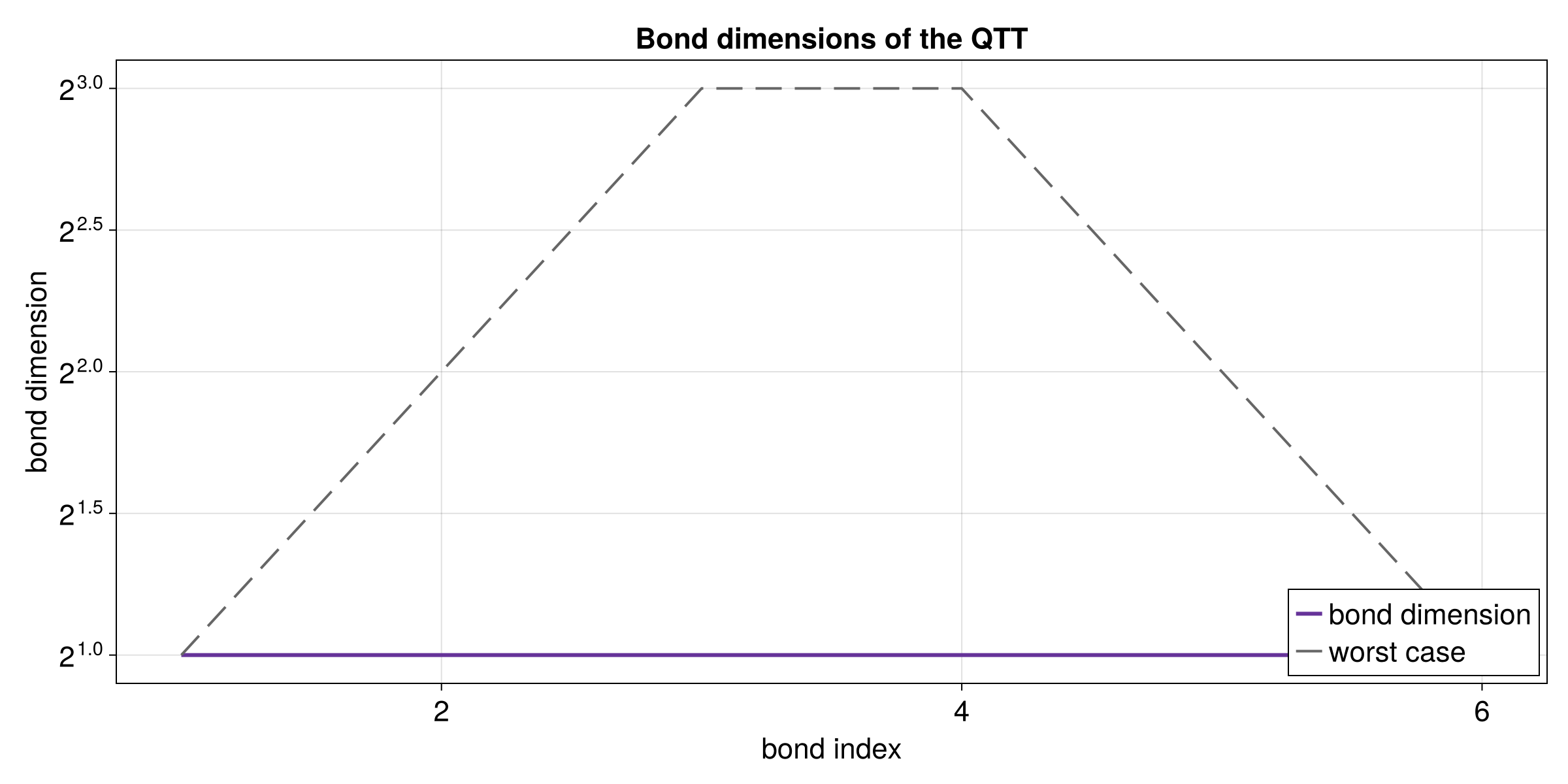
QTT on a Physical Interval
The previous tutorial used integer grid indices. This one maps those indices to
a real interval, for example [-1, 2]. That is useful when the function is
defined as f(x), not as f(i).
Runnable source: docs/tutorial-code/src/bin/qtt_interval.rs
Key API Pieces
DiscretizedGrid owns the mapping from grid index to physical coordinate.
Here the target function is f(x) = x^2 on [-1, 2].
fn main() -> anyhow::Result<()> {
use tensor4all_quanticstci::{
    pointwise_coordinate_batch,
    quanticscrossinterpolate_batch, DiscretizedGrid, QtciOptions, UnfoldingScheme,
};
let grid = DiscretizedGrid::builder(&[7])
    .with_lower_bound(&[-1.0])
    .with_upper_bound(&[2.0])
    .include_endpoint(true)
    .with_unfolding_scheme(UnfoldingScheme::Interleaved)
    .build()?;

let f = |coords: &[f64]| -> f64 {
    let x = coords[0];
    x.powi(2)
};
let options = QtciOptions::default()
    .with_verbosity(0);
let (qtt, _ranks, _errors) = quanticscrossinterpolate_batch(&grid, pointwise_coordinate_batch(f), None, options)?;

assert!((qtt.evaluate(&[127])? - 4.0).abs() < 1e-8);
Ok(())
}
Indices passed to evaluate are zero-based grid indices. The grid converts them
to the physical coordinate before the function is sampled. Passing None for
the optional initial-pivot argument keeps the tutorial on the default QTCI
initialization path.
What It Computes
The example builds a DiscretizedGrid, evaluates f(x) = x^2 on that grid,
and checks that the QTT follows the direct values on the interval.
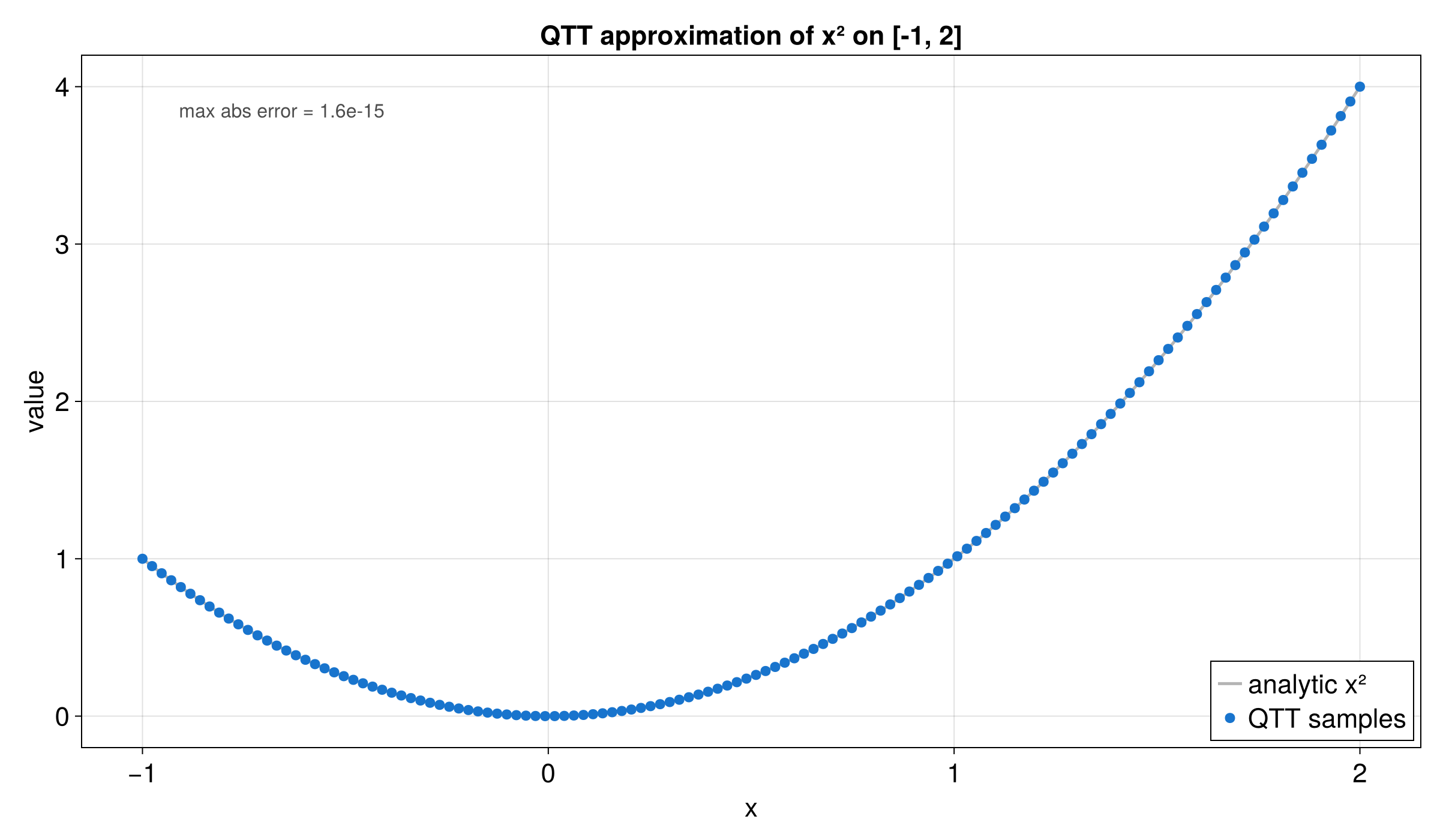
The bond-dimension plot shows how much information is carried between QTT sites. For this smooth example, the internal sizes stay modest.
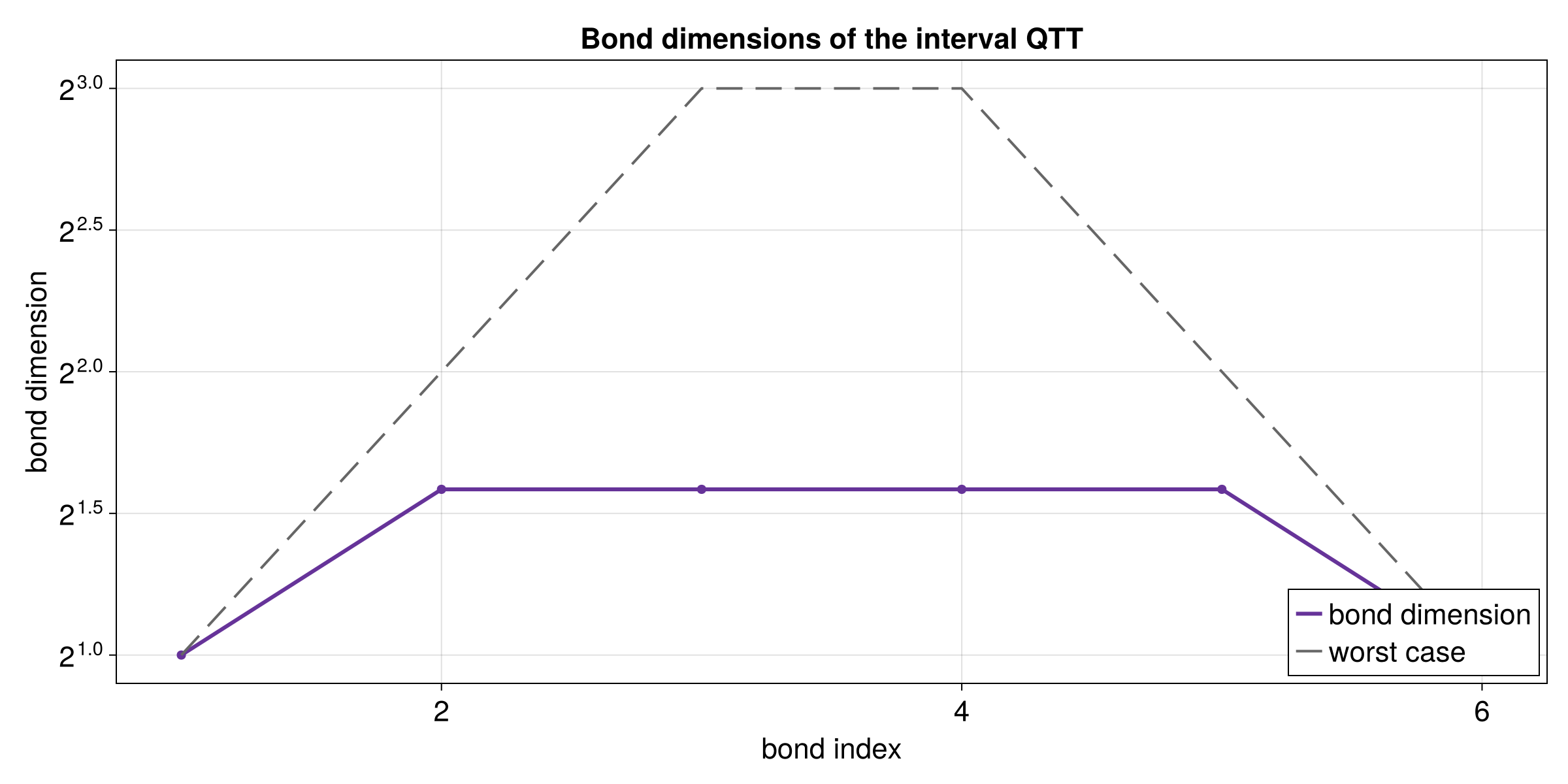
Definite Integrals
After a QTT has been built on a physical interval, it can approximate an integral by summing its grid values and multiplying by the grid spacing. For a smooth function this is a compact way to keep the sampled values and an integral estimate together.
Runnable source: docs/tutorial-code/src/bin/qtt_integral.rs
Key API Pieces
integral() is available when the QTT was built from a DiscretizedGrid.
This example uses the same target function as the interval tutorial,
f(x) = x^2 on [-1, 2].
fn main() -> anyhow::Result<()> {
use tensor4all_quanticstci::{
    pointwise_coordinate_batch,quanticscrossinterpolate_batch, DiscretizedGrid, QtciOptions};
let grid = DiscretizedGrid::builder(&[7])
    .with_lower_bound(&[-1.0])
    .with_upper_bound(&[2.0])
    .include_endpoint(true)
    .build()?;

let f = |coords: &[f64]| -> f64 {
    let x = coords[0];
    x.powi(2)
};
let options = QtciOptions::default()
    .with_verbosity(0);
let (qtt, _ranks, _errors) = quanticscrossinterpolate_batch(&grid, pointwise_coordinate_batch(f), None, options)?;

let integral = qtt.integral()?;
let exact = 3.0;
assert!((integral - exact).abs() < 8e-2);
Ok(())
}
For non-constant functions, compare the result against an analytic integral or a trusted high-resolution reference.
What It Computes
The tutorial builds the same interval QTT as before and calls integral() on
it. The plot below comes from the bit-depth sweep and shows how the integral
error changes as the grid is refined.
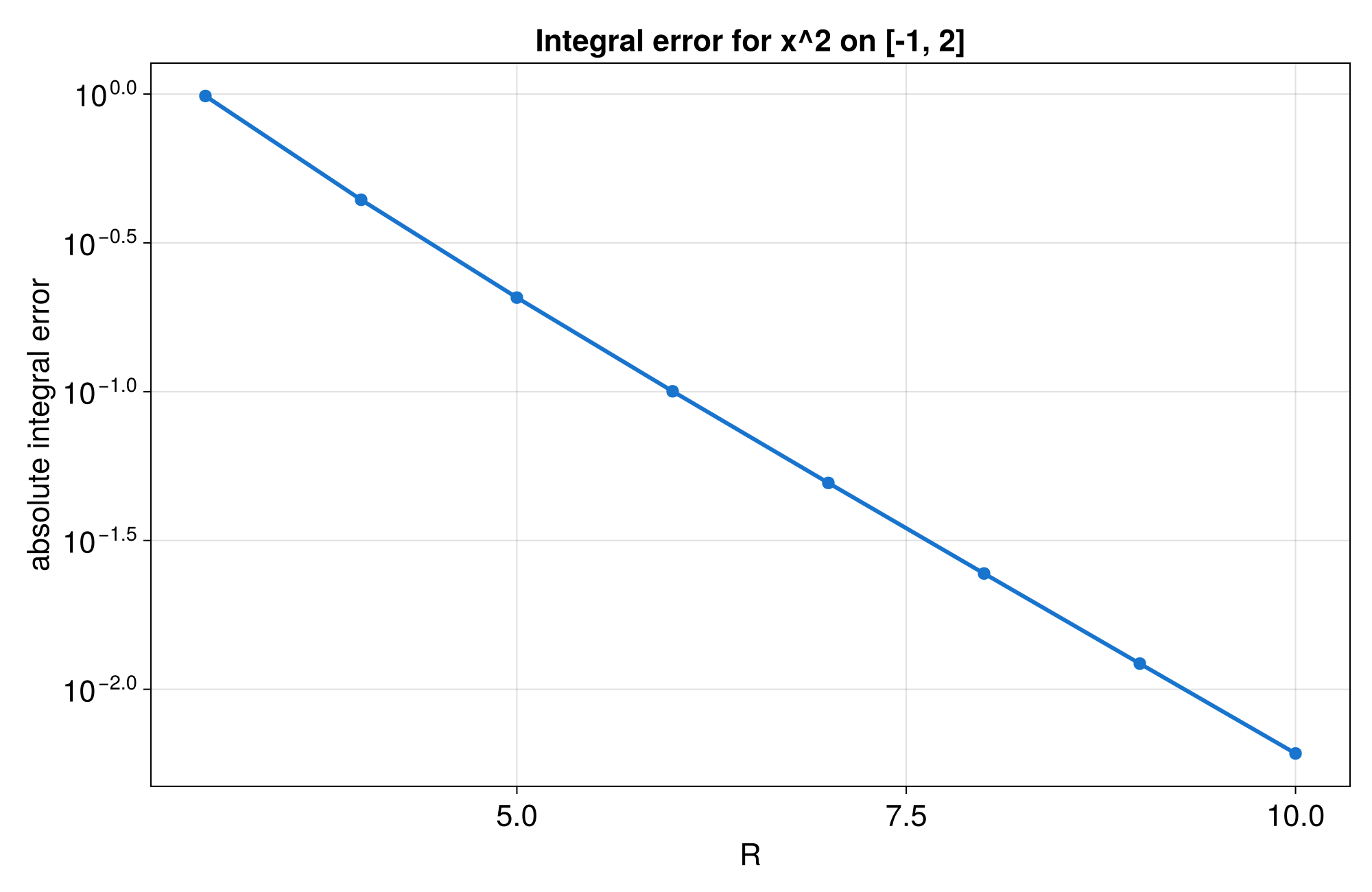
The integral is still a grid approximation. More bits give more grid points, but they can also increase the work needed to build the QTT.
Sweep over Bit Depth
The bit depth R sets the number of grid points: 2^R. Increasing R
usually improves resolution, but it may also increase build time or bond
dimensions.
Runnable source: docs/tutorial-code/src/bin/qtt_r_sweep.rs
Key API Pieces
The core loop changes only the grid size. The QTCI call stays the same.
The target function is f(x) = sin(10x) on the unit interval, with the
zero-based discrete grid index mapped to x in [0, 1).
fn main() -> anyhow::Result<()> {
use tensor4all_quanticstci::{
    pointwise_index_batch,quanticscrossinterpolate_discrete_batch, QtciOptions};
let mut point_counts = Vec::new();

for bits in [7usize, 8] {
    let size = 1usize << bits;
    let sizes = [size];
    let target_function = |x: f64| -> f64 { (10.0 * x).sin() };
    let f = move |idx: &[usize]| -> f64 {
        let x = idx[0] as f64 / size as f64;
        target_function(x)
    };
    let options = QtciOptions::default()
        .with_verbosity(0);
    let (qtt, _ranks, _errors) =
        quanticscrossinterpolate_discrete_batch::<f64, _>(&sizes, pointwise_index_batch(f), None, options)?;

    let last_grid_index = size - 1;
    let x_last = last_grid_index as f64 / size as f64;
    assert!((qtt.evaluate(&[last_grid_index])? - target_function(x_last)).abs() < 1e-8);
    point_counts.push(size);
}

assert_eq!(point_counts, vec![128, 256]);
Ok(())
}
Use sweeps like this when choosing a grid before running a larger computation.
What It Computes
The example repeats the same QTT construction for several bit depths and writes
the value error, runtime, and sample curves. The runnable binary sweeps
R = 2..15 for sin(30x) and checks every sampled value against that function
with maximum absolute error below 1e-8. The shorter snippet above uses
sin(10x) to illustrate the API.
For a faster validation run, set QTT_R_SWEEP_MAX_BITS to an integer from 2
through 15. CI uses 10: all depths from 2 through 10 and every grid point at
those depths are still checked and exported. The default remains 15 so the
published plots retain their full range.
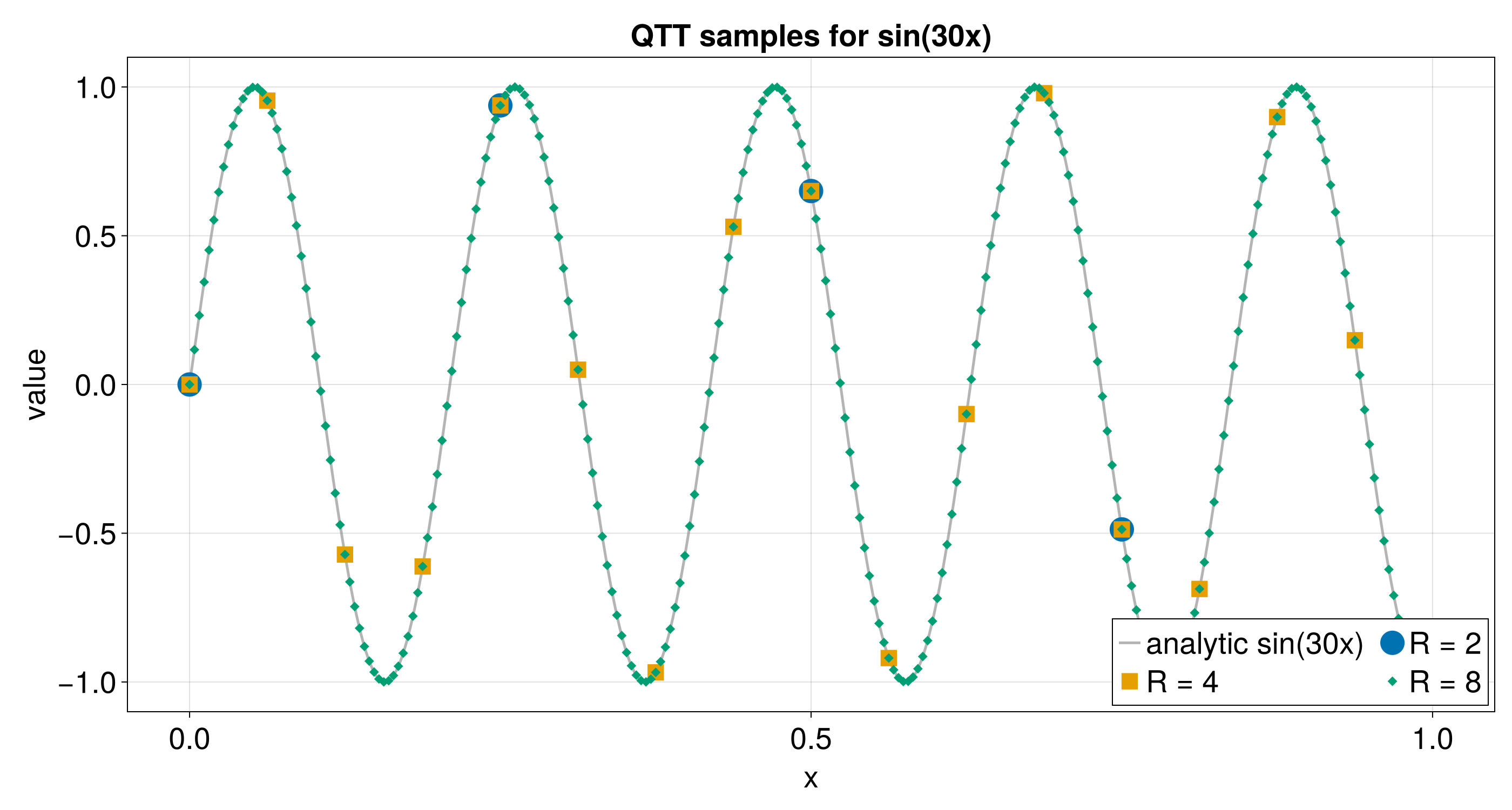
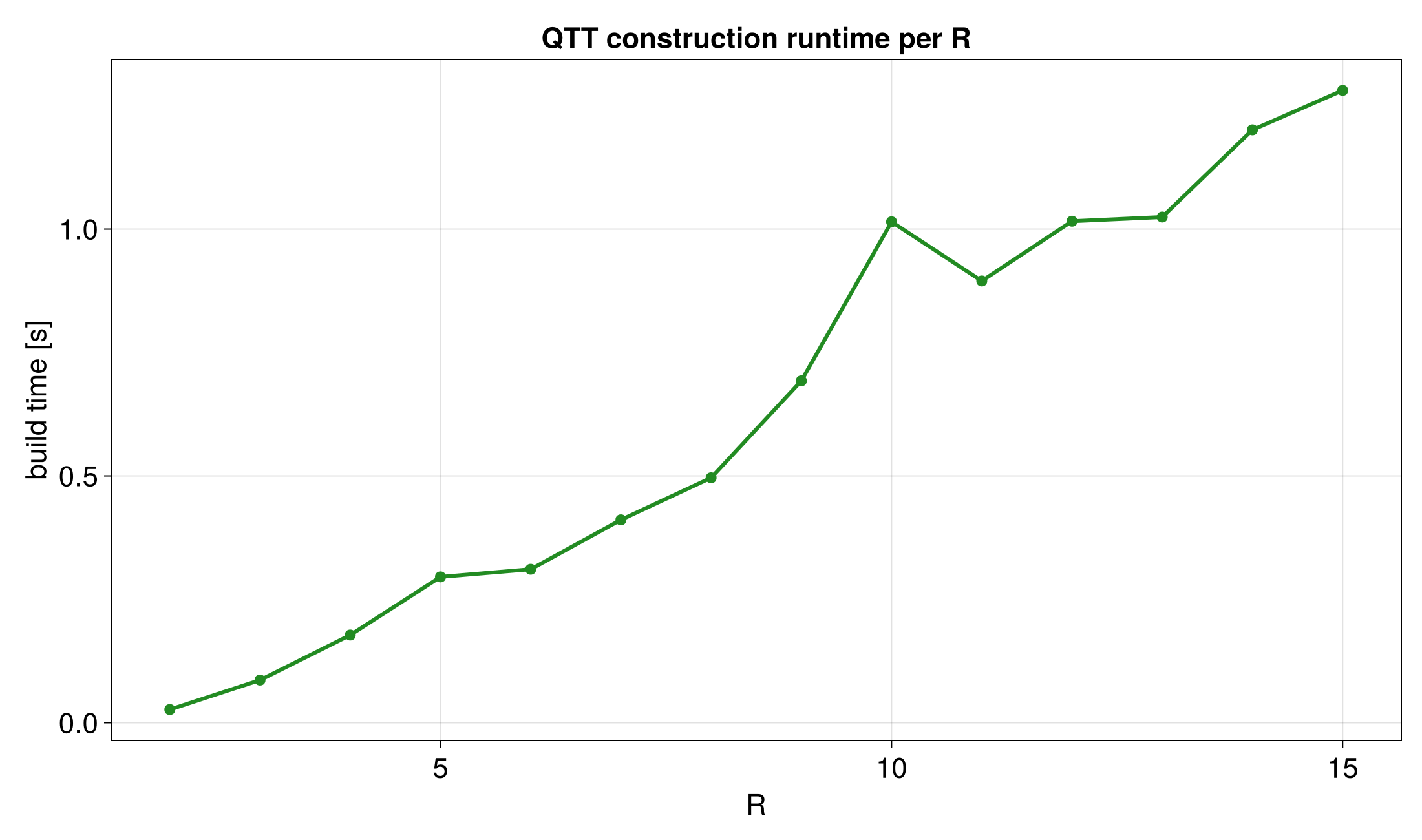
Multivariate Functions
A multivariate QTT stores a function such as f(x, y). The sites can be
grouped by variable or interleaved. Grouped means all bits for one variable
come first; interleaved means the first bit of each variable appears before the
second bit of each variable. The best choice depends on the function.
Runnable source: docs/tutorial-code/src/bin/qtt_multivariate.rs
Key API Pieces
Use one bit-depth entry per variable when building a DiscretizedGrid.
The target function is f(x, y) = x * cos(x) * cos(y).
fn main() -> anyhow::Result<()> {
use tensor4all_quanticstci::{
    pointwise_coordinate_batch,
    quanticscrossinterpolate_batch, DiscretizedGrid, QtciOptions, UnfoldingScheme,
};
let grid = DiscretizedGrid::builder(&[7, 7])
    .with_variable_names(&["x", "y"])
    .with_bounds(-2.0, 2.0)
    .include_endpoint(false)
    .with_unfolding_scheme(UnfoldingScheme::Interleaved)
    .build()?;

let f = |coords: &[f64]| -> f64 {
    let x = coords[0];
    let y = coords[1];
    x * x.cos() * y.cos()
};
let options = QtciOptions::default()
    .with_unfoldingscheme(UnfoldingScheme::Interleaved)
    .with_verbosity(0);
let (qtt, _ranks, _errors) = quanticscrossinterpolate_batch(&grid, pointwise_coordinate_batch(f), None, options)?;

assert!((qtt.evaluate(&[0, 0])? - f(&[-2.0, -2.0])).abs() < 1e-6);
Ok(())
}
The tutorial binary builds a QTT for f(x, y) = x * cos(x) * cos(y) and compares
the two layouts visually.
What It Computes
The example builds a two-dimensional QTT with both layouts and compares the values, errors, and bond dimensions.
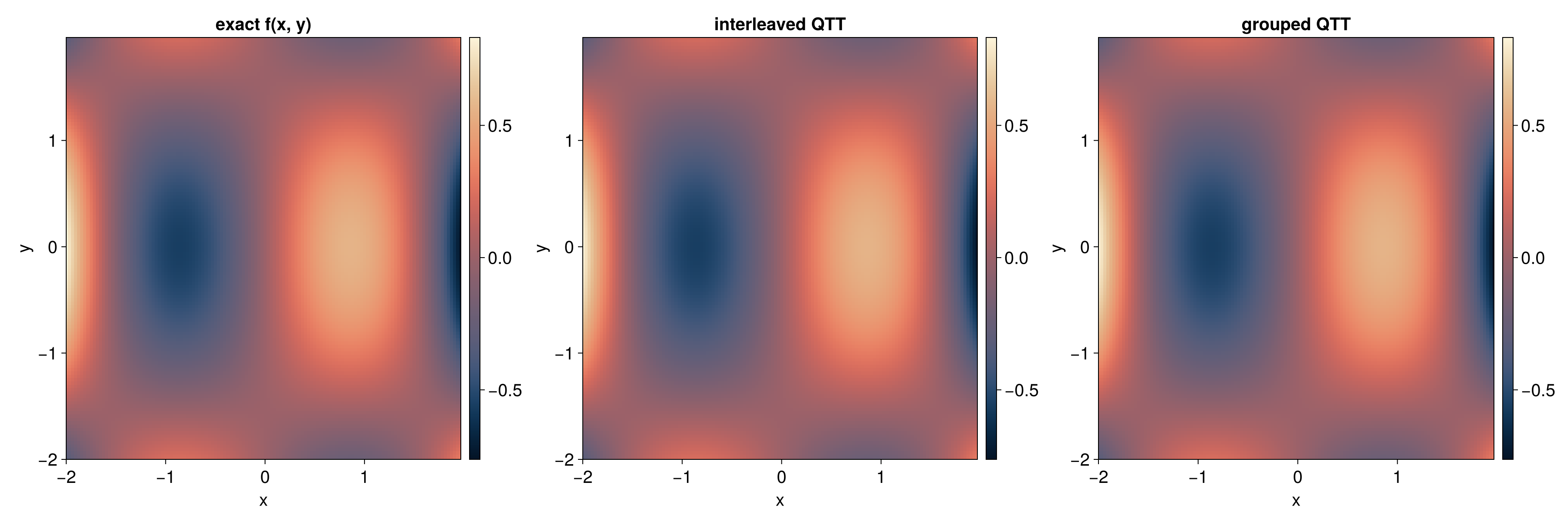
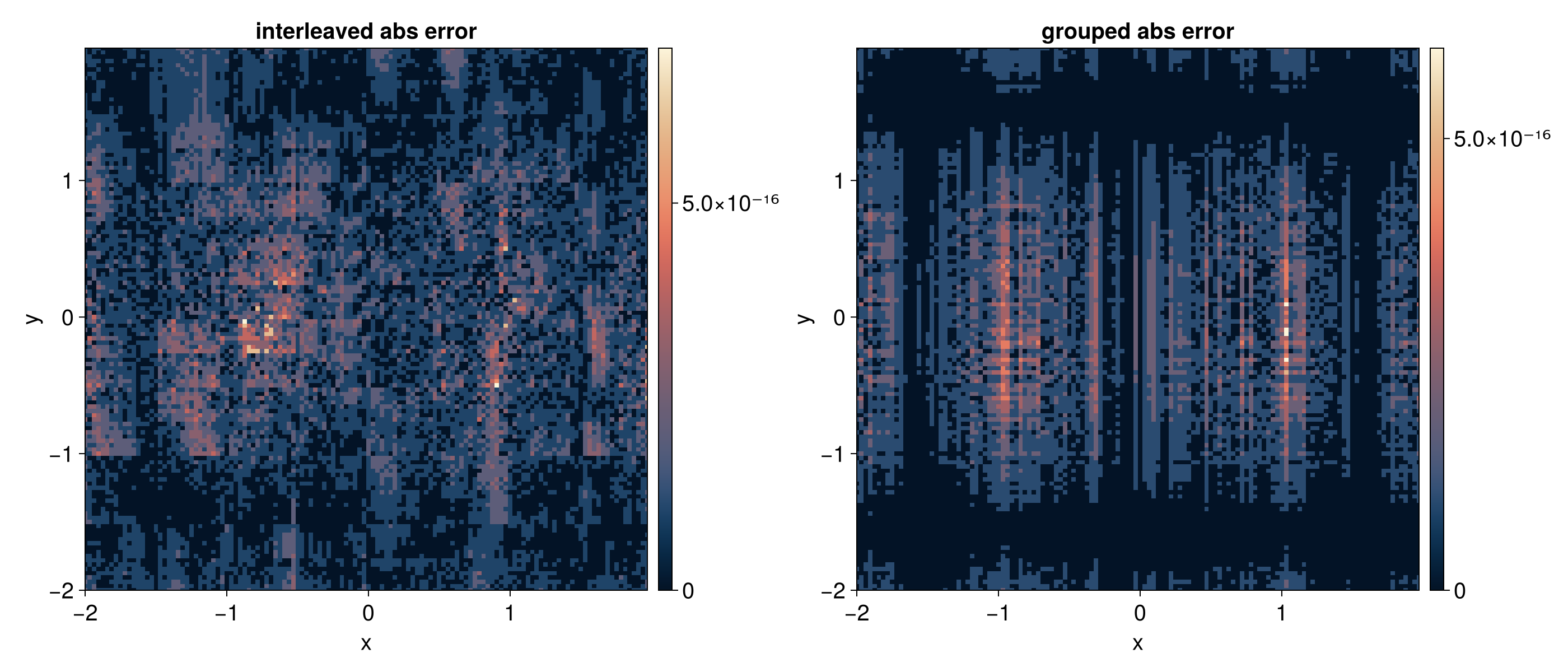
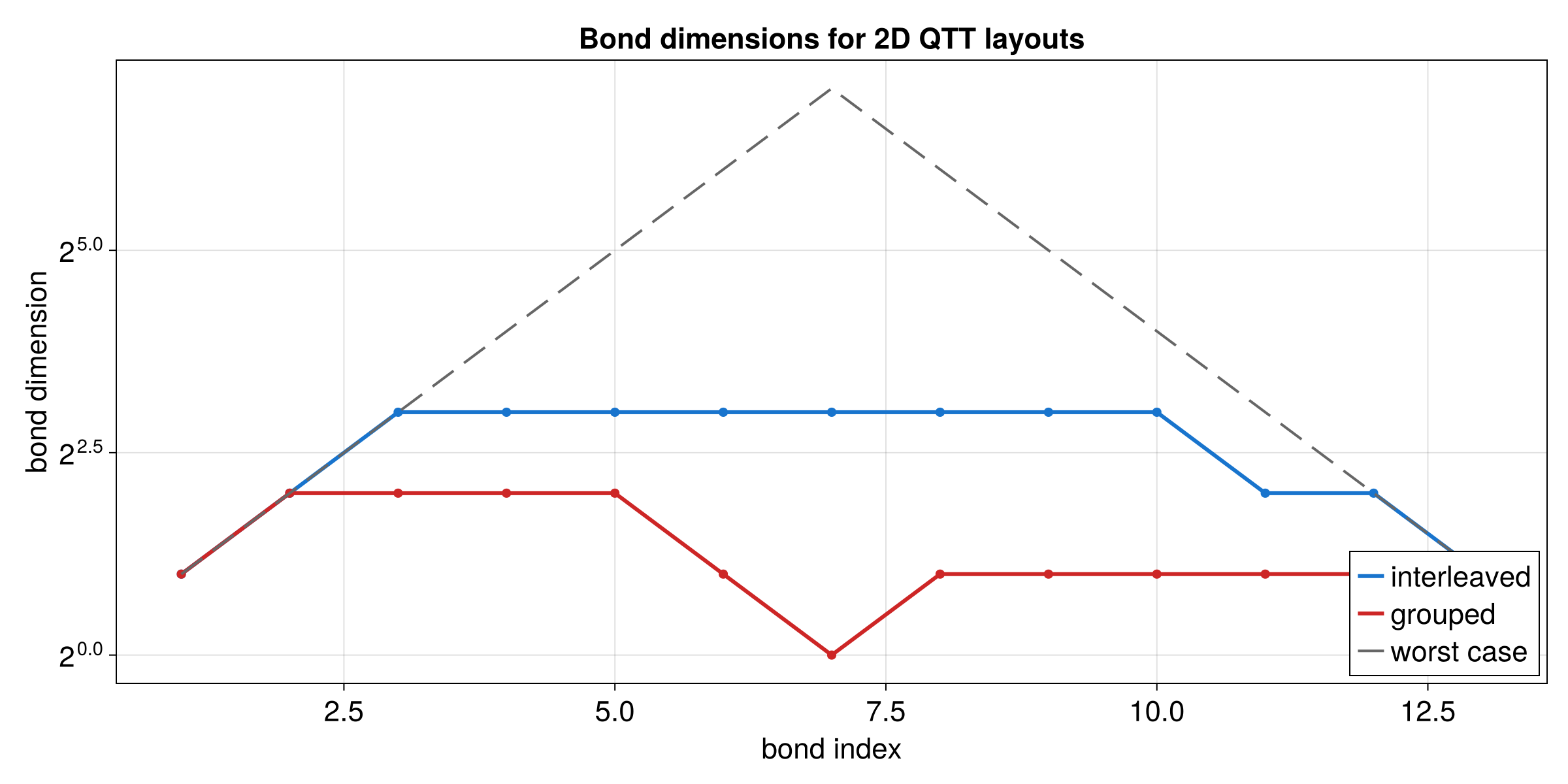
Interpolative QTT
Interpolative QTT builds a tensor train by sampling a function through local Chebyshev-Lobatto interpolation. This is useful when the function is already given on a physical interval and known nonsmooth or sharply localized points should stay on a multiscale refinement path.
Runnable source: docs/tutorial-code/src/bin/interpolative_qtt.rs
Key API Pieces
Use interpolate_single_scale for a smooth one-dimensional function on one
interval. The result is a binary SimpleTensorTrain, so the site index [0, 0, ...]
evaluates the left endpoint of the sampled interval.
fn main() -> anyhow::Result<()> {
use tensor4all_interpolativeqtt::{
    interpolate_single_scale, AbstractTensorTrain, InterpolativeQttOptions,
};

let options = InterpolativeQttOptions::default().with_tolerance(1e-12);
let tt = interpolate_single_scale(
    |x| (-x * x).exp(),
    -1.0,
    1.0,
    5,
    12,
    &options,
)?;

let value = tt.evaluate(&[0, 0, 0, 0, 0])?;
assert!((value - (-1.0_f64).exp()).abs() < 1e-10);
Ok(())
}
Use interpolate_multi_scale when a known location should remain refined. The
following target is a finite, softened version of 1 / r^2; the point x = 0
is still the sharp feature.
fn main() -> anyhow::Result<()> {
use tensor4all_interpolativeqtt::{
    interpolate_multi_scale, AbstractTensorTrain, InterpolativeQttOptions,
};

let epsilon = 0.2_f64;
let inverse_square = |x: f64| 1.0 / (x.abs() + epsilon).powi(2);
let options = InterpolativeQttOptions::default().with_tolerance(1e-12);
let tt = interpolate_multi_scale(
    inverse_square,
    -1.0,
    1.0,
    5,
    16,
    &[0.0],
    &options,
)?;

let value = tt.evaluate(&[0, 0, 0, 0, 0])?;
assert!((value - inverse_square(-1.0)).abs() < 1e-8);
Ok(())
}
The multidimensional constructor fuses all variables at the same bit level. For
two variables each site has dimension 4, corresponding to the two binary
digits at that level.
fn main() -> anyhow::Result<()> {
use tensor4all_interpolativeqtt::{
    interpolate_multi_scale_nd, AbstractTensorTrain, InterpolativeQttOptions,
};

let epsilon = 0.2_f64;
let radial_inverse_square = |x: &[f64]| {
    1.0 / (x[0] * x[0] + x[1] * x[1] + epsilon * epsilon)
};
let options = InterpolativeQttOptions::default().with_tolerance(1e-12);
let tt = interpolate_multi_scale_nd(
    radial_inverse_square,
    &[-1.0, -1.0],
    &[1.0, 1.0],
    4,
    8,
    &[vec![0.0, 0.0]],
    &options,
)?;

assert_eq!(tt.site_dims(), vec![4, 4, 4, 4]);
let value = tt.evaluate(&[0, 0, 0, 0])?;
assert!((value - radial_inverse_square(&[-1.0, -1.0])).abs() < 1e-8);
Ok(())
}
The tutorial binary runs these three constructions and writes CSV output for the plots below.
What It Computes
The first example uses single-scale interpolation for exp(-x^2). The second
uses multiscale interpolation for a softened one-dimensional inverse-square
profile, keeping the origin on the refinement path.
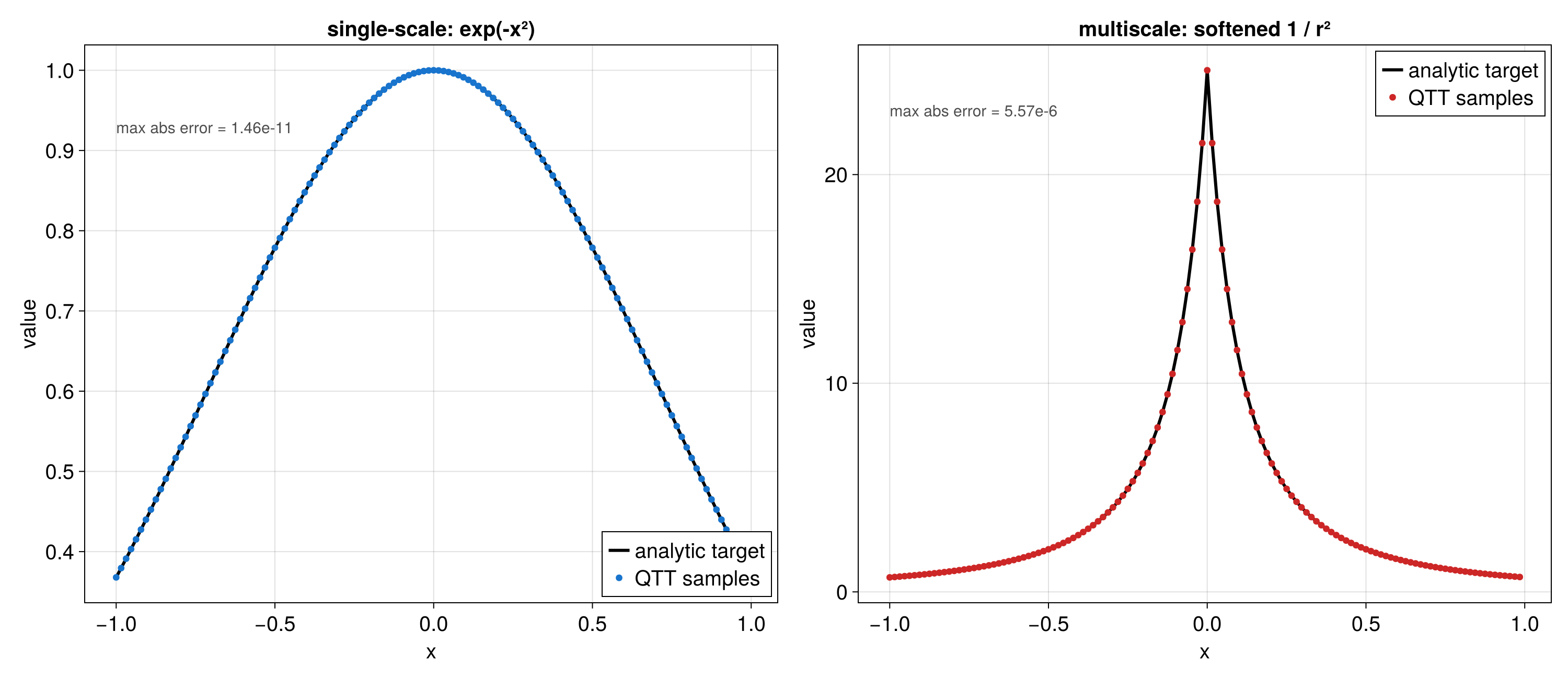
The third example uses interpolate_multi_scale_nd for a two-dimensional
softened radial inverse-square profile. The error plot uses log10 absolute
error so both the peak and the background remain visible.
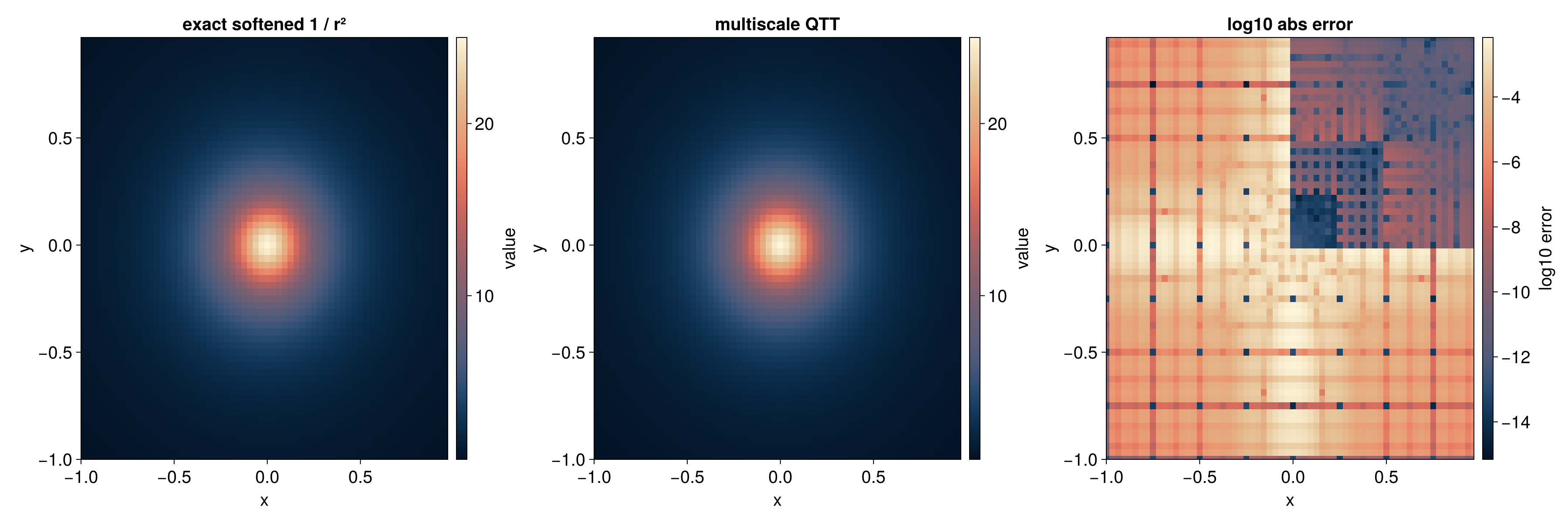
The final plot compares the bond dimensions for all three examples. The multiscale cases need larger internal spaces near the refined point, and the two-dimensional fused sites are more expensive than the one-dimensional sites.
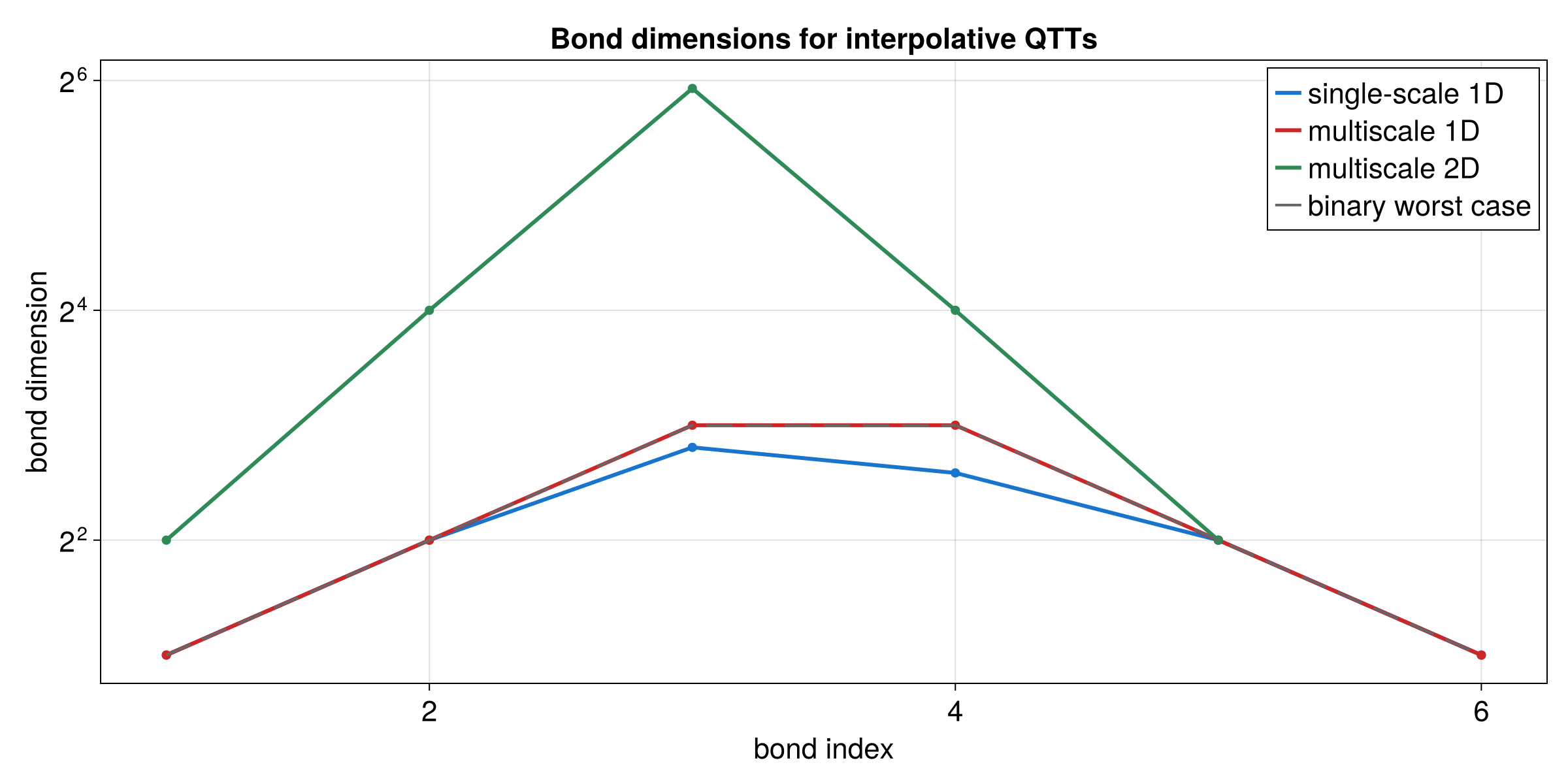
CUDA TreeTN Contraction
This experimental path contracts a small dense TreeTN<IdxTensor> on one NVIDIA GPU. Transfers are explicit: tensor4all-rs never uploads, downloads, or falls back to the CPU inside the contraction.
Prerequisites
- A stable Rust toolchain; see Getting Started.
- An NVIDIA GPU and CUDA driver/toolkit compatible with the CUDA versions used by the pinned tenferro/cubecl dependencies. No wider version or compute-capability support matrix is currently promised.
- The intended device must be visible as CUDA ordinal 0.
- Build with the non-default
tenferro-cudafeature. The commands also name the defaulttenferro-cpu-faerfeature explicitly because the quickstart computes a CPU reference alongside the CUDA contraction.
Clone tensor4all-rs and run the checked quickstart:
git clone https://github.com/tensor4all/tensor4all-rs.git
cd tensor4all-rs
cargo run --release -p tensor4all-treetn --example cuda_quickstart \
  --features tenferro-cuda,tenferro-cpu-faer
The complete checked source is embedded below. It is rendered as text rather than an mdBook-tested Rust block because executing it requires CUDA hardware; the feature-gated example itself is compile-checked and run on CUDA.
use std::error::Error;

use tensor4all_core::{CudaExecutionContext, DynIndex, IdxTensor};
use tensor4all_treetn::TreeTN;

fn main() -> Result<(), Box<dyn Error>> {
    let left = DynIndex::new_dyn(2);
    let bond = DynIndex::new_dyn(2);
    let right = DynIndex::new_dyn(2);
    let tree = TreeTN::from_tensors(
        vec![
            IdxTensor::from_dense(vec![left, bond.clone()], vec![1.0_f64, 2.0, 3.0, 4.0])?,
            IdxTensor::from_dense(vec![bond, right], vec![5.0_f64, 6.0, 7.0, 8.0])?,
        ],
        vec![0, 1],
    )?;

    let cpu = tree.contract_to_tensor()?;
    let context = CudaExecutionContext::new()?;
    let resident_tree = tree.upload_cuda(&context)?;
    let resident_result = resident_tree.contract_to_tensor_cuda(&context)?;
    resident_result.validate_cuda_residency(&context)?;
    assert!(resident_result.to_vec::<f64>().is_err());

    let result = resident_result.download(&context)?;
    let residual = result.sub(&cpu)?.maxabs()?;
    assert!(residual <= 1.0e-10, "CUDA/CPU residual: {residual}");
    println!(
        "device={:?} residual_max_abs={residual:.3e}",
        context.device_name()
    );
    Ok(())
}
Source: cuda_quickstart.rs.
It performs this flow:
- Build a two-node host
TreeTNand compute a CPU reference. - Create one caller-owned
CudaExecutionContextfor visible ordinal 0. - Upload every node with
TreeTN::upload_cuda. - Contract all internal bonds with
contract_to_tensor_cuda. - Verify that the result is still resident in the same CUDA context.
- Download explicitly and assert a maximum CPU/GPU residual of at most
1e-10.
A successful run prints the GPU name and residual, for example:
device="NVIDIA A100 80GB PCIe" residual_max_abs=0.000e0
Using it from another project
The crates are not published to crates.io yet. Enable CUDA on both crates imported by the quickstart:
[dependencies]
tensor4all-core = { git = "https://github.com/tensor4all/tensor4all-rs", features = ["tenferro-cuda", "tenferro-cpu-faer"] }
tensor4all-treetn = { git = "https://github.com/tensor4all/tensor4all-rs", features = ["tenferro-cuda", "tenferro-cpu-faer"] }
Create a binary project, put the dependency entries above under [dependencies] in Cargo.toml, and copy the embedded program to src/main.rs:
cd ..
cargo new cuda-tree-quickstart
cd cuda-tree-quickstart
# Add the dependency entries above to Cargo.toml.
cp ../tensor4all-rs/crates/tensor4all-treetn/examples/cuda_quickstart.rs src/main.rs
cargo run --release
Keep one CudaExecutionContext for upload, contraction, synchronization, and download. Mixing host and CUDA nodes, CUDA contexts, or node dtypes returns a typed error before contraction; it does not trigger a hidden transfer or CPU fallback.
Current limits
This is a dense full-network contraction, so output memory scales with the product of external-index dimensions. It currently supports only:
- dense, untracked
IdxTensornodes; - one dtype and one CUDA context across the tree;
- visible CUDA ordinal 0;
- full contraction to one dense tensor.
CUDA SVD, QR, truncation, TreeTN-to-TreeTN contraction, zip-up/fitting/SRC, TCI/ACI, automatic device selection, and multi-GPU execution are not yet supported.
For timing, use the separate cuda_tree_contraction example, which reports context setup, upload, warm-up, steady-state GPU contraction plus synchronization, download, and CPU contraction independently:
cargo run --release -p tensor4all-treetn --example cuda_tree_contraction \
  --features tenferro-cuda,tenferro-cpu-faer
Elementwise Product
This tutorial multiplies two functions after both have been represented as
QTTs. Elementwise means that values at the same grid point are multiplied:
h(x_i) = f(x_i) g(x_i).
Runnable source: docs/tutorial-code/src/bin/qtt_elementwise_product.rs
Key API Pieces
The first step is simply to build two QTTs on the same grid. Converting
to TreeTN enables partial_contract with diagonal_pairs for the
pointwise product. The two target functions are f(x) = x^2 and
g(x) = sin(10x) on the unit interval.
fn main() -> anyhow::Result<()> {
use tensor4all_quanticstci::{
pointwise_index_batch,quanticscrossinterpolate_discrete_batch, QtciOptions};
use tensor4all_treetn::{
contraction::ContractionOptions,
partial_contract, tensor_train_to_treetn, PartialContractionSpec,
};
let npoints = 8usize;
let sizes = [npoints];
let f = move |idx: &[usize]| -> f64 {
let x = idx[0] as f64 / npoints as f64;
x.powi(2)
};
let g = move |idx: &[usize]| -> f64 {
let x = idx[0] as f64 / npoints as f64;
(10.0 * x).sin()
};
let options = QtciOptions::default()
.with_verbosity(0);
let (qtt_a, _, _) = quanticscrossinterpolate_discrete_batch::<f64, _>(
&sizes, pointwise_index_batch(f), None, options.clone())?;
let (qtt_b, _, _) = quanticscrossinterpolate_discrete_batch::<f64, _>(
&sizes, pointwise_index_batch(g), None, options)?;
let tt_a = qtt_a.tensor_train();
let tt_b = qtt_b.tensor_train();
let (tn_a, site_indices_a) = tensor_train_to_treetn(&tt_a)?;
let (tn_b, site_indices_b) = tensor_train_to_treetn(&tt_b)?;
let diagonal_pairs: Vec<_> = site_indices_a
.iter()
.cloned()
.zip(site_indices_b.iter().cloned())
.collect();
let spec = PartialContractionSpec {
contract_pairs: vec![],
diagonal_pairs,
output_order: Some(site_indices_a.clone()),
};
let center = tn_a.node_names()[0];
let product = partial_contract(
&tn_a, &tn_b, &spec, ¢er, ContractionOptions::default(),
)?;
let value = product.evaluate_point(&site_indices_a, &[0usize, 1, 1])?;
let x = (4.0 - 1.0) / npoints as f64;
let expected = x.powi(2) * (10.0 * x).sin();
assert!((value.real() - expected).abs() < 1e-8);
assert_eq!(product.node_count(), 3);
Ok(())
}The important condition is that both QTTs use compatible grids, so that a site in one QTT refers to the same grid bit as the paired site in the other QTT.
What It Computes
The example builds two QTTs, converts them to TreeTN form, pairs matching grid
sites, and contracts those pairs via partial_contract to form the product.
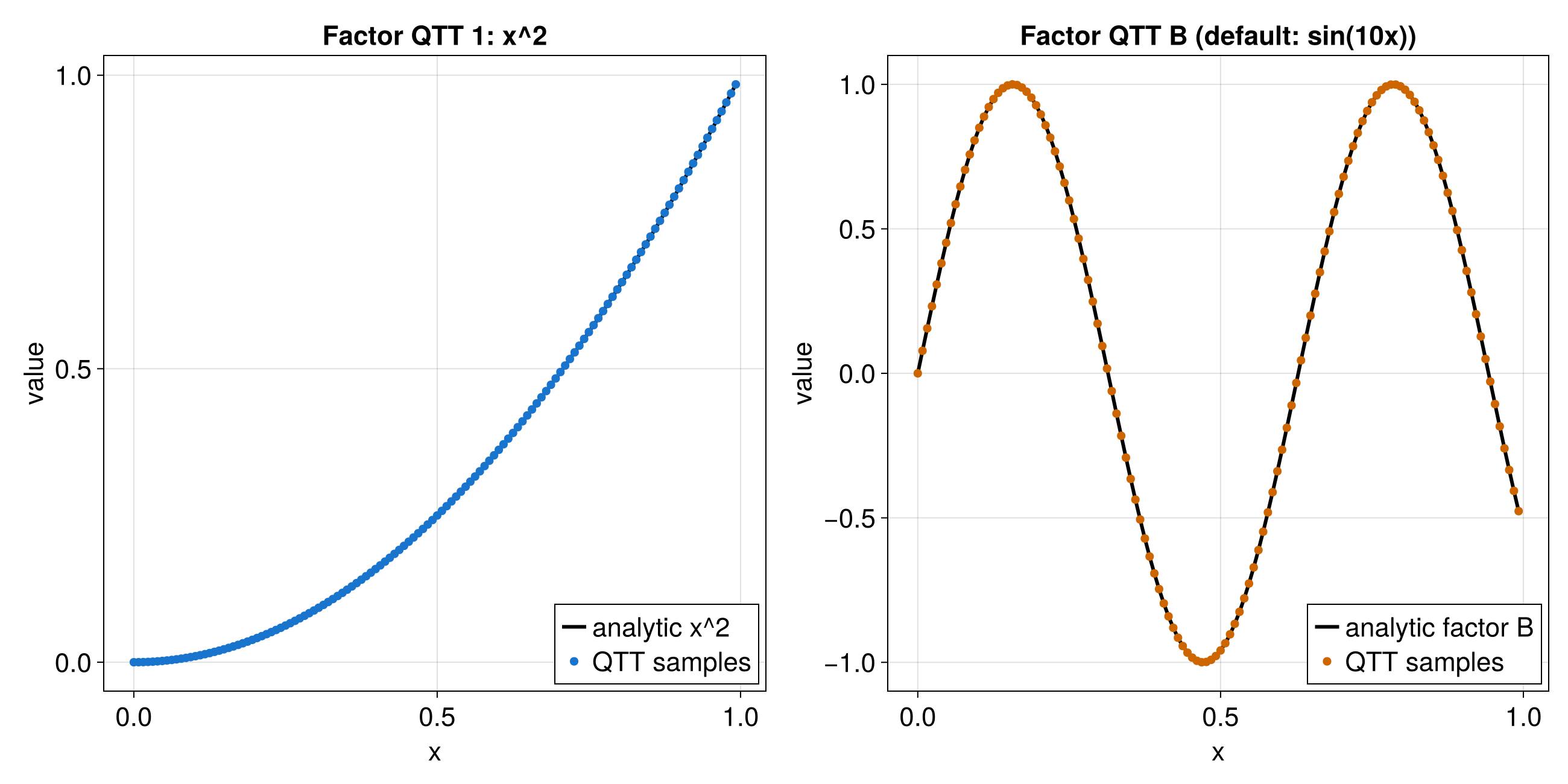
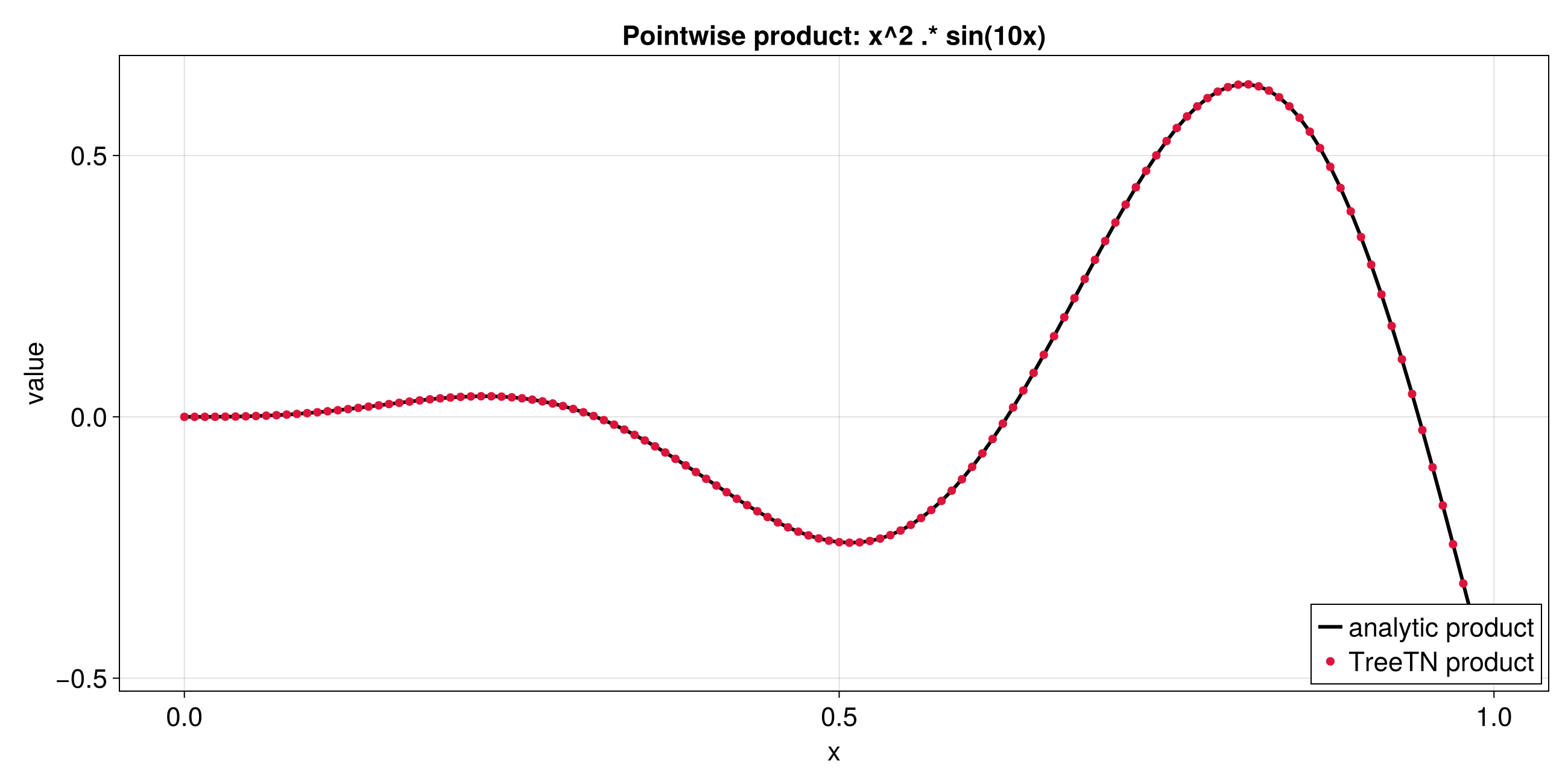
The product may need larger bond dimensions than either factor alone, because it carries information from both inputs.
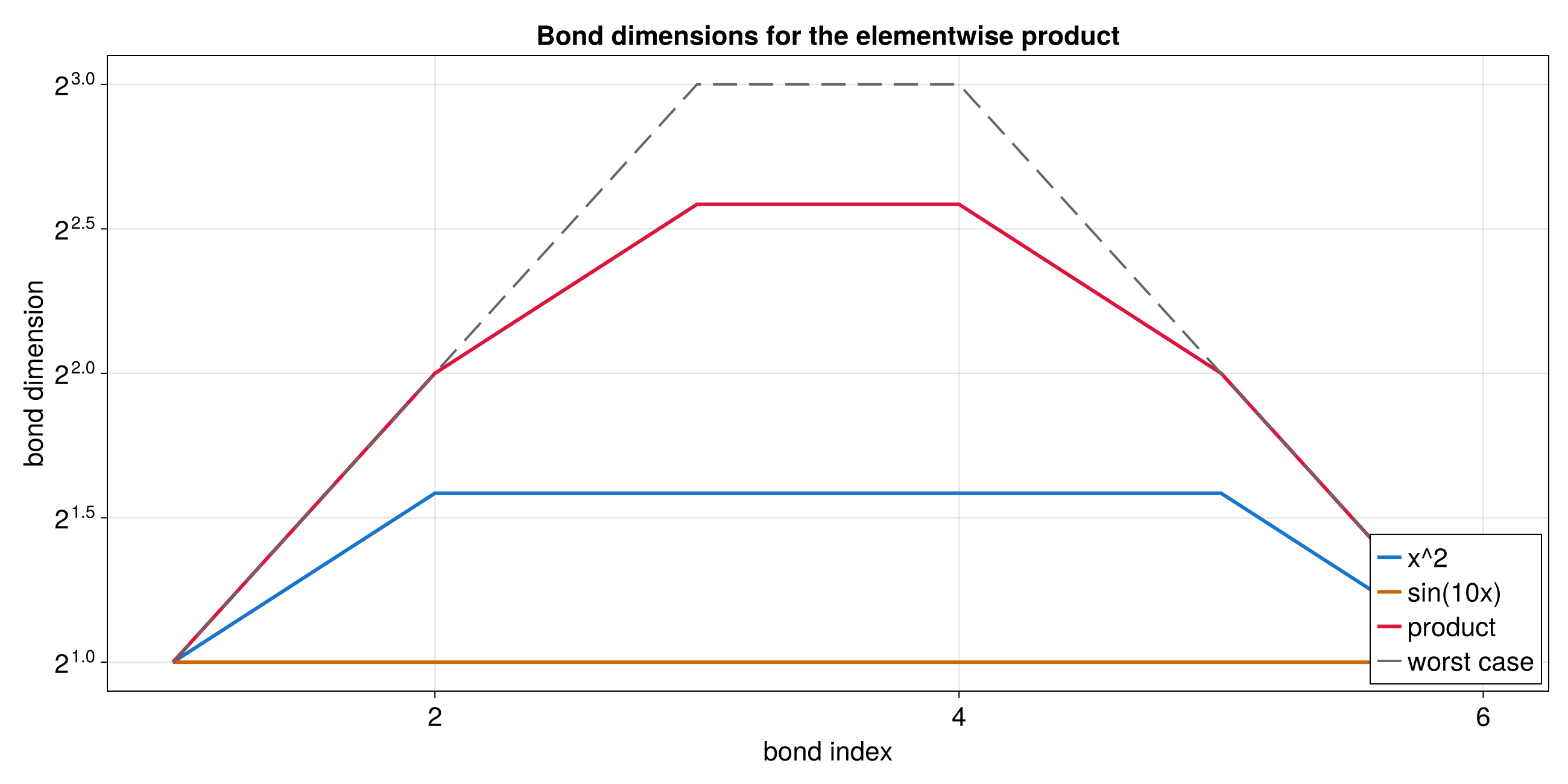
Affine Transformation
An affine transformation evaluates a function at shifted or mixed coordinates. The tutorial uses the pullback point of view: to get the new value at an output point, look up the old function at the transformed input point.
Runnable source: docs/tutorial-code/src/bin/qtt_affine.rs
Key API Pieces
AffineParams stores the matrix and offset. Boundary conditions say what
happens when transformed coordinates leave the grid. The operator is
applied via tensor_train_to_treetn, align_to_state, and
apply_linear_operator. The source function is
f(u, v) = sin(2πu/N) + 0.5 cos(2πv/N) + 0.25 sin(2π(u + 2v)/N).
fn main() -> anyhow::Result<()> {
use tensor4all_core::TensorIndex;
use tensor4all_quanticstci::{
pointwise_index_batch,
quanticscrossinterpolate_discrete_batch, QtciOptions, UnfoldingScheme,
};
use tensor4all_quanticstransform::{
affine_operator, AffineParams, BoundaryCondition,
};
use tensor4all_treetn::{apply_linear_operator, tensor_train_to_treetn, ApplyOptions};
use std::f64::consts::PI;
let bits = 7;
let n = 1usize << bits;
let source_grid = [n, n];
let source_function = move |grid_idx: &[usize]| -> f64 {
let u = grid_idx[0] as f64;
let v = grid_idx[1] as f64;
let n = n as f64;
(2.0 * PI * u / n).sin()
+ 0.5 * (2.0 * PI * v / n).cos()
+ 0.25 * (2.0 * PI * (u + 2.0 * v) / n).sin()
};
let source_options = QtciOptions::default()
.with_unfoldingscheme(UnfoldingScheme::Fused)
.with_verbosity(0);
let (source, _, _) = quanticscrossinterpolate_discrete_batch::<f64, _>(
&source_grid, pointwise_index_batch(source_function),
None,
source_options)?;
let params = AffineParams::from_integers(vec![1, 1, 0, 1], vec![0, 0], 2, 2)?;
let mut operator = affine_operator(bits, ¶ms, &[BoundaryCondition::Periodic; 2])?
.transpose();
let source_tt = source.tensor_train();
let (state, _indices) = tensor_train_to_treetn(&source_tt)?;
operator.align_to_state(&state)?;
let result = apply_linear_operator(&operator, &state, ApplyOptions::naive())?;
let external = TensorIndex::external_indices(&result);
assert_eq!(external.len(), bits);
assert!(result.node_count() >= state.node_count());
Ok(())
}The full tutorial repeats the same workflow for three boundary conditions. The
anti-periodic case uses [AntiPeriodic, Periodic], so only the wrapped
u = x + y coordinate changes sign.
What It Computes
The example builds a two-dimensional QTT, creates affine operators, applies
them to the QTT, and compares the transformed values with direct references.
The anti-periodic pullback matches the periodic wrap except that the region
x + y >= N is multiplied by -1.
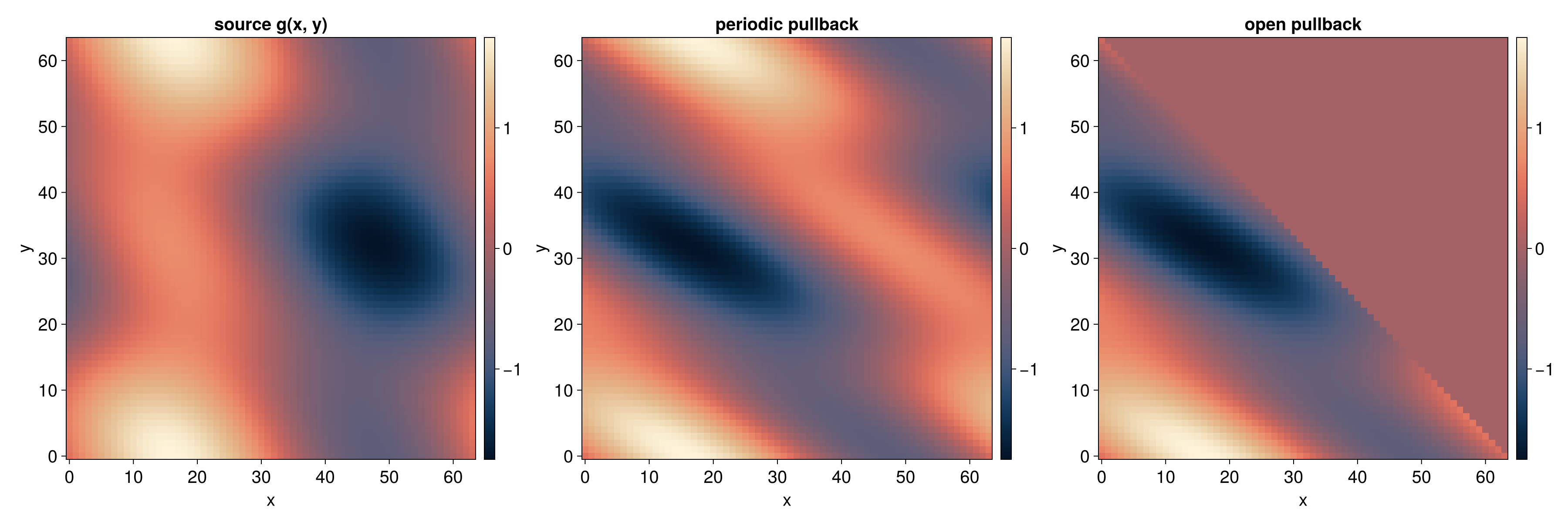
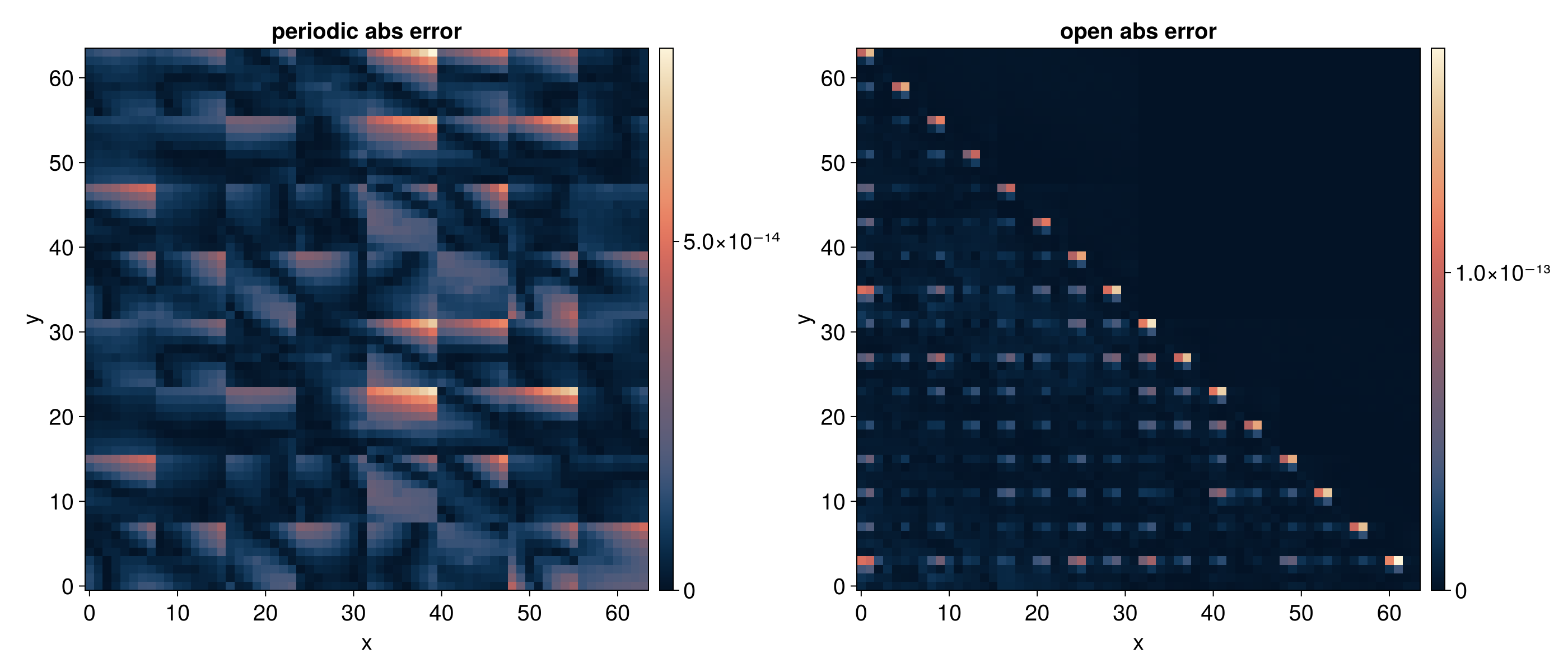
The operator has its own bond dimensions, and the transformed QTT has another set. Both are useful when judging the cost of the operation.
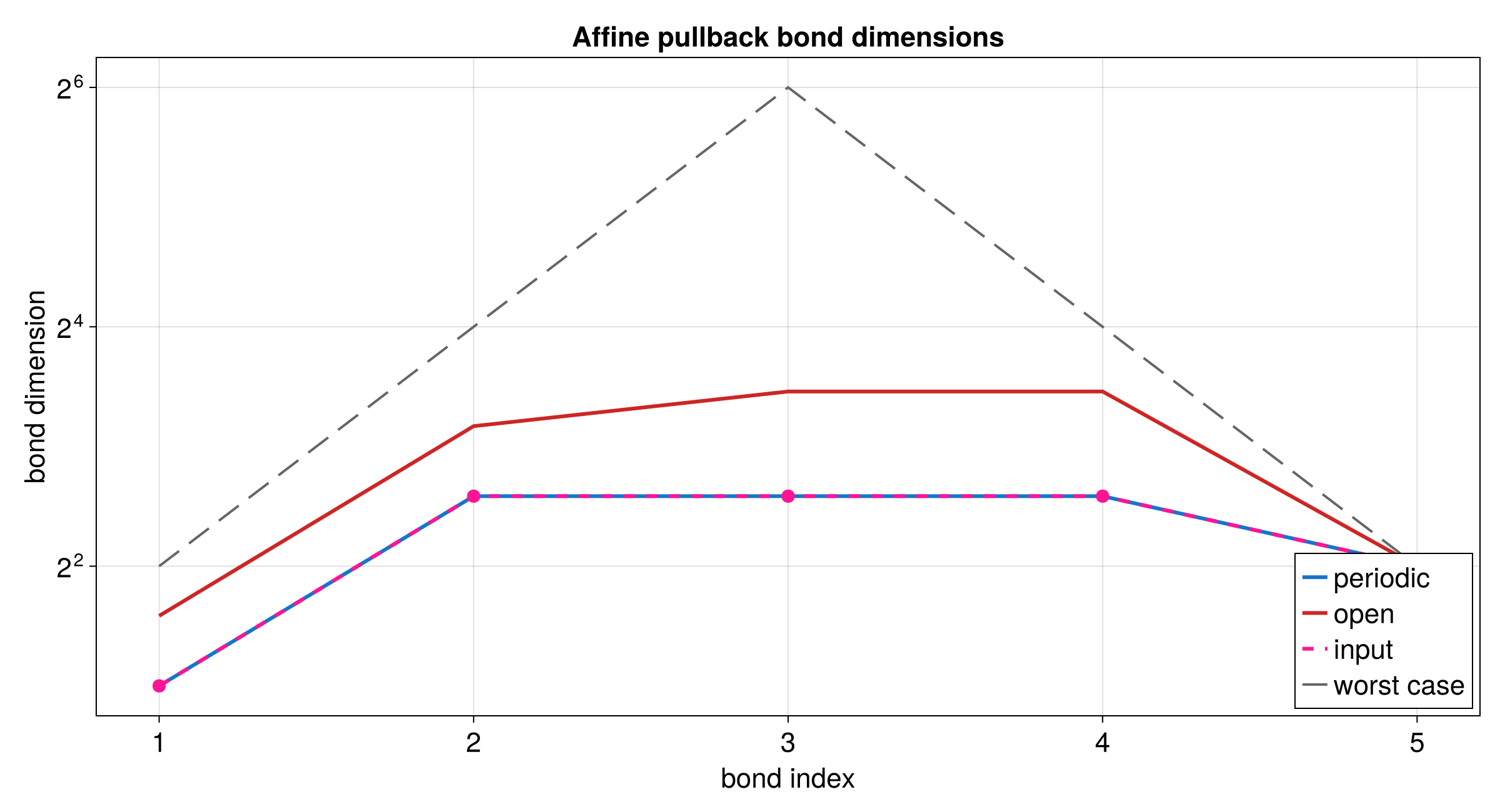
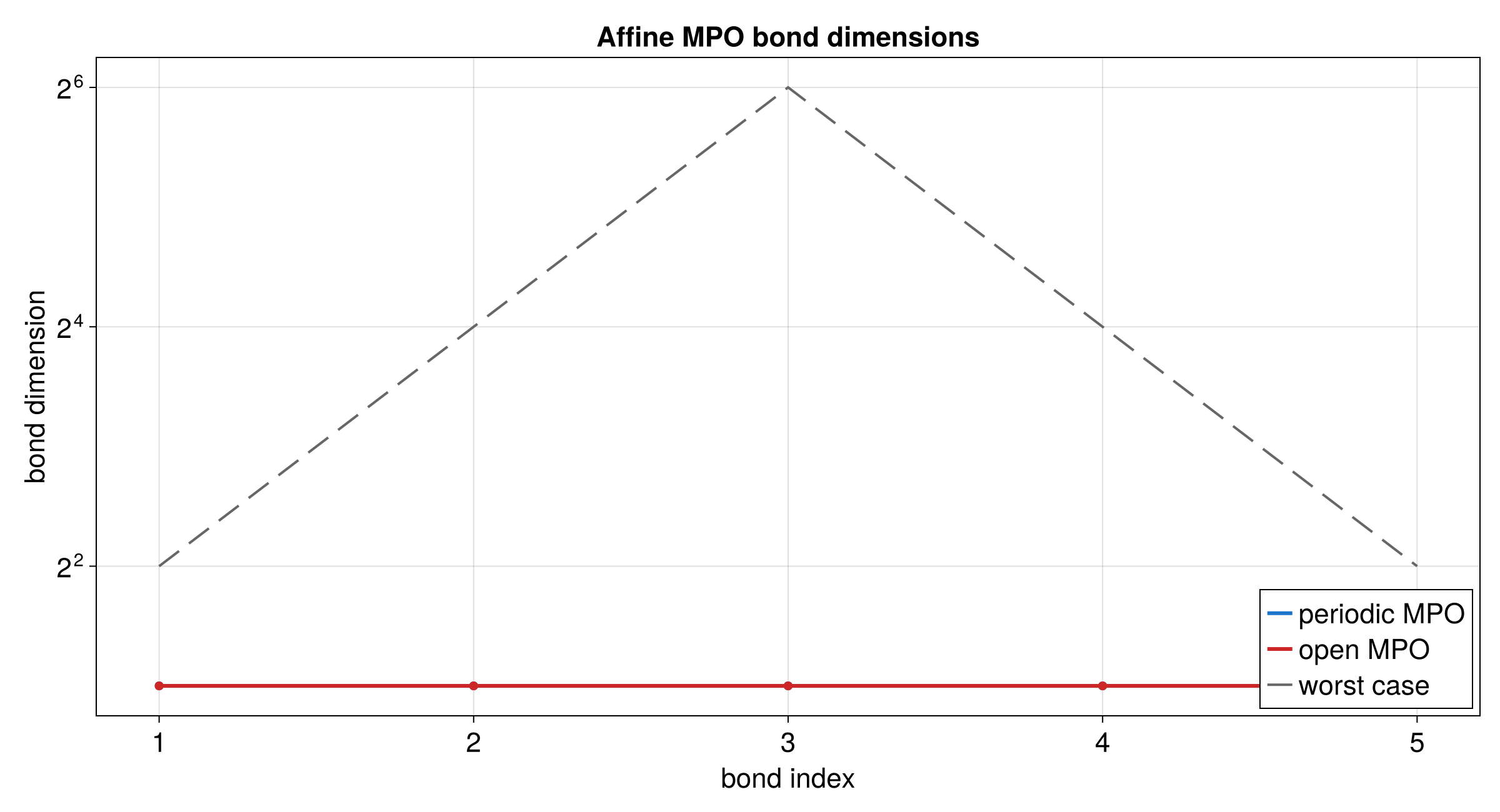
Difference Kernel MPO
A difference kernel is a matrix whose entries depend only on the coordinate difference:
A[x, x'] = f(x - x').
This tutorial starts from a one-dimensional QTT for f(z) and builds the
periodic MPO for A[x, x'] = f((x - x') mod 2^R).
Runnable source: docs/tutorial-code/src/bin/qtt_difference_kernel.rs
Key API Pieces
difference_kernel_mpo takes a binary QTT over the difference coordinate and
returns an MPO with one fused local index per bit. The local value is encoded as
x_bit * 2 + xprime_bit.
fn main() -> anyhow::Result<()> {
use num_complex::Complex64;
use tensor4all_quanticstransform::{difference_kernel_mpo, BoundaryCondition};
use tensor4all_simplett::{AbstractTensorTrain, SimpleTensorTrain};
let bits = 6;
let site_dims = vec![2; bits];

// A real-valued QTT can be converted to Complex64 before calling the transform.
// This compact example uses a constant kernel QTT.
let f = SimpleTensorTrain::constant(&site_dims, Complex64::new(1.0, 0.0));

let mpo = difference_kernel_mpo(&f, BoundaryCondition::Periodic)?;
assert_eq!(mpo.len(), bits);
assert_eq!(mpo.site_dims(), vec![4; bits]);
Ok(())
}
For BoundaryCondition::AntiPeriodic, the same API multiplies entries with
x < x' by -1. The checked-in tutorial data uses the periodic case only.
What It Computes
The example builds a smooth periodic source kernel
f(z) = exp(2(cos(2πz/N) - 1))
with N = 2^R, converts the real QTT cores to Complex64, and calls
difference_kernel_mpo. The resulting MPO is sampled densely and compared with
the direct reference f((x - x') mod N).
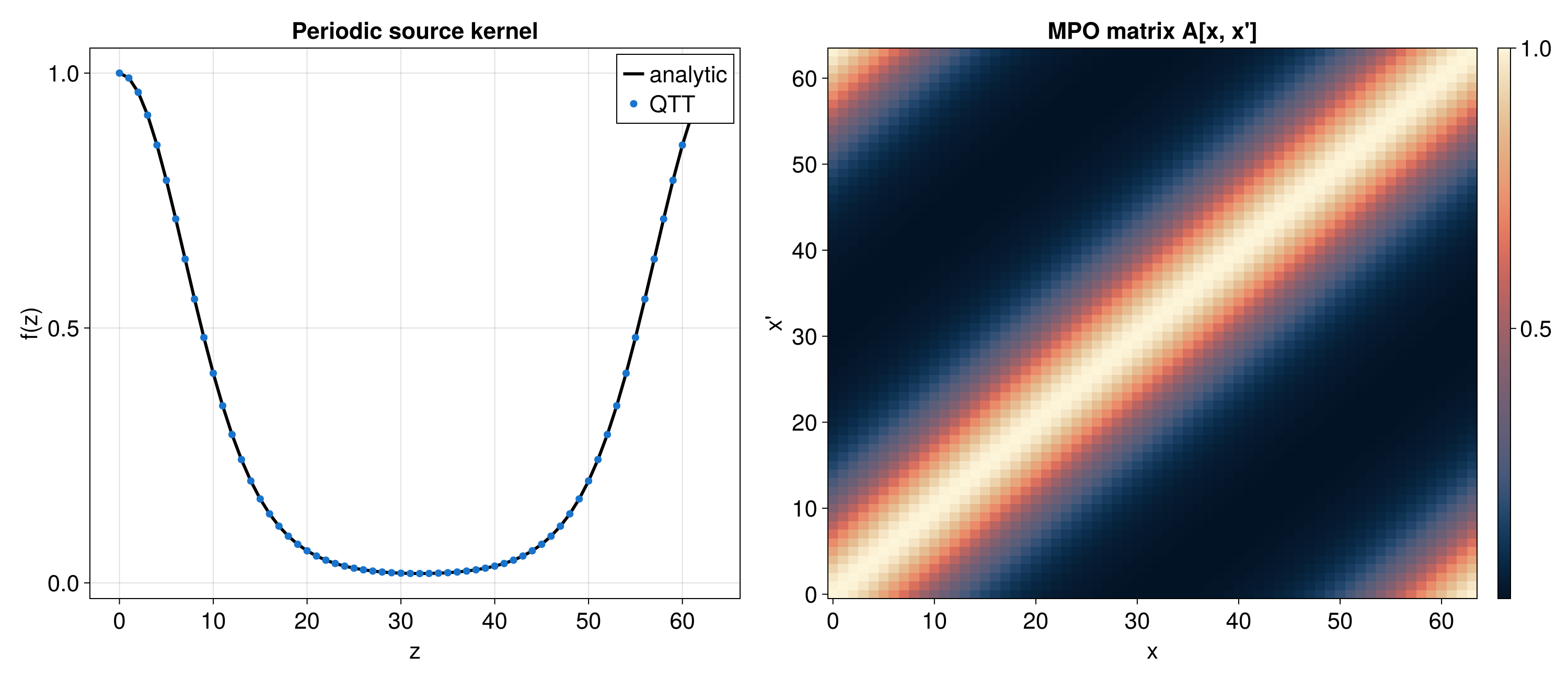
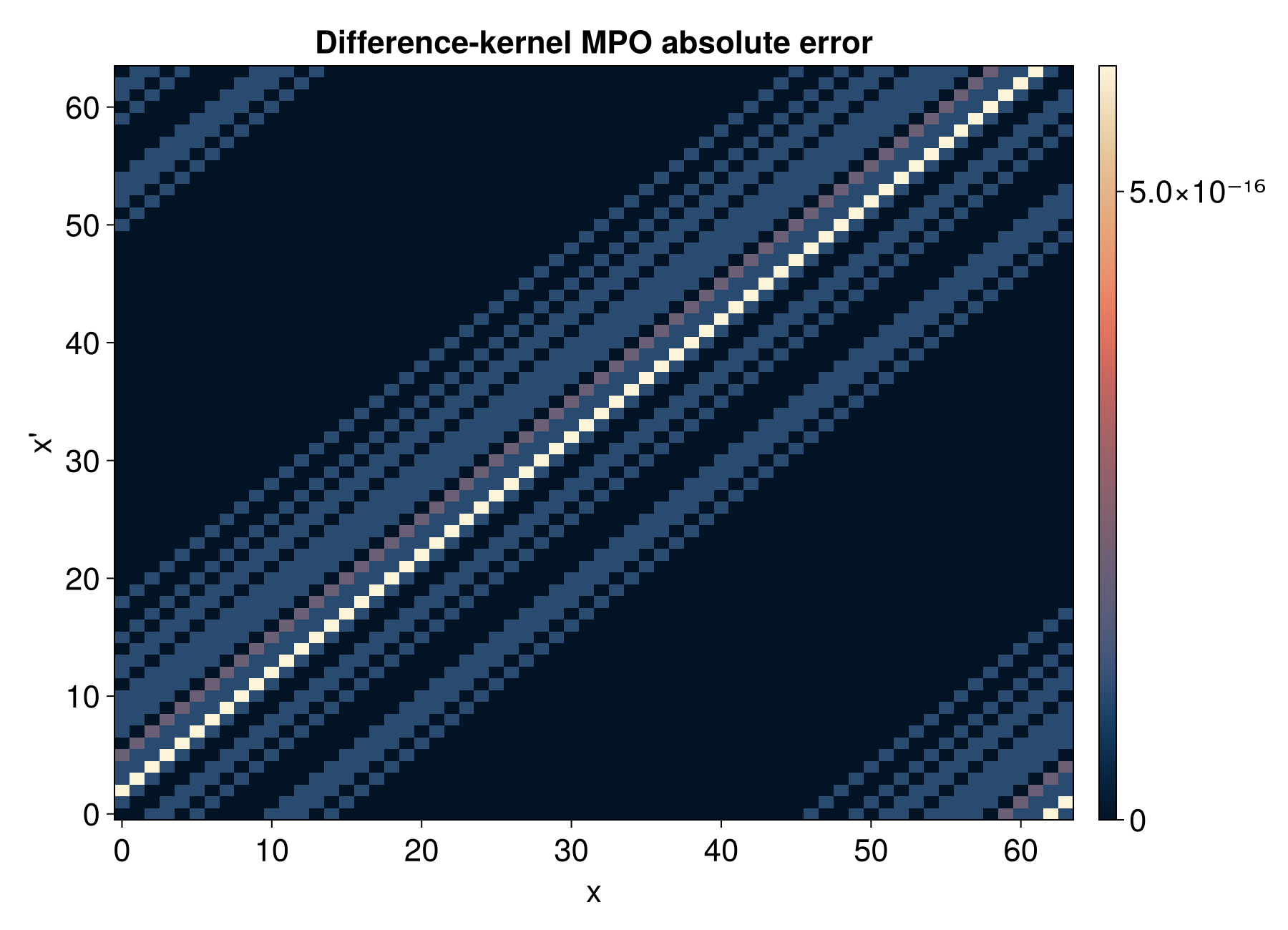
The MPO bonds combine the two-state carry network for x - x' with the source
kernel QTT bonds, so the practical bond dimensions are bounded by twice the
kernel QTT bond dimensions before any later compression.
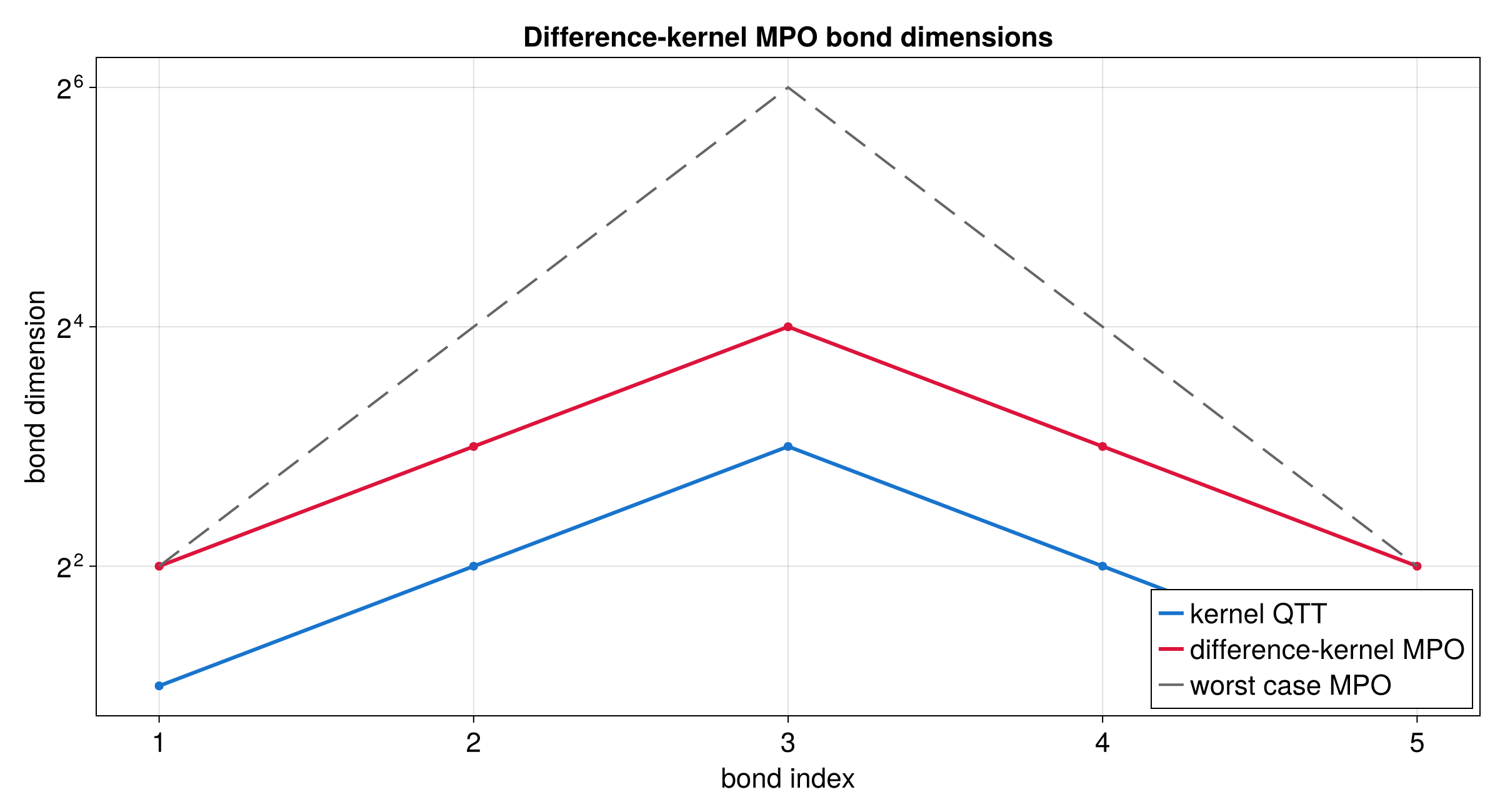
Fourier Transform
This tutorial applies the quantics Fourier operator to a QTT representation of a Gaussian. A Gaussian is a helpful first check because its Fourier transform is also a Gaussian, so the result has a simple reference.
Runnable source: docs/tutorial-code/src/bin/qtt_fourier.rs
Key API Pieces
quantics_fourier_operator creates the operator. The tutorial binary then
converts the state to TreeTN, aligns site indices, and applies it via
apply_linear_operator. The input target function is the standard Gaussian
f(x) = exp(-x^2 / 2).
fn main() -> anyhow::Result<()> {
use tensor4all_quanticstci::{
    pointwise_coordinate_batch,
    quanticscrossinterpolate_batch, DiscretizedGrid, QtciOptions, UnfoldingScheme,
};
use tensor4all_quanticstransform::{quantics_fourier_operator, FourierOptions};
use tensor4all_treetn::{apply_linear_operator, tensor_train_to_treetn, ApplyOptions};
let bits = 7;
let grid = DiscretizedGrid::builder(&[bits])
    .with_lower_bound(&[-10.0])
    .with_upper_bound(&[10.0])
    .include_endpoint(true)
    .with_unfolding_scheme(UnfoldingScheme::Interleaved)
    .build()?;
let gaussian = |coords: &[f64]| -> f64 {
    let x = coords[0];
    (-0.5 * x * x).exp()
};
let options = QtciOptions::default()
    .with_unfoldingscheme(UnfoldingScheme::Interleaved)
    .with_verbosity(0);

let (state, _, _) = quanticscrossinterpolate_batch(&grid, pointwise_coordinate_batch(gaussian), None, options)?;

let mut operator = quantics_fourier_operator(bits, FourierOptions::forward())?;
assert_eq!(operator.mpo().node_count(), bits);

let tt = state.tensor_train();
let (state_tn, _indices) = tensor_train_to_treetn(&tt)?;

operator.align_to_state(&state_tn)?;
let result = apply_linear_operator(&operator, &state_tn, ApplyOptions::naive())?;

assert_eq!(result.node_count(), bits);
Ok(())
}
The plotted frequency axis is scaled back to physical units, so the curve can be compared with the analytic Gaussian transform. The quantics Fourier operator follows the bit-reversed output convention described in the Quantum Fourier Transform guide.
What It Computes
The example builds a QTT for the input Gaussian, applies the Fourier operator, and compares selected output values with the analytic transform.
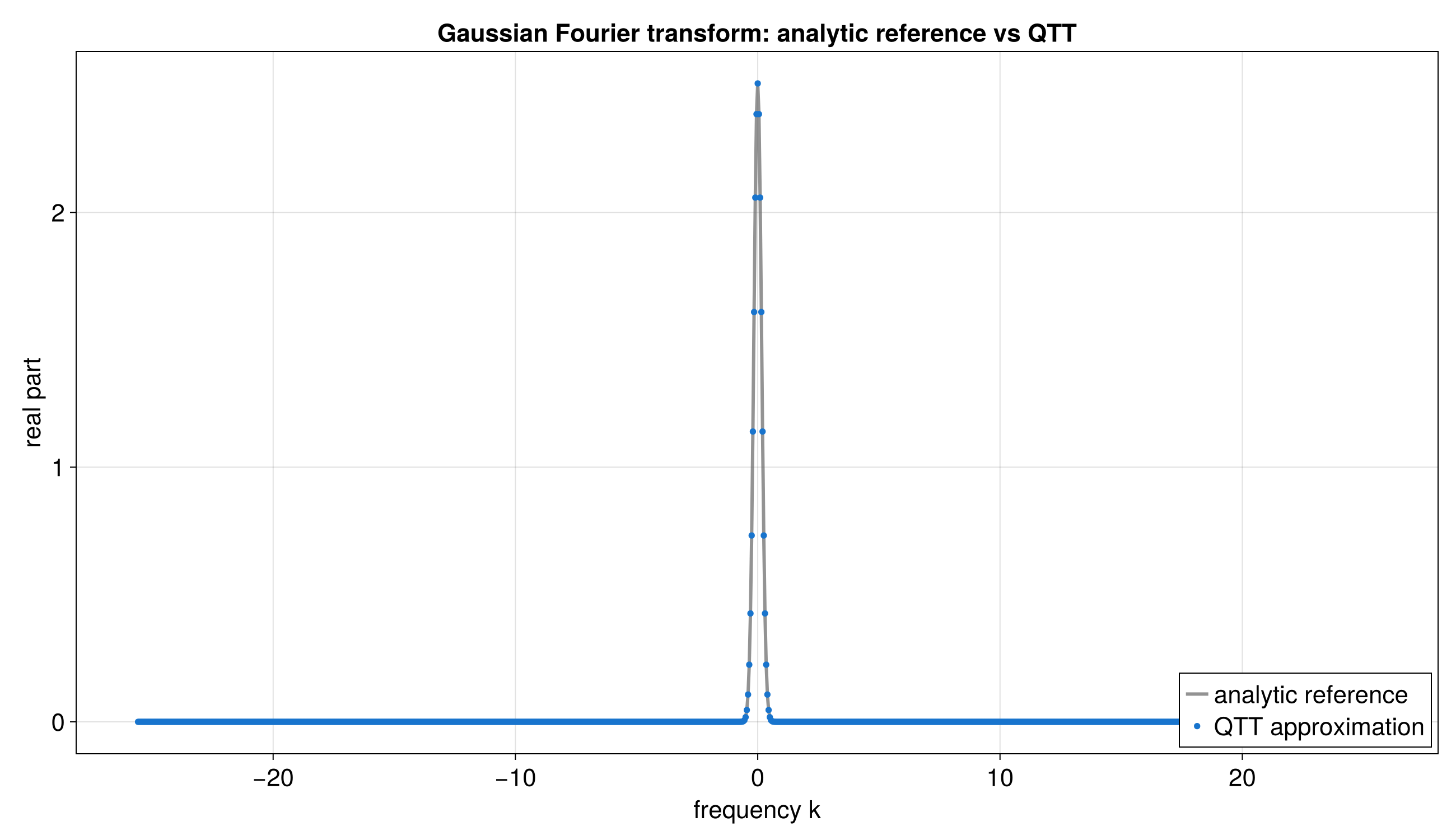
The next plots show the bond dimensions for the input QTT and the operator. The operator dimensions are part of the cost of applying the transform.
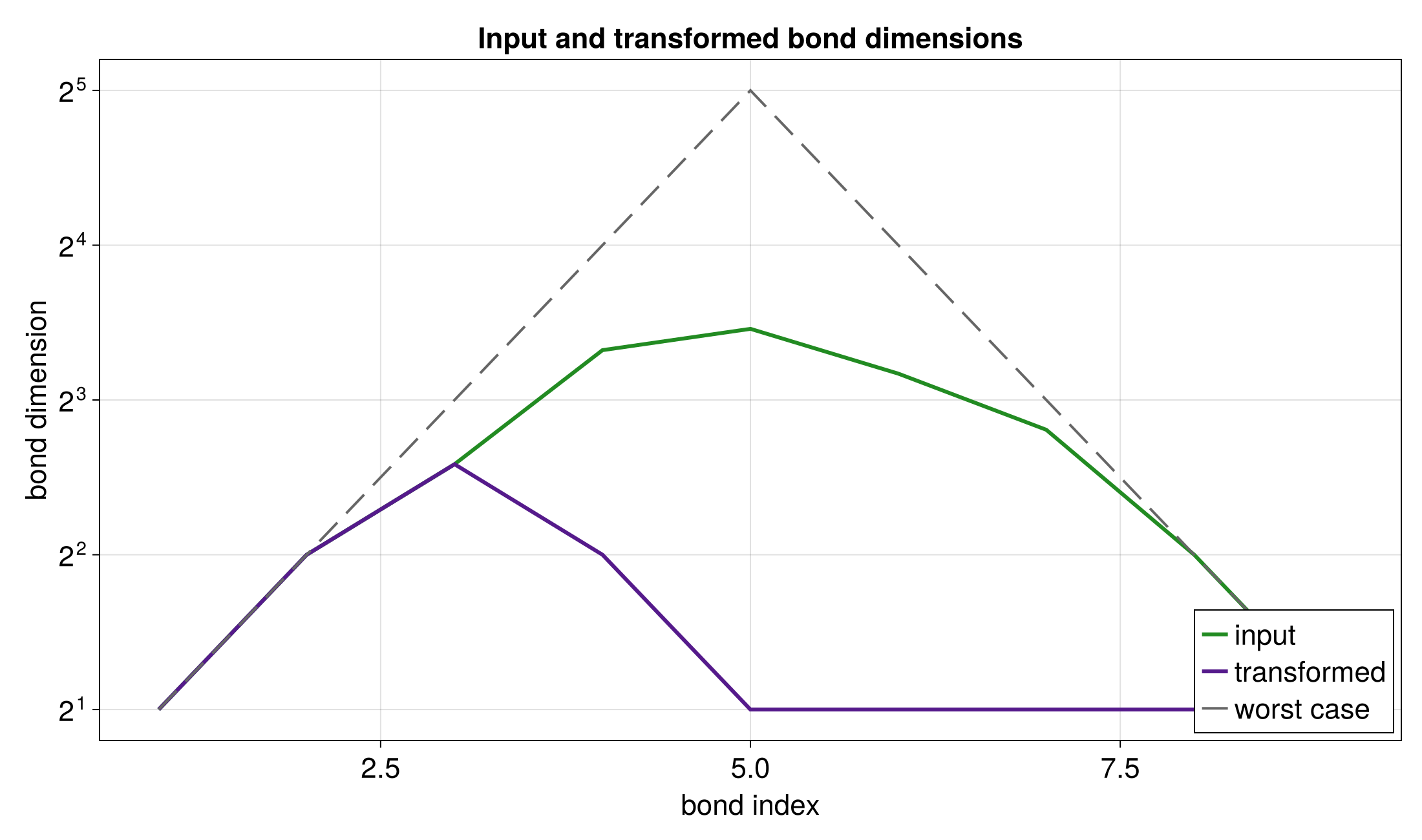
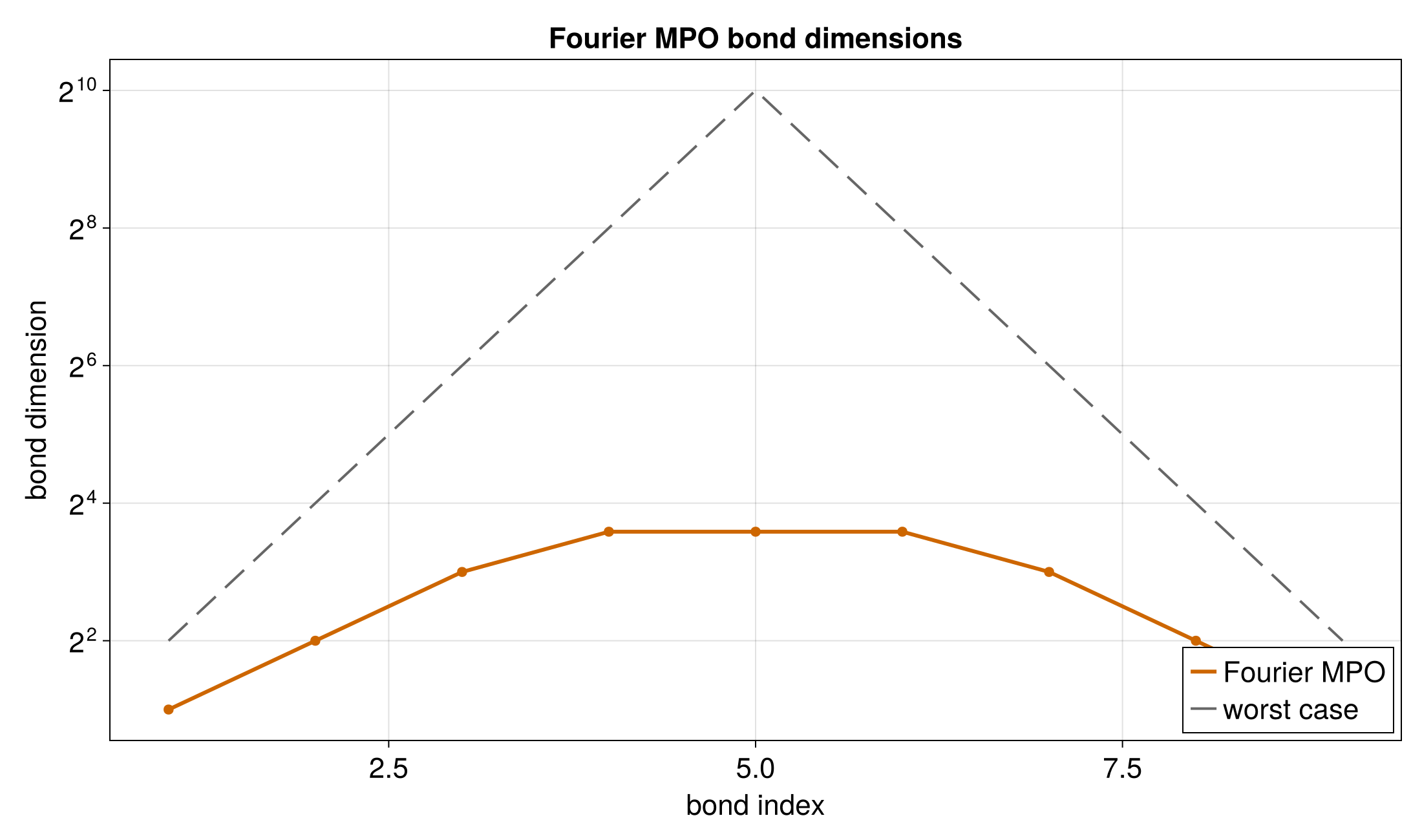
2D Partial Fourier Transform
A partial Fourier transform applies Fourier only along one coordinate of a
multivariate function. Here the function is f(x, t), and only the x
direction is transformed. The t direction passes through unchanged.
Runnable source: docs/tutorial-code/src/bin/qtt_partial_fourier2d.rs
Key API Pieces
For an interleaved two-variable QTT, the state nodes are ordered
x0, t0, x1, t1, .... A one-dimensional Fourier MPO has only x nodes, so the
operator nodes are renamed onto the even state nodes. apply_linear_operator
then handles the partial operator and leaves the missing t nodes as identity
gaps. The source function is
f(x, t) = exp(-x^2 / 2) * cos(2πt).
fn main() -> anyhow::Result<()> {
use tensor4all_quanticstci::{
    pointwise_coordinate_batch,
    quanticscrossinterpolate_batch, DiscretizedGrid, QtciOptions, UnfoldingScheme,
};
use tensor4all_quanticstransform::{quantics_fourier_operator, FourierOptions};
use tensor4all_simplett::AbstractTensorTrain;
let bits = 7;
let grid = DiscretizedGrid::builder(&[bits, bits])
    .with_variable_names(&["x", "t"])
    .with_lower_bound(&[-4.0, 0.0])
    .with_upper_bound(&[4.0, 1.0])
    .include_endpoint(true)
    .with_unfolding_scheme(UnfoldingScheme::Interleaved)
    .build()?;

let f = |coords: &[f64]| -> f64 {
    let x = coords[0];
    let t = coords[1];
    (-0.5 * x * x).exp() * (2.0 * std::f64::consts::PI * t).cos()
};
let options = QtciOptions::default()
    .with_unfoldingscheme(UnfoldingScheme::Interleaved)
    .with_verbosity(0);

let (state, _ranks, _errors) = quanticscrossinterpolate_batch(&grid, pointwise_coordinate_batch(f), None, options)?;

let operator = quantics_fourier_operator(bits, FourierOptions::forward())?;
assert_eq!(operator.mpo().node_count(), bits);

let x_site_mapping: Vec<_> = (0..bits).map(|site| (site, 2 * site)).collect();
let renamed_operator = operator.rename_nodes(&x_site_mapping)?;

assert_eq!(state.tensor_train().len(), 2 * bits);
assert_eq!(x_site_mapping.len(), bits);
assert_eq!(x_site_mapping[0], (0, 0));
assert_eq!(x_site_mapping[bits - 1], (bits - 1, 2 * (bits - 1)));
assert_eq!(renamed_operator.mpo().node_count(), bits);
Ok(())
}
The full source then aligns the renamed partial operator to the state and
applies it. Passing None for initial_pivots is the best starting point for
tutorial code because it keeps QTCI on its default initialization path. Explicit
pivot lists are a later tuning tool for cases where you already know important
grid points.
Use apply_linear_operator_to_numbered_tags if and only if numbered tags such as x=1, x=2, … are the intended operator binding.
What It Computes
The example builds an interleaved two-dimensional QTT, applies a one-dimensional Fourier operator to the x-sites, and compares the result with an analytic partial transform.
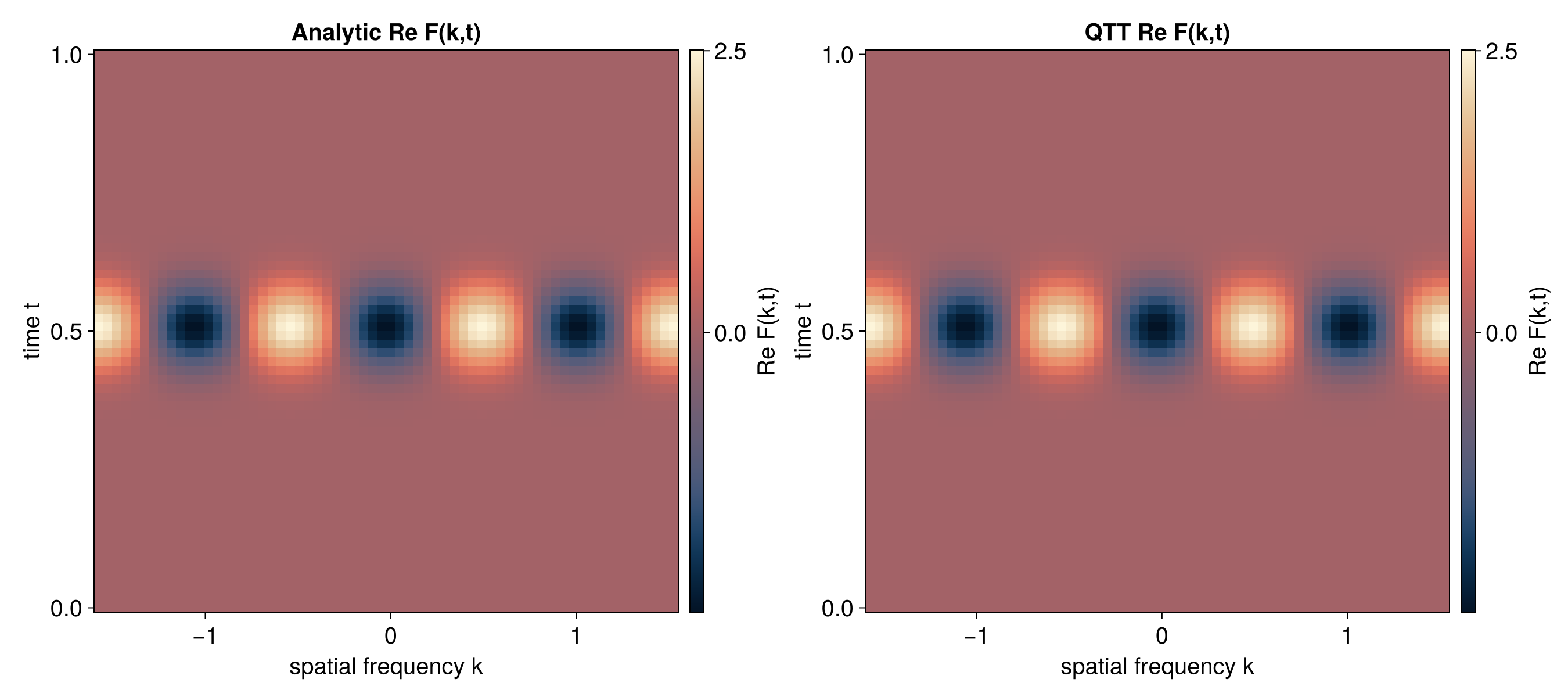
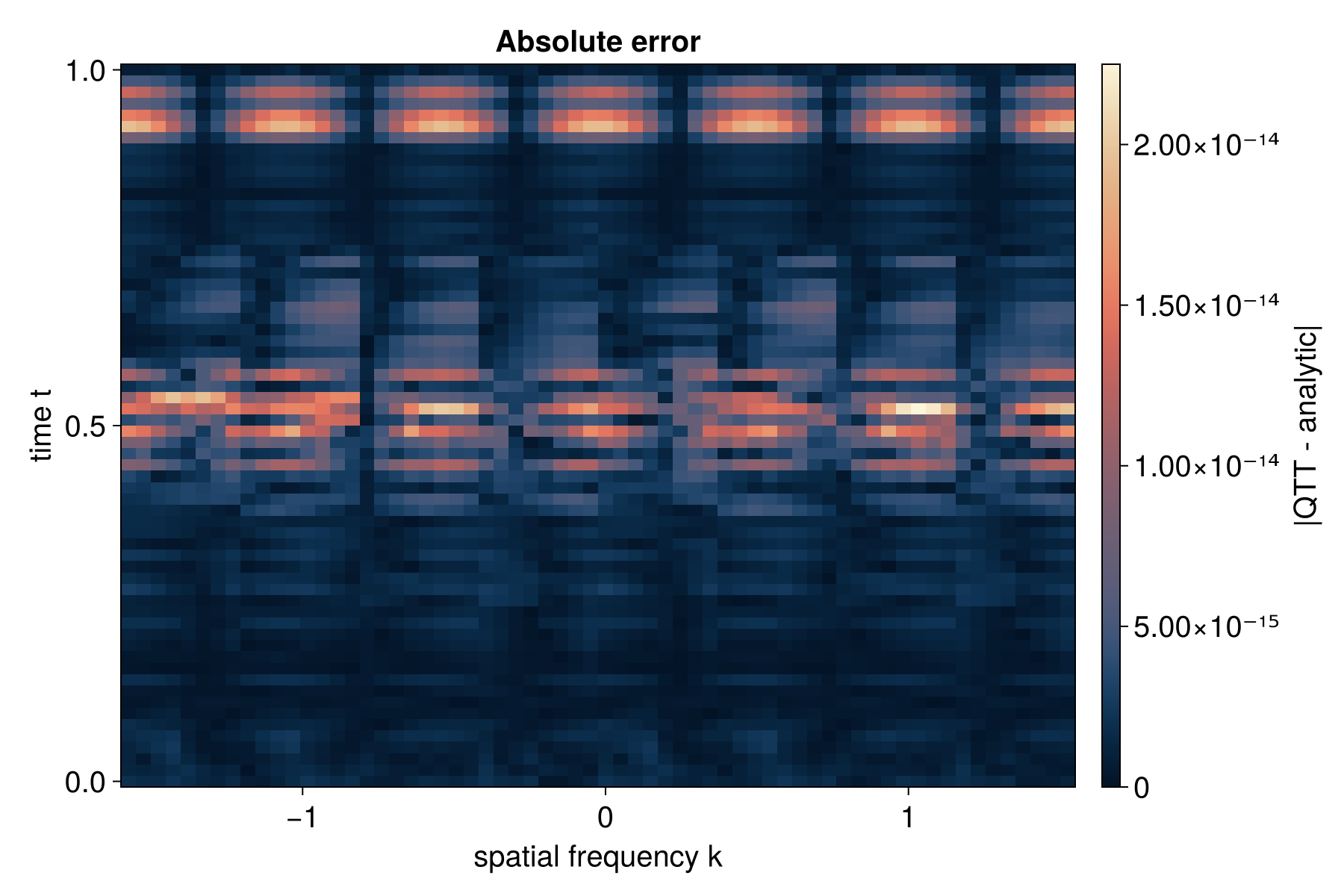
Only the x-sites receive the operator, so the implementation maps the one-dimensional operator nodes onto the even nodes of the interleaved state and lets partial apply supply the identity behavior on the t-sites.
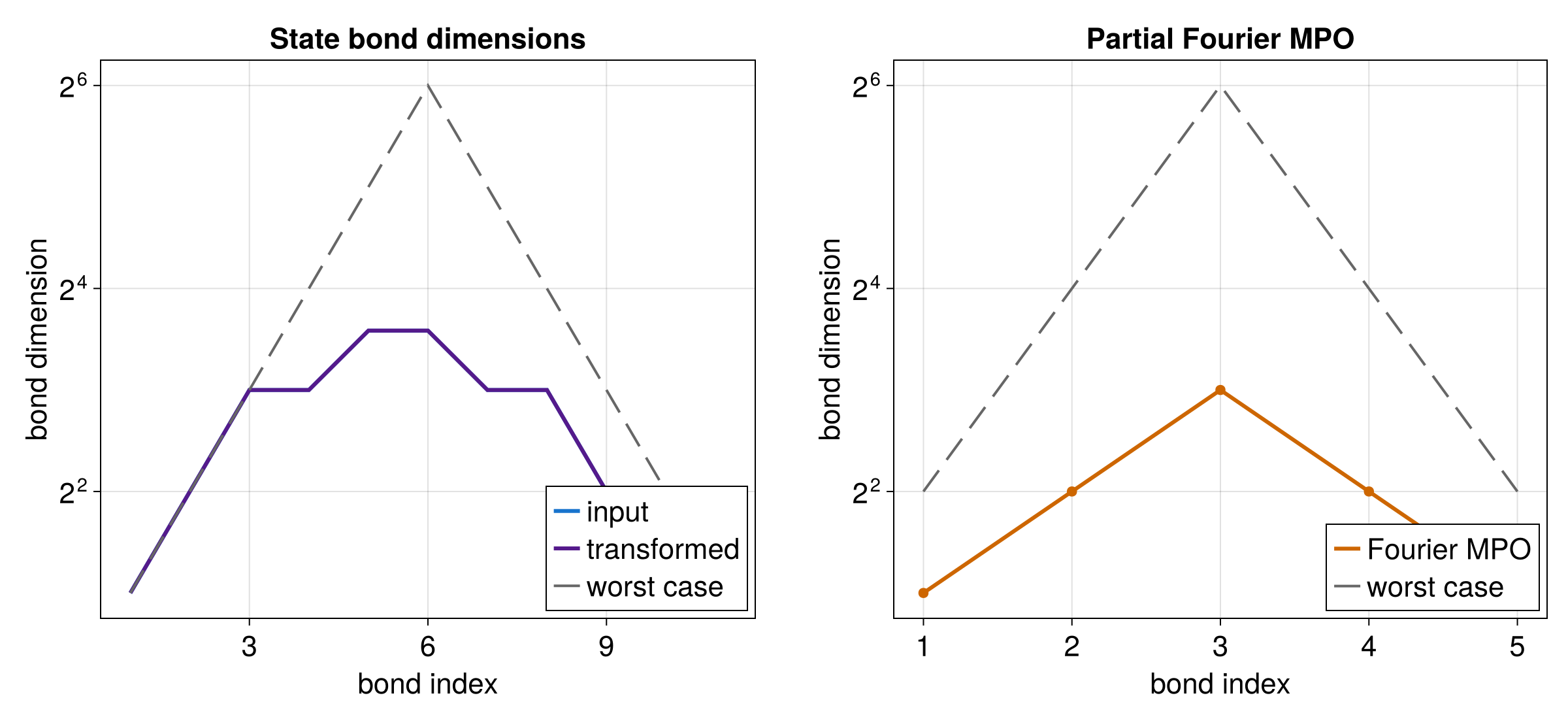
Conventions
This page collects important conventions that apply across the entire tensor4all-rs codebase.
Dense Layout (Column-Major)
tensor4all-rs uses column-major (Fortran order) dense linearization internally. Flat dense
buffers, reshape/flatten semantics, the C API, and the HDF5 layer are all defined in terms
of column-major ordering.
This matches Julia, ITensors.jl, and tenferro-rs. When exchanging dense data with NumPy, use
order="F" when you need explicit control over flattening or reshaping.
Indexing
- Sites and grid indices are 0-indexed in Rust (unlike ITensors.jl, which is 1-indexed). QuanticsTCI.jl scripts must subtract 1 from grid indices at the call boundary.
Truncation Tolerance
tensor4all-rs uses rtol (relative tolerance). ITensors.jl uses cutoff. The conversion is:
rtol = sqrt(cutoff)
| Library | Parameter | Conversion |
|---|---|---|
| tensor4all-rs | rtol | — |
| ITensors.jl | cutoff | rtol = √cutoff |
Example: ITensors.jl cutoff=1e-10 corresponds to rtol=1e-5 in tensor4all-rs.
Exception — partitioned TreeTNs.
tensor4all-partitionedtreetn’s adaptive surface (PatchingOptions::cutoff,truncate_adaptive) follows ITensors.jlcutoffdirectly: it is a local discarded-weight cutoff, 1:1 with ITensorscutoff(for a caller migrating from the old root-relative value,cutoff = old_rtol², equivalentlyrtol = sqrt(cutoff)). The final whole-network error is best effort and is not bounded bycutoff;max_bond_dimis the hard cap. The deprecatedtensor4all-partitionedttcrate keeps thertolconvention documented above.
Bond-Dimension Cap
tensor4all-rs uses one spelling and one type for the bond-dimension cap across
all crates: max_bond_dim: Option<usize> (None = unlimited). No
usize::MAX sentinel is used.
| Library | Parameter | tensor4all-rs |
|---|---|---|
| tensor4all-rs | max_bond_dim: Option<usize> | — |
| ITensors.jl | maxdim | max_bond_dim: Some(d) |
| QuanticsTCI.jl / TCI | maxbonddim | max_bond_dim: Some(d) |
| (historical) | max_rank | max_bond_dim: Option<usize> |
maxdim is the closest ITensors.jl cousin of max_bond_dim (bond dimension
is the unambiguous tensor-network term; “rank” is overloaded in TCI
context).
ITensors.jl Type Correspondence
| ITensors.jl | tensor4all-rs |
|---|---|
Index{Int} | Index<Id, NoSymmSpace> |
ITensor | IdxTensor |
Dense | eager dense payload; Storage snapshot for f64/Complex64 |
Diag | compact Storage for f64/Complex64, eager diagonal payload for f32/Complex32 |
A * B | a.contract(&b) |
Scalar Types
IdxTensor supports four scalar types:
f32— single-precision realf64— double-precision realComplex32— single-precision complexComplex64— double-precision complex (from thenum-complexcrate)
Generic APIs handle all four types. Compact Storage snapshots are limited to
f64/Complex64; 32-bit tensors retain eager payloads rather than silently
promoting their values. Prefer generic code over scalar-specific variants
(*_f64 / *_c64) in library and test code. The C API uses scalar-specific
names at the FFI boundary where generic dispatch is not available.
Julia Bindings
The Julia bindings for tensor4all-rs are maintained in a separate repository: Tensor4all.jl.
Installation
To install Tensor4all.jl, use Julia’s package manager:
using Pkg
Pkg.add(url="https://github.com/tensor4all/Tensor4all.jl")
This will automatically download and build the Rust library via the C API (tensor4all-capi).
Overview
The current C ABI is intentionally smaller than the full Rust workspace. It exposes the pieces needed to build a Julia-native surface on top:
- Indices — immutable index handles with IDs, tags, and prime levels
- Dense tensors —
Float64/ complex tensor construction, export, and contraction - Tree tensor networks — topology queries, orthogonalization, truncation, evaluation, and dense export
- Canonical QTT layouts — interleaved and fused binary layouts
- Quantics transform materialization — shift, flip, phase rotation, cumsum, Fourier, and affine operators materialized directly as
TreeTN - Error reporting —
enum t4a_status_codeplust4a_last_error_message
This split is deliberate: the Rust side owns performance-critical kernels and the Julia side owns higher-level ergonomics.
ABI Conventions
The C API follows Julia-friendly conventions:
- Dense buffers are column-major
- Complex values are interleaved
Float64pairs - Variable-length outputs use a query-then-fill pattern
- Opaque handles must be released explicitly
The generated public header lives at
crates/tensor4all-capi/include/tensor4all_capi.h.
Documentation
For Julia-side examples and package-level documentation, see the Tensor4all.jl README.
For ABI details in this repository, see:
Linking Rust and Julia Code
If you want to use tensor4all-rs directly in a Rust project and interoperate
with Julia, build against the generated C header and follow the conventions
documented in docs/CAPI_DESIGN.md.