Fourier Transform
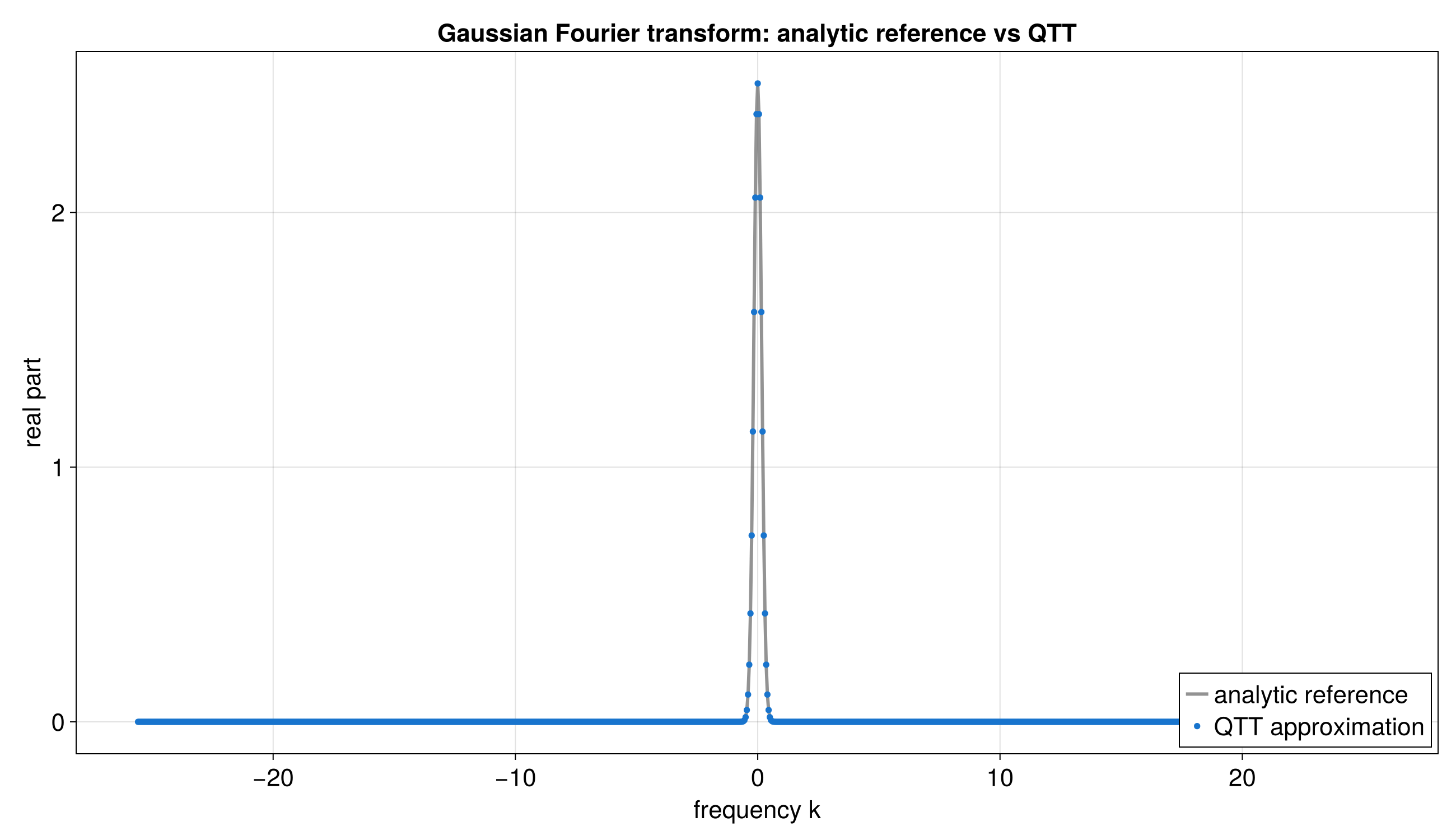
This tutorial applies the quantics Fourier operator to a QTT representation of a Gaussian. A Gaussian is a helpful first check because its Fourier transform is also a Gaussian, so the result has a simple reference.
Runnable source: docs/tutorial-code/src/bin/qtt_fourier.rs
Key API Pieces
quantics_fourier_operator creates the operator. The tutorial binary then
converts the state to TreeTN, aligns site indices, and applies it via
apply_linear_operator. The input target function is the standard Gaussian
f(x) = exp(-x^2 / 2).
fn main() -> anyhow::Result<()> {
use tensor4all_quanticstci::{
    pointwise_coordinate_batch,
    quanticscrossinterpolate_batch, DiscretizedGrid, QtciOptions, UnfoldingScheme,
};
use tensor4all_quanticstransform::{quantics_fourier_operator, FourierOptions};
use tensor4all_treetn::{apply_linear_operator, tensor_train_to_treetn, ApplyOptions};
let bits = 7;
let grid = DiscretizedGrid::builder(&[bits])
    .with_lower_bound(&[-10.0])
    .with_upper_bound(&[10.0])
    .include_endpoint(true)
    .with_unfolding_scheme(UnfoldingScheme::Interleaved)
    .build()?;
let gaussian = |coords: &[f64]| -> f64 {
    let x = coords[0];
    (-0.5 * x * x).exp()
};
let options = QtciOptions::default()
    .with_unfoldingscheme(UnfoldingScheme::Interleaved)
    .with_verbosity(0);

let (state, _, _) = quanticscrossinterpolate_batch(&grid, pointwise_coordinate_batch(gaussian), None, options)?;

let mut operator = quantics_fourier_operator(bits, FourierOptions::forward())?;
assert_eq!(operator.mpo().node_count(), bits);

let tt = state.tensor_train();
let (state_tn, _indices) = tensor_train_to_treetn(&tt)?;

operator.align_to_state(&state_tn)?;
let result = apply_linear_operator(&operator, &state_tn, ApplyOptions::naive())?;

assert_eq!(result.node_count(), bits);
Ok(())
}
The plotted frequency axis is scaled back to physical units, so the curve can be compared with the analytic Gaussian transform. The quantics Fourier operator follows the bit-reversed output convention described in the Quantum Fourier Transform guide.
What It Computes
The example builds a QTT for the input Gaussian, applies the Fourier operator, and compares selected output values with the analytic transform.
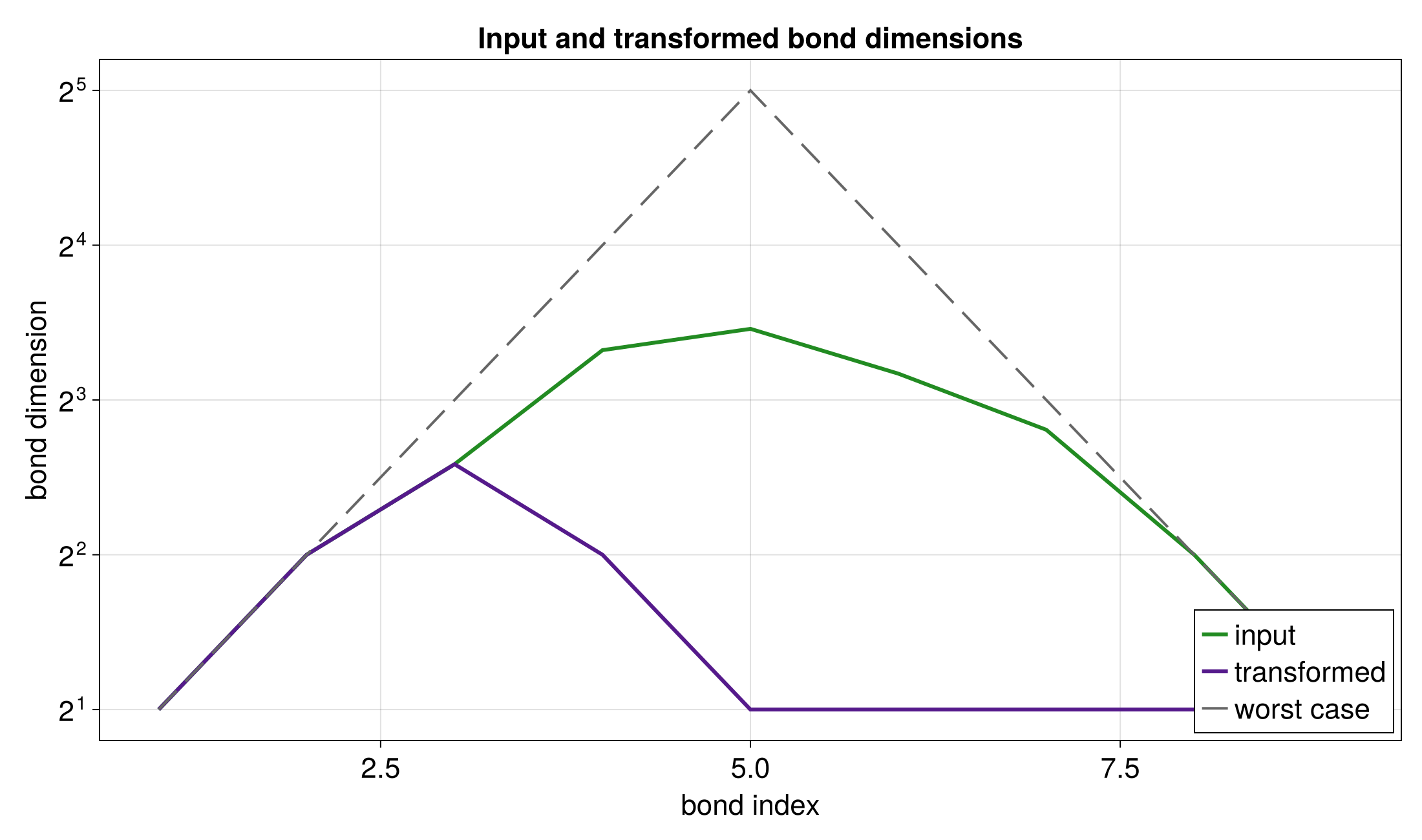
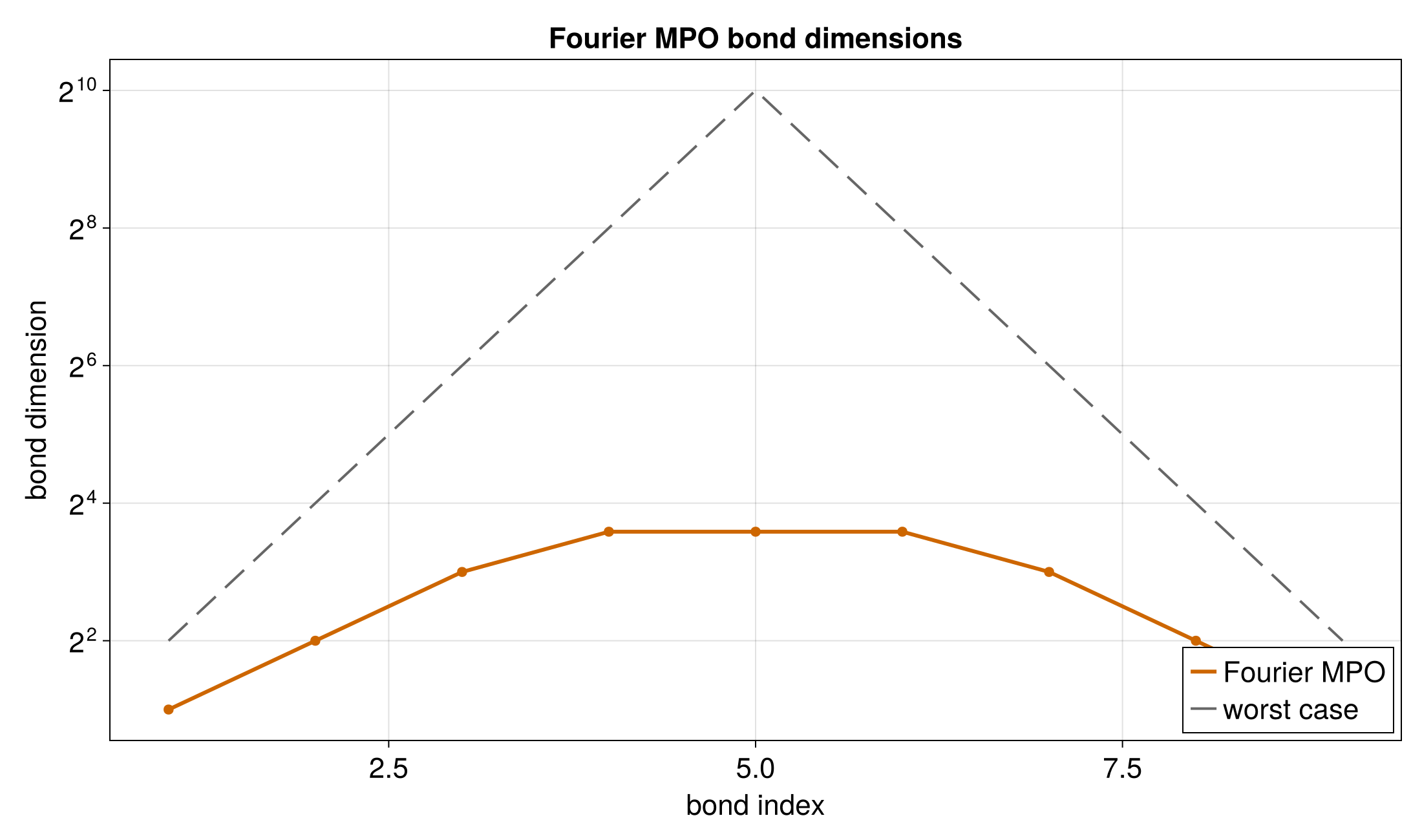
The next plots show the bond dimensions for the input QTT and the operator. The operator dimensions are part of the cost of applying the transform.