2D Partial Fourier Transform
A partial Fourier transform applies Fourier only along one coordinate of a
multivariate function. Here the function is f(x, t), and only the x
direction is transformed. The t direction passes through unchanged.
Runnable source: docs/tutorial-code/src/bin/qtt_partial_fourier2d.rs
Key API Pieces
For an interleaved two-variable QTT, the state nodes are ordered
x0, t0, x1, t1, .... A one-dimensional Fourier MPO has only x nodes, so the
operator nodes are renamed onto the even state nodes. apply_linear_operator
then handles the partial operator and leaves the missing t nodes as identity
gaps. The source function is
f(x, t) = exp(-x^2 / 2) * cos(2πt).
fn main() -> anyhow::Result<()> {
use tensor4all_quanticstci::{
    pointwise_coordinate_batch,
    quanticscrossinterpolate_batch, DiscretizedGrid, QtciOptions, UnfoldingScheme,
};
use tensor4all_quanticstransform::{quantics_fourier_operator, FourierOptions};
use tensor4all_simplett::AbstractTensorTrain;
let bits = 7;
let grid = DiscretizedGrid::builder(&[bits, bits])
    .with_variable_names(&["x", "t"])
    .with_lower_bound(&[-4.0, 0.0])
    .with_upper_bound(&[4.0, 1.0])
    .include_endpoint(true)
    .with_unfolding_scheme(UnfoldingScheme::Interleaved)
    .build()?;

let f = |coords: &[f64]| -> f64 {
    let x = coords[0];
    let t = coords[1];
    (-0.5 * x * x).exp() * (2.0 * std::f64::consts::PI * t).cos()
};
let options = QtciOptions::default()
    .with_unfoldingscheme(UnfoldingScheme::Interleaved)
    .with_verbosity(0);

let (state, _ranks, _errors) = quanticscrossinterpolate_batch(&grid, pointwise_coordinate_batch(f), None, options)?;

let operator = quantics_fourier_operator(bits, FourierOptions::forward())?;
assert_eq!(operator.mpo().node_count(), bits);

let x_site_mapping: Vec<_> = (0..bits).map(|site| (site, 2 * site)).collect();
let renamed_operator = operator.rename_nodes(&x_site_mapping)?;

assert_eq!(state.tensor_train().len(), 2 * bits);
assert_eq!(x_site_mapping.len(), bits);
assert_eq!(x_site_mapping[0], (0, 0));
assert_eq!(x_site_mapping[bits - 1], (bits - 1, 2 * (bits - 1)));
assert_eq!(renamed_operator.mpo().node_count(), bits);
Ok(())
}
The full source then aligns the renamed partial operator to the state and
applies it. Passing None for initial_pivots is the best starting point for
tutorial code because it keeps QTCI on its default initialization path. Explicit
pivot lists are a later tuning tool for cases where you already know important
grid points.
Use apply_linear_operator_to_numbered_tags if and only if numbered tags such as x=1, x=2, … are the intended operator binding.
What It Computes
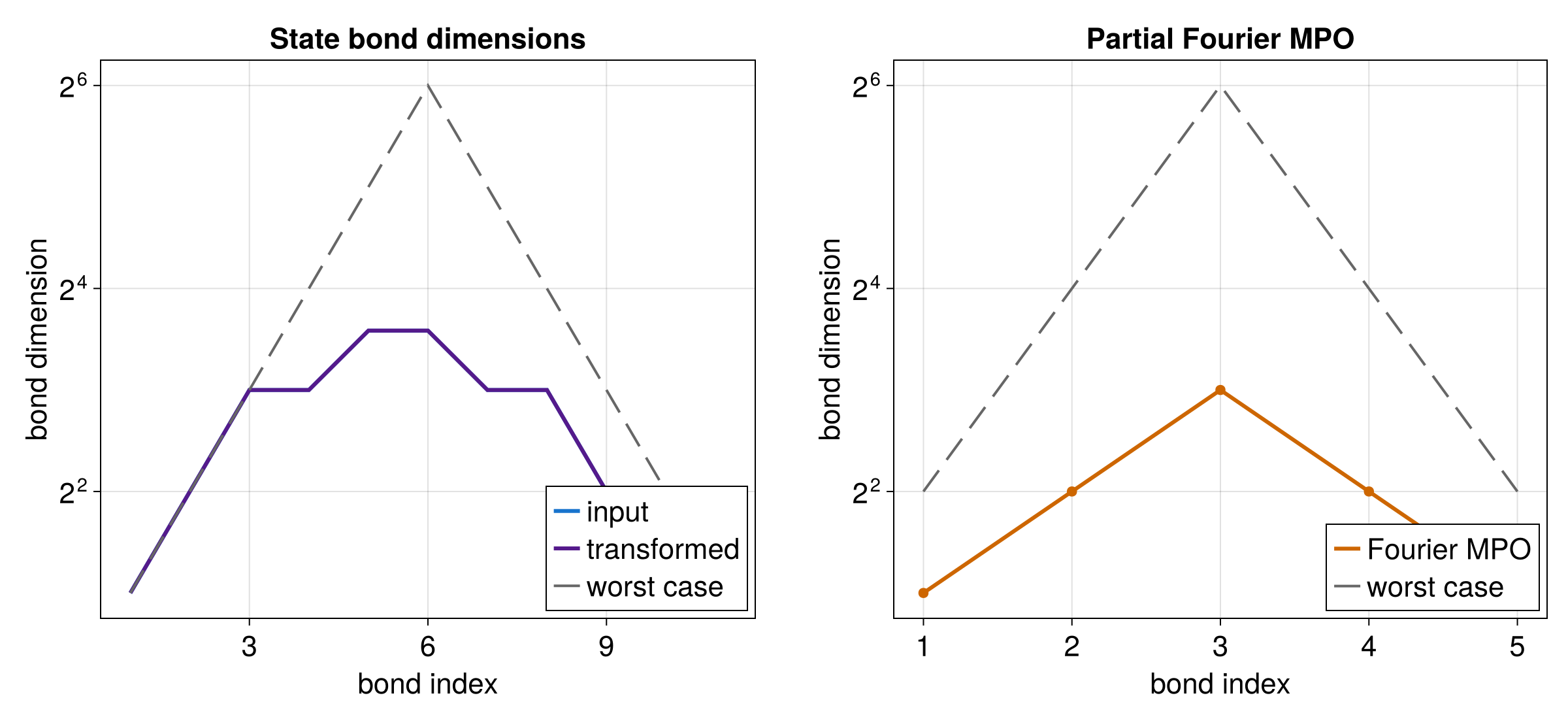
The example builds an interleaved two-dimensional QTT, applies a one-dimensional Fourier operator to the x-sites, and compares the result with an analytic partial transform.
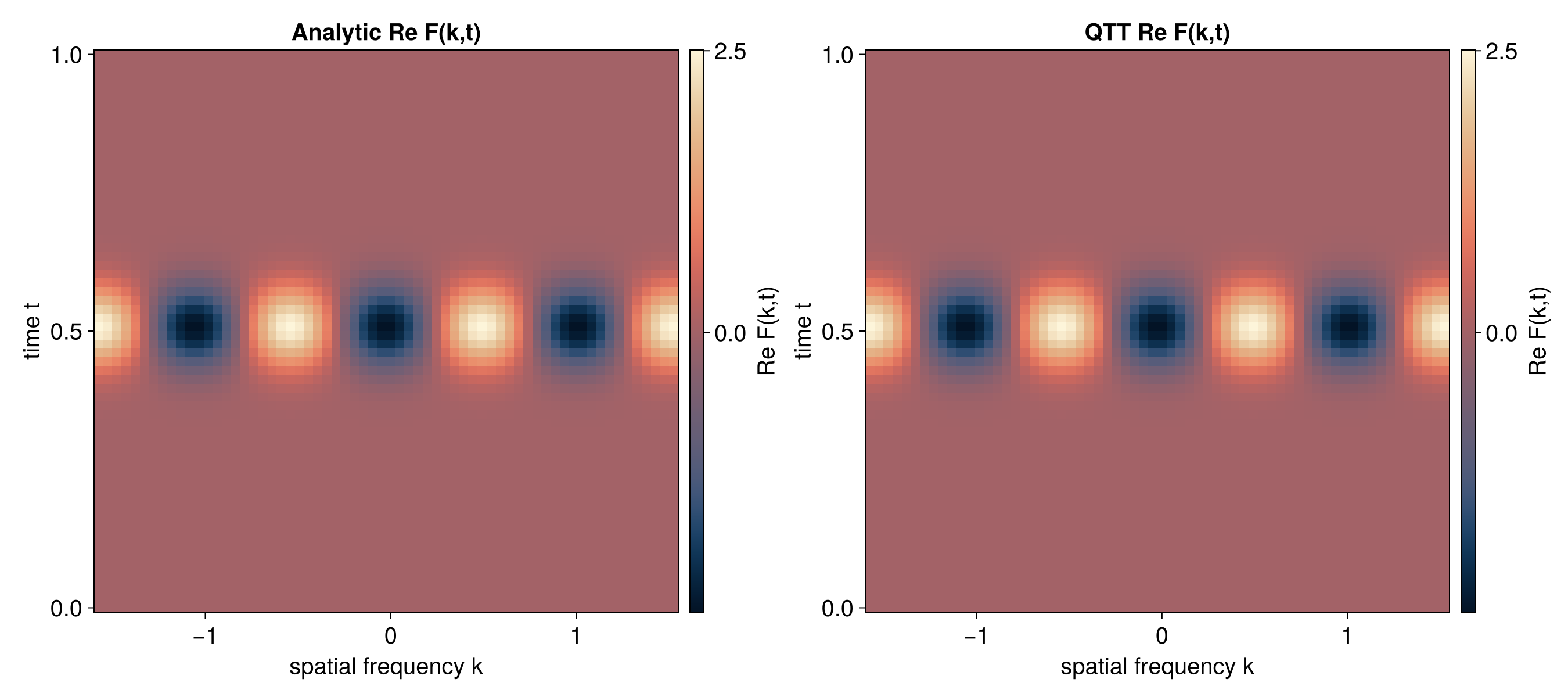
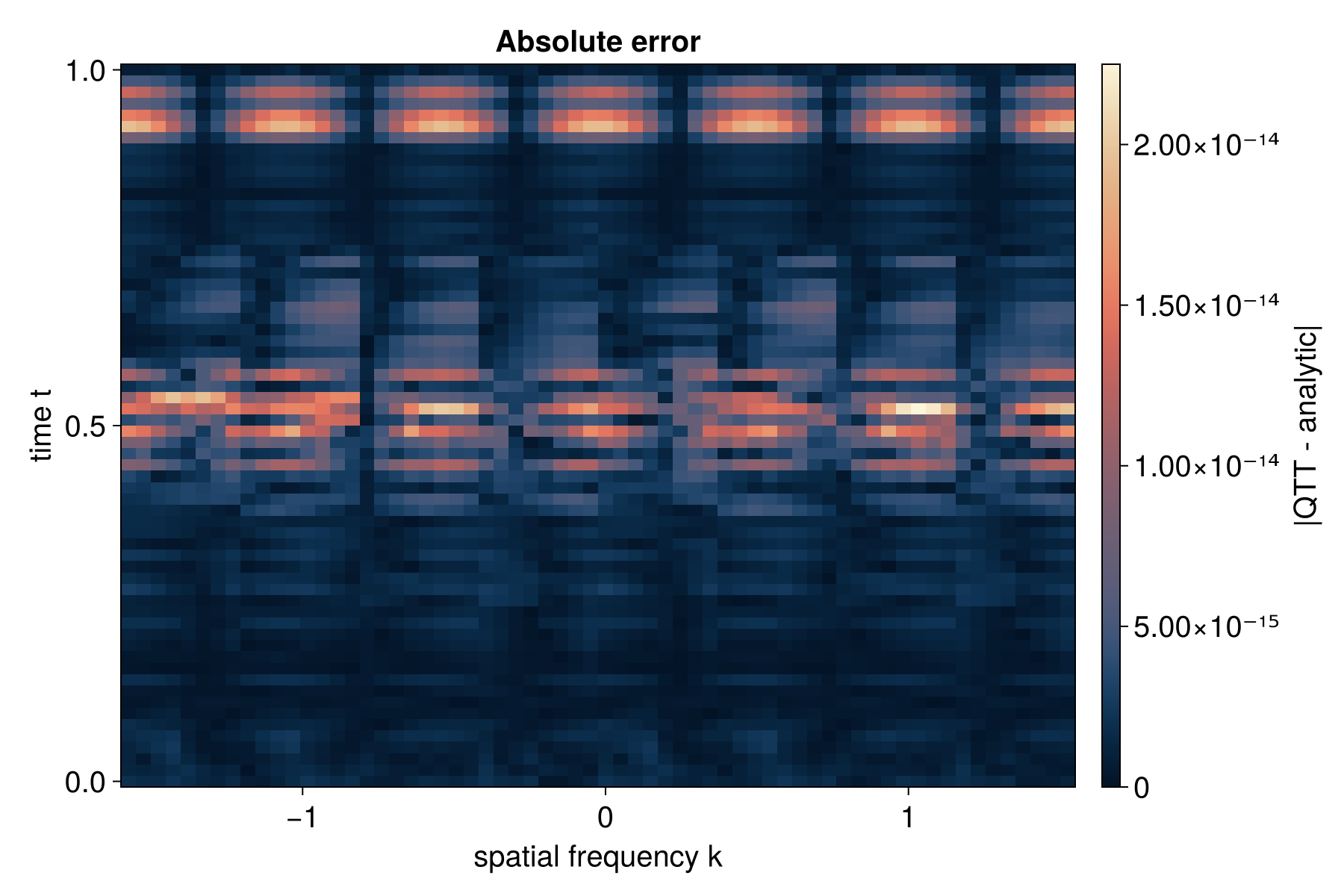
Only the x-sites receive the operator, so the implementation maps the one-dimensional operator nodes onto the even nodes of the interleaved state and lets partial apply supply the identity behavior on the t-sites.