Affine Transformation
An affine transformation evaluates a function at shifted or mixed coordinates. The tutorial uses the pullback point of view: to get the new value at an output point, look up the old function at the transformed input point.
Runnable source: docs/tutorial-code/src/bin/qtt_affine.rs
Key API Pieces
AffineParams stores the matrix and offset. Boundary conditions say what
happens when transformed coordinates leave the grid. The operator is
applied via tensor_train_to_treetn, align_to_state, and
apply_linear_operator. The source function is
f(u, v) = sin(2πu/N) + 0.5 cos(2πv/N) + 0.25 sin(2π(u + 2v)/N).
fn main() -> anyhow::Result<()> {
use tensor4all_core::TensorIndex;
use tensor4all_quanticstci::{
pointwise_index_batch,
quanticscrossinterpolate_discrete_batch, QtciOptions, UnfoldingScheme,
};
use tensor4all_quanticstransform::{
affine_operator, AffineParams, BoundaryCondition,
};
use tensor4all_treetn::{apply_linear_operator, tensor_train_to_treetn, ApplyOptions};
use std::f64::consts::PI;
let bits = 7;
let n = 1usize << bits;
let source_grid = [n, n];
let source_function = move |grid_idx: &[usize]| -> f64 {
let u = grid_idx[0] as f64;
let v = grid_idx[1] as f64;
let n = n as f64;
(2.0 * PI * u / n).sin()
+ 0.5 * (2.0 * PI * v / n).cos()
+ 0.25 * (2.0 * PI * (u + 2.0 * v) / n).sin()
};
let source_options = QtciOptions::default()
.with_unfoldingscheme(UnfoldingScheme::Fused)
.with_verbosity(0);
let (source, _, _) = quanticscrossinterpolate_discrete_batch::<f64, _>(
&source_grid, pointwise_index_batch(source_function),
None,
source_options)?;
let params = AffineParams::from_integers(vec![1, 1, 0, 1], vec![0, 0], 2, 2)?;
let mut operator = affine_operator(bits, ¶ms, &[BoundaryCondition::Periodic; 2])?
.transpose();
let source_tt = source.tensor_train();
let (state, _indices) = tensor_train_to_treetn(&source_tt)?;
operator.align_to_state(&state)?;
let result = apply_linear_operator(&operator, &state, ApplyOptions::naive())?;
let external = TensorIndex::external_indices(&result);
assert_eq!(external.len(), bits);
assert!(result.node_count() >= state.node_count());
Ok(())
}The full tutorial repeats the same workflow for three boundary conditions. The
anti-periodic case uses [AntiPeriodic, Periodic], so only the wrapped
u = x + y coordinate changes sign.
What It Computes
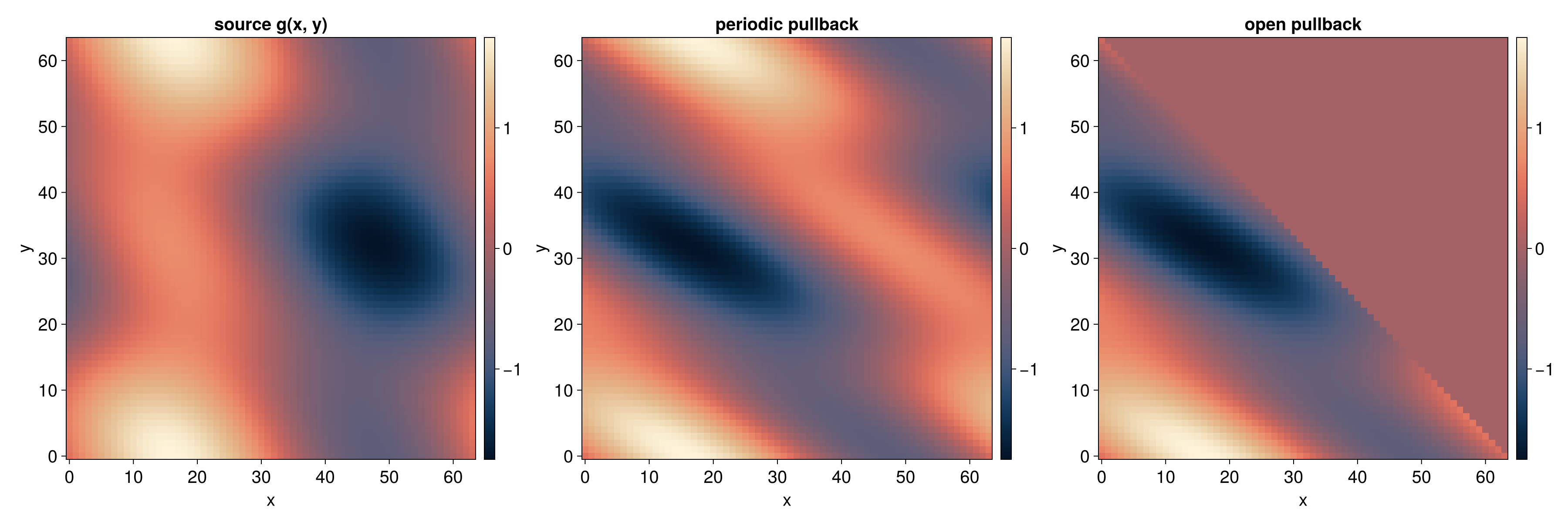
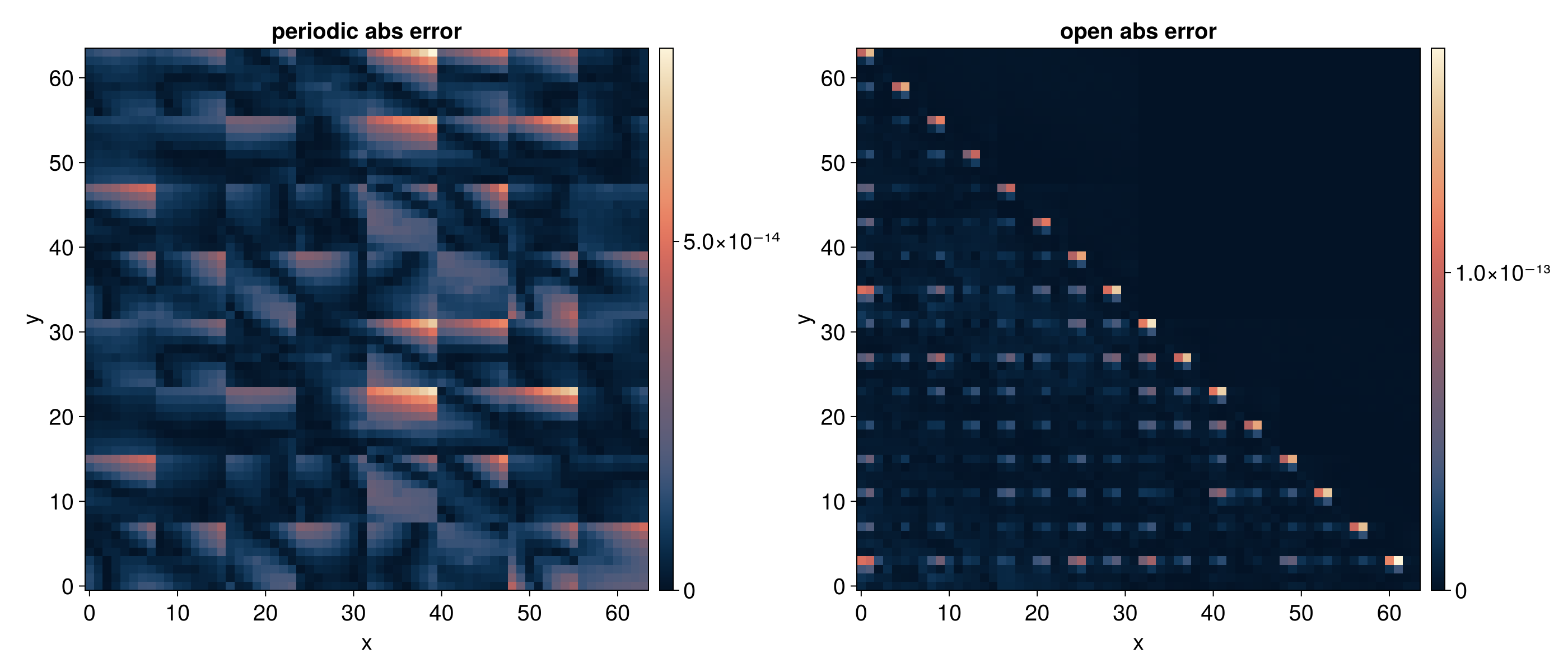
The example builds a two-dimensional QTT, creates affine operators, applies
them to the QTT, and compares the transformed values with direct references.
The anti-periodic pullback matches the periodic wrap except that the region
x + y >= N is multiplied by -1.
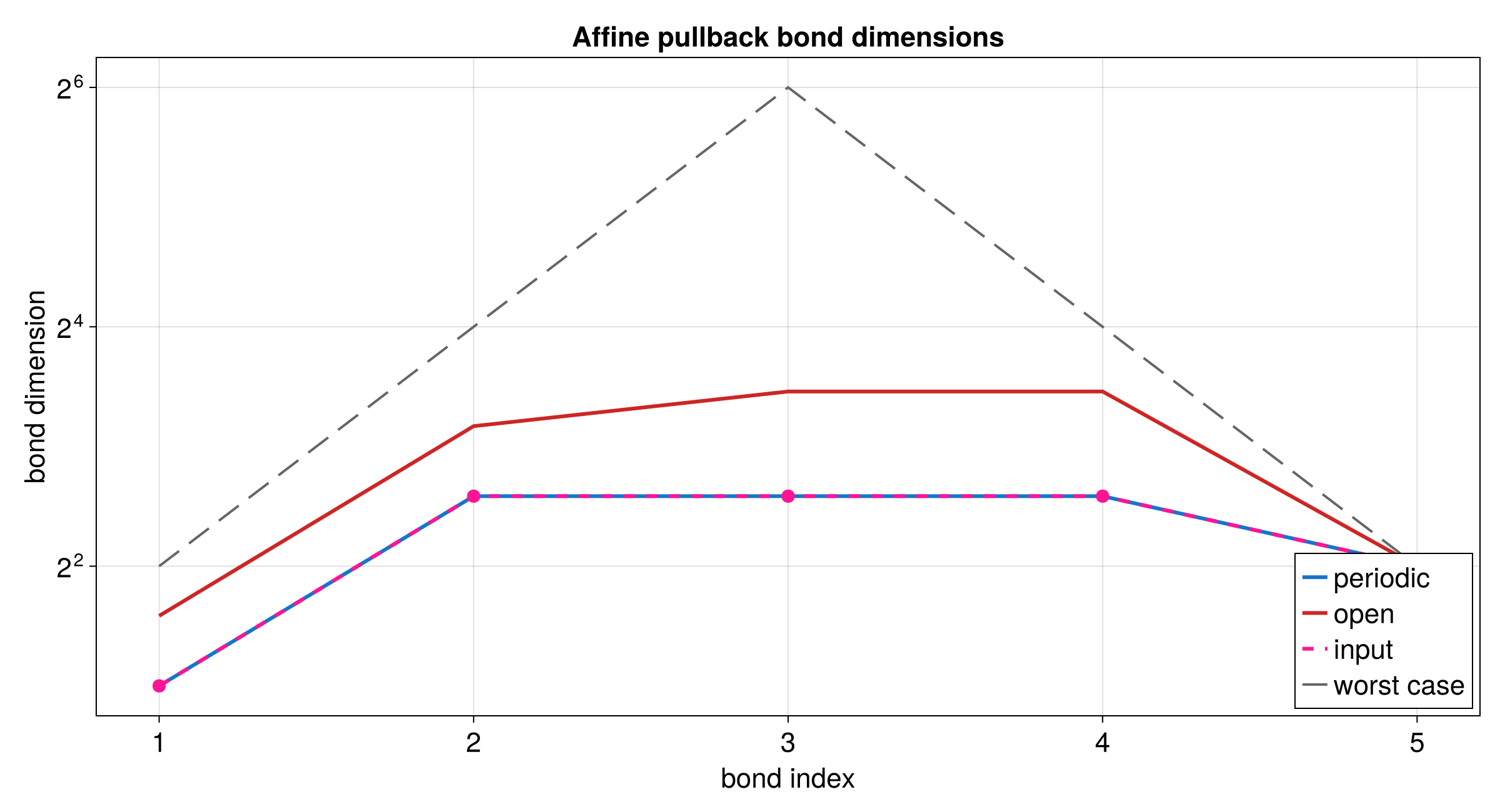
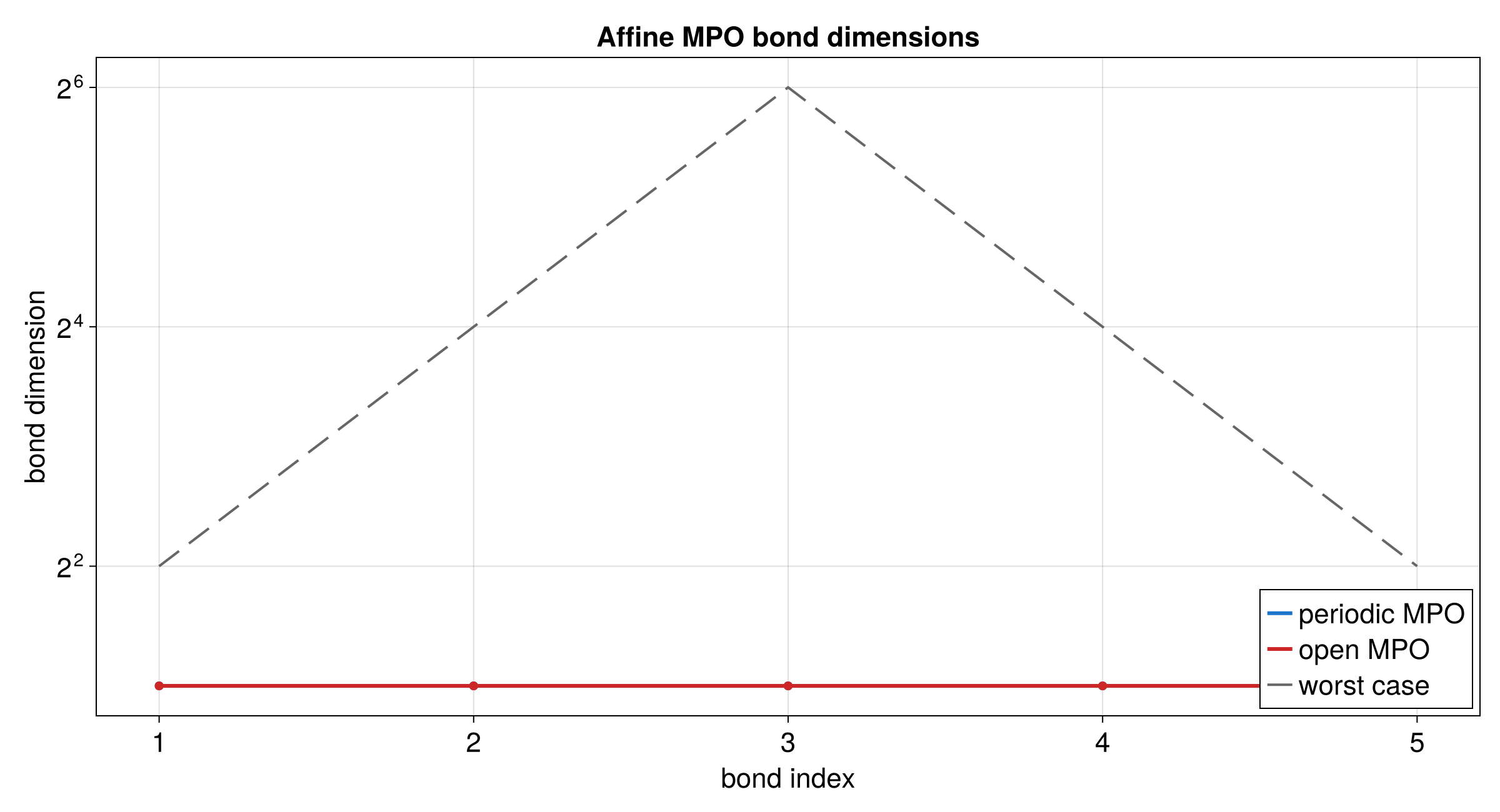
The operator has its own bond dimensions, and the transformed QTT has another set. Both are useful when judging the cost of the operation.