Elementwise Product
This tutorial multiplies two functions after both have been represented as
QTTs. Elementwise means that values at the same grid point are multiplied:
h(x_i) = f(x_i) g(x_i).
Runnable source: docs/tutorial-code/src/bin/qtt_elementwise_product.rs
Key API Pieces
The first step is simply to build two QTTs on the same grid. Converting
to TreeTN enables partial_contract with diagonal_pairs for the
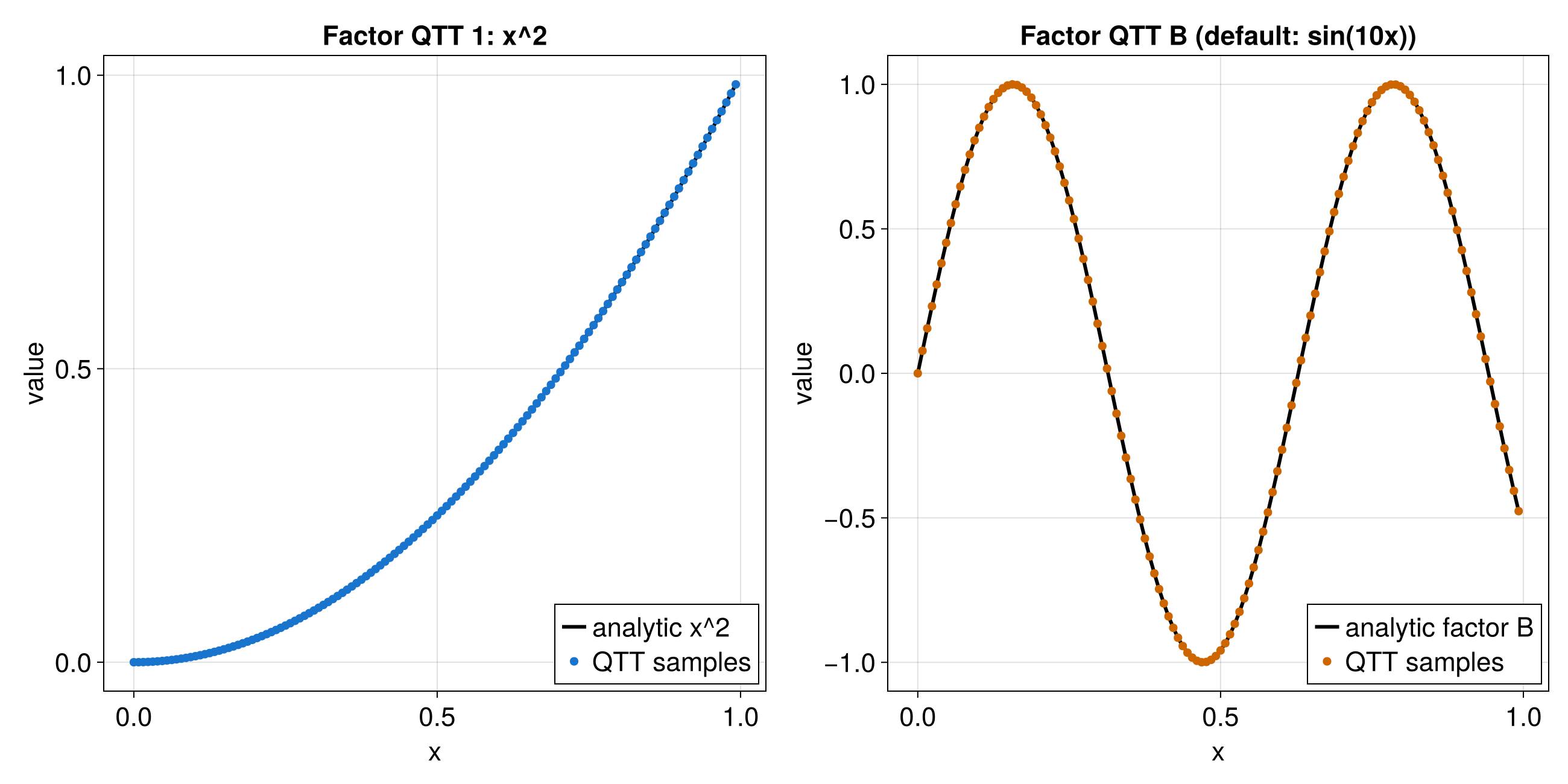
pointwise product. The two target functions are f(x) = x^2 and
g(x) = sin(10x) on the unit interval.
fn main() -> anyhow::Result<()> {
use tensor4all_quanticstci::{
pointwise_index_batch,quanticscrossinterpolate_discrete_batch, QtciOptions};
use tensor4all_treetn::{
contraction::ContractionOptions,
partial_contract, tensor_train_to_treetn, PartialContractionSpec,
};
let npoints = 8usize;
let sizes = [npoints];
let f = move |idx: &[usize]| -> f64 {
let x = idx[0] as f64 / npoints as f64;
x.powi(2)
};
let g = move |idx: &[usize]| -> f64 {
let x = idx[0] as f64 / npoints as f64;
(10.0 * x).sin()
};
let options = QtciOptions::default()
.with_verbosity(0);
let (qtt_a, _, _) = quanticscrossinterpolate_discrete_batch::<f64, _>(
&sizes, pointwise_index_batch(f), None, options.clone())?;
let (qtt_b, _, _) = quanticscrossinterpolate_discrete_batch::<f64, _>(
&sizes, pointwise_index_batch(g), None, options)?;
let tt_a = qtt_a.tensor_train();
let tt_b = qtt_b.tensor_train();
let (tn_a, site_indices_a) = tensor_train_to_treetn(&tt_a)?;
let (tn_b, site_indices_b) = tensor_train_to_treetn(&tt_b)?;
let diagonal_pairs: Vec<_> = site_indices_a
.iter()
.cloned()
.zip(site_indices_b.iter().cloned())
.collect();
let spec = PartialContractionSpec {
contract_pairs: vec![],
diagonal_pairs,
output_order: Some(site_indices_a.clone()),
};
let center = tn_a.node_names()[0];
let product = partial_contract(
&tn_a, &tn_b, &spec, ¢er, ContractionOptions::default(),
)?;
let value = product.evaluate_point(&site_indices_a, &[0usize, 1, 1])?;
let x = (4.0 - 1.0) / npoints as f64;
let expected = x.powi(2) * (10.0 * x).sin();
assert!((value.real() - expected).abs() < 1e-8);
assert_eq!(product.node_count(), 3);
Ok(())
}The important condition is that both QTTs use compatible grids, so that a site in one QTT refers to the same grid bit as the paired site in the other QTT.
What It Computes
The example builds two QTTs, converts them to TreeTN form, pairs matching grid
sites, and contracts those pairs via partial_contract to form the product.
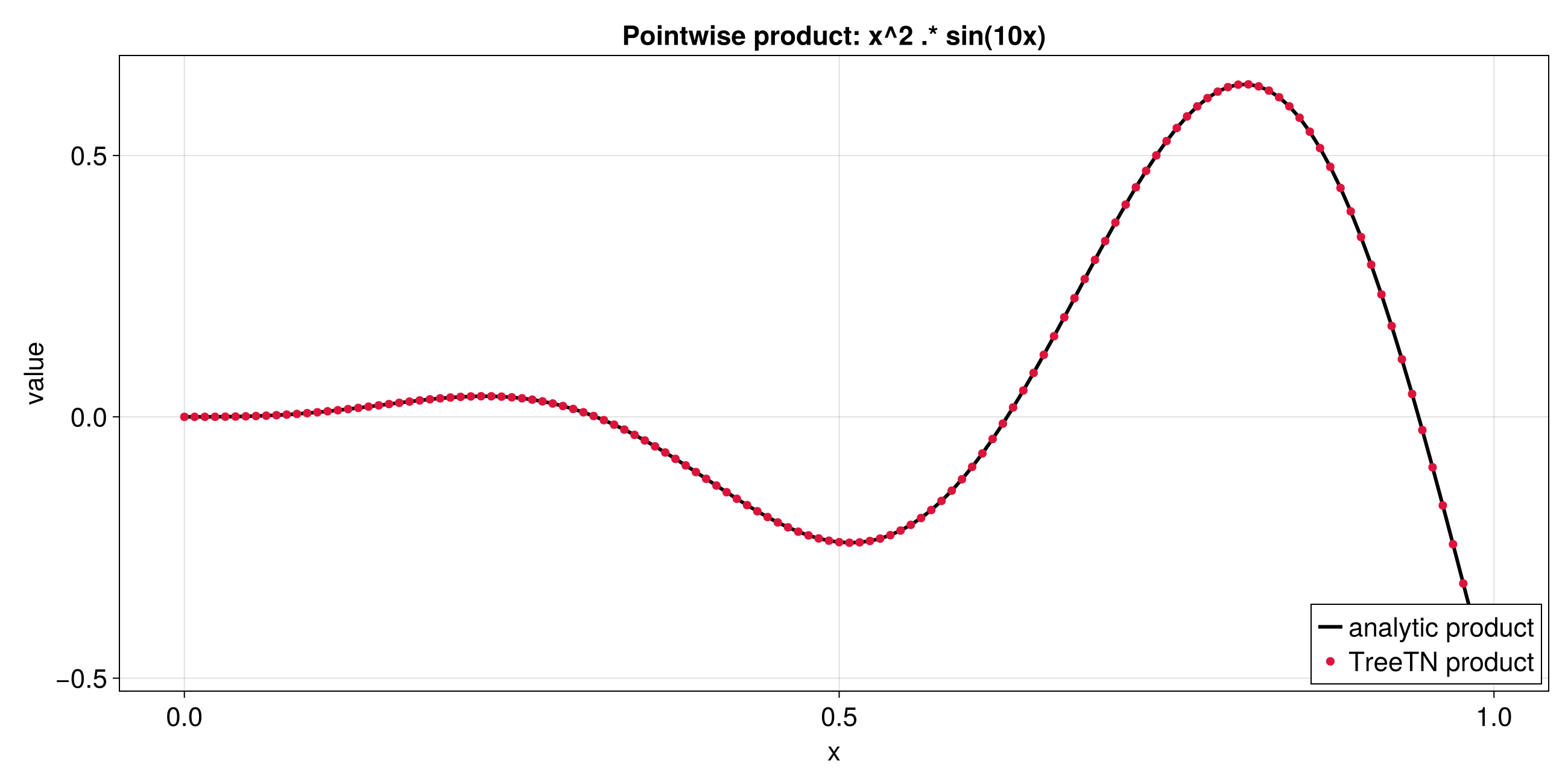
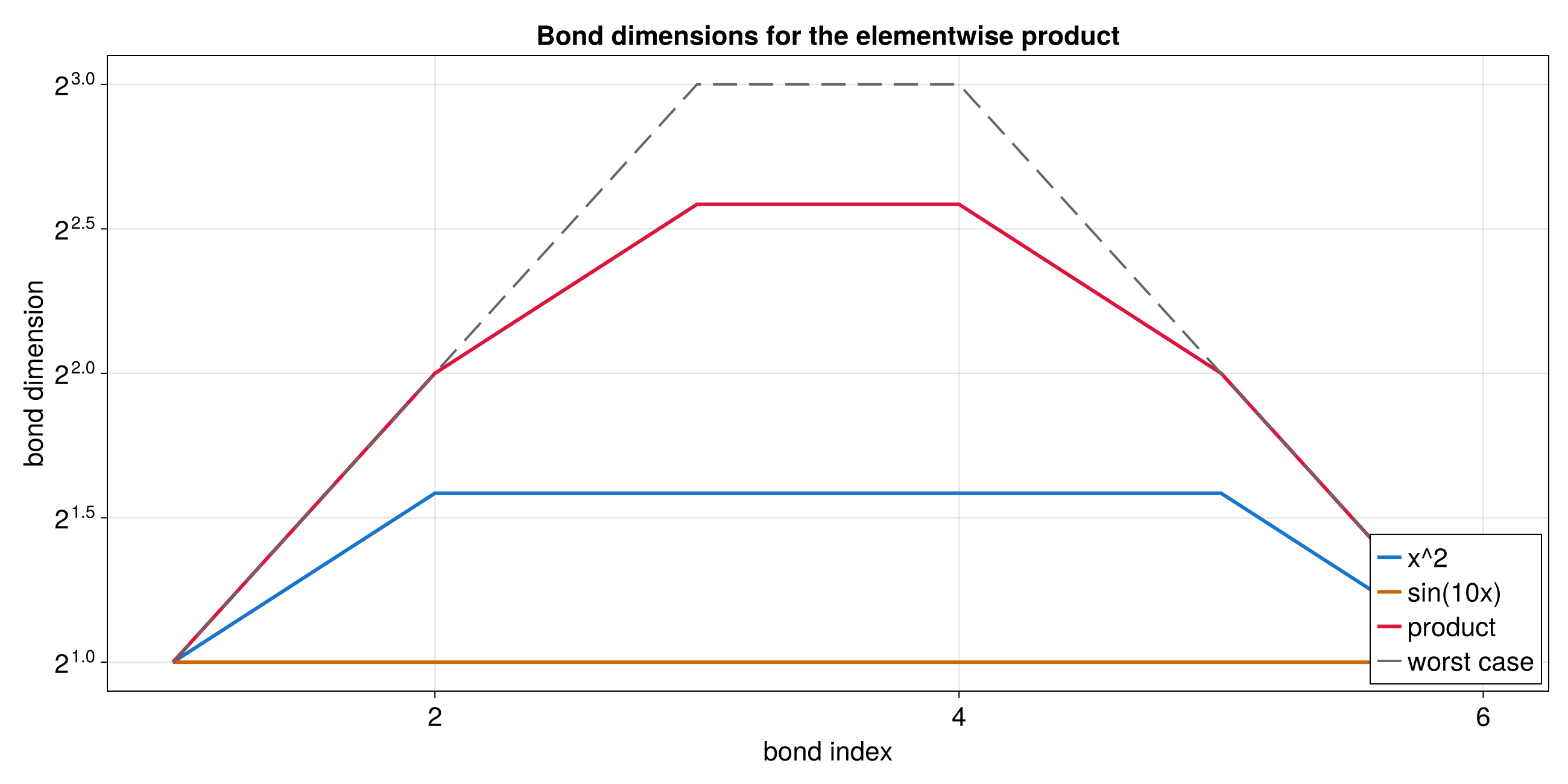
The product may need larger bond dimensions than either factor alone, because it carries information from both inputs.