From Julia to Rust: a differentiable tensor stack for scientific computing in the agentic AI era
tenferro-rs is a Rust-native tensor & autodiff stack for scientific computing: linear algebra, PyTorch-style eager autodiff, JAX-style traced transforms, NumPy-style einsum, FFT, extensible operation crates, and explicit CPU/CUDA backends. The first crates are on crates.io as of June 23, 2026 (JST).
by Hiroshi Shinaoka (Saitama University), for the tensor4all team
Most tensor-network code has been written in Julia, and ours was no exception. ITensors and the surrounding ecosystem are good for prototyping: the code stays close to the math, and it is easy to iterate. Our own work on the IR basis, sparse modeling, and the tensor4all tensor-cross-interpolation and quantics stack started there.
Once the codebase gets large, though, Julia development starts to slow down: type instability that only shows up at run time, compile and precompile times that stretch the edit/test loop, and the sense that correctness gets harder to check as the code grows. When we started fitting the tensor-network stack into a larger system, that became hard to ignore. We began moving the compute engine to Rust.
That immediately exposed a second problem. The tensor library we wanted to build on was not there yet. Rust has libraries for individual jobs: ndarray for arrays, Burn for deep learning, faer for linear algebra. What was missing was a tensor layer that could cover autodiff through einsum and still feel usable for scientific computing. The goal was not to replace those libraries. It was to connect the pieces that already exist.
The Rust ecosystem has changed a lot in the last few years. crates.io went from
602 crates in 2015 to roughly 210,000 in 2026
(data). For dense linear
algebra there is faer; for GPU kernels, CubeCL;
for generic numerics, num-traits and num-complex. There are also libraries
at nearby layers: ndarray for arrays, nalgebra and faer for linear algebra, Burn
and candle for deep learning, and numr for a NumPy-style array API. What we
needed was the layer between them: a scientific-computing tensor stack with
column-major storage, dynamic shapes, eager and traced autodiff, einsum, FFT,
CPU/CUDA backends, and extensible operations. That is what tenferro-rs is for.
We build on faer and CubeCL and add the missing parts instead of reinventing
them. Porting SparseIR.jl and Julia tensor-network code made it clearer where
that missing layer was.
That is the background for tenferro-rs. This post explains why we are building it, and why we chose Rust now that code is no longer written only by humans.
Why Rust now, when Julia was fine before?
A couple of years ago I would probably have told students to start with Julia. Julia code can stay close to the math, memory management is easy, and the numerical libraries were already there. Rust had more to learn, and the ecosystem was still missing pieces.
I would not give the same advice now. Not because Rust changed, but because I am no longer the one writing most of the code.
Fortran, Python, and Julia all developed around lowering the cost for humans to write, read, and maintain code by hand. Readability, a REPL, notation close to the math, and a low barrier to entry all matter for that. When AI writes more of the code, the tradeoff changes. Writing speed matters less. Much of the learning cost can be handled by the agent. But “it reads like the math” still does not guarantee correctness: aliasing, mutation, and allocation are not visible from the surface of a line.
For us, the question stopped being “how fast can a human write this?” and became “how confident can we be that it is correct?”. That reframing is why Rust became the more practical choice.
Concretely:
- Ownership and types rule out a wide range of errors at compile time.
cargo
check
answers in seconds, so when the agent gets something wrong, we find out before running the program. - Cargo handles builds, dependency resolution, tests, and benchmarks in one place. No CMake, no link-time version conflicts. A from-scratch build of the full stack plus dependencies takes a couple of minutes on a laptop, and the edit/test loop is tens of seconds.
- Rust controls symbol visibility along module and crate boundaries. An agent can only work inside a layer; it cannot reach into another crate’s internals and quietly break the abstraction. In an AI-written codebase of about 130K lines, that boundary matters.
- Lifetimes and ownership mechanics can largely be left to the agent, so human attention goes to algorithms, design, and correctness. The early learning cost that used to count against Rust is less of a problem now.
In C++, Python, and Julia, large codebases tend to come with the worry that they are becoming too hard to verify. With Rust, that worry is noticeably smaller.
From a port to a stack
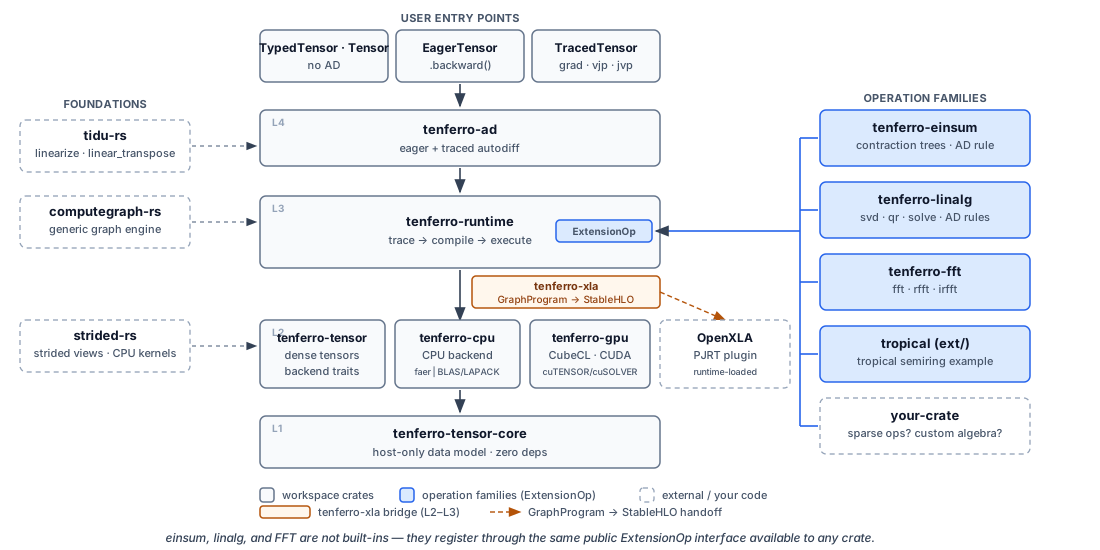
We did not set out to build a general tensor library. We wanted to port the pieces we needed and spend less time fighting the tools. But as the implementation progressed, it became clear that autodiff, backends, and the way new operations are added should not be trapped inside a tensor-network-specific layer. We designed the shared parts as an independent tensor stack.
- Operation families live in their own crates rather than inside one all-in-one tensor type.
- Autodiff rules live outside the tensor type. Following the Julia/ChainRules lesson, the derivative rule belongs to the operation itself, not to one concrete tensor class. The AD substrate, tidu-rs, is generic, and the tensor type is just one consumer of it.
- Backends and devices are explicit. Nothing silently moves data between CPU and GPU. We also keep separate the question of which backend can execute an operation and which devices are available at run time.
- Storage is column-major, matching Fortran, Julia, MATLAB, and LAPACK/BLAS. Row-major data can still be handled through strided views, without unnecessary eager copies.
That design makes the stack useful outside tensor networks too.
tenferro-rs in two minutes
The stack gives you typed tensors, immediate (eager) execution with backward(),
traced graphs with grad/vjp/jvp/HVP, linear algebra, einsum, FFT, and
explicit CPU and CUDA backends (plus experimental WebGPU).
Here is PyTorch-style eager autodiff for sum(x²), whose gradient is 2x, copied
verbatim from the repo’s
eager_autodiff_pytorch_style.rs:
use tenferro_ad::{EagerRuntime, Tensor};

fn assert_close(actual: &[f64], expected: &[f64]) {
    assert_eq!(actual.len(), expected.len());
    for (index, (actual, expected)) in actual.iter().zip(expected).enumerate() {
        let error = (actual - expected).abs();
        assert!(
            error < 1.0e-12,
            "value {index}: actual={actual}, expected={expected}, error={error}"
        );
    }
}

fn main() -> Result<(), Box<dyn std::error::Error>> {
    let runtime = EagerRuntime::new();
    let x = runtime.variable_from(Tensor::from_vec_col_major(
        vec![3],
        vec![1.0_f64, 2.0, 3.0],
    )?)?;

    let prediction = x.mul(&x).unwrap();
    let loss = prediction.reduce_sum(&[0])?;

    assert_eq!(loss.shape(), &[]);
    assert_close(loss.materialized()?.as_slice::<f64>().unwrap(), &[14.0]);

    loss.backward()?;

    let grad = x
        .grad()?
        .expect("tracked variable should receive a gradient");
    assert_eq!(grad.shape(), &[3]);
    assert_close(grad.as_slice::<f64>().unwrap(), &[2.0, 4.0, 6.0]);

    x.clear_grad()?;
    assert!(x.grad()?.is_none());

    Ok(())
}
In this example, the program checks its own result. That small example reflects
the way we build the library. The same computation can also run as a JAX-style
traced graph, compiled once and reused, with grad/vjp/jvp
(see traced_autodiff_jax_style.rs).
You can choose the layer you need: typed tensors, eager execution with autodiff,
or traced graphs. Autodiff, CUDA, einsum, FFT, and linalg can all be enabled only
when needed.
Computations whose sizes depend on data
JAX and XLA are good at optimizing a computation whose shapes are fixed and then
running it quickly again for inputs of the same shape. Once shapes depend on the
data, things get harder. Truncation thresholds, adaptive bond dimensions,
data-dependent iteration counts: if sizes are only known at run time, every new
shape can force a recompilation. If you avoid recompilation by falling back to
eager execution, transforms such as grad and vjp no longer fit into the same
workflow.
That is the daily reality of tensor networks and much of adaptive scientific computing. It is most of what we do. For calculations where ranks or bond dimensions change with the data, reusing the same traced program without recompilation matters.
tenferro compiles a traced program once and reuses it even when concrete
sizes (ranks, thresholds, iteration counts) are decided at run time. grad,
vjp, and jvp remain available. At the same time, static-size computations can
use OpenXLA. tenferro-xla lowers graphs to StableHLO and can load PJRT plugins,
so in principle it can reach the same execution speed as JAX.
Checking correctness from the outside
The obvious worry with AI-written numerical code is that it can look correct without being correct.
So we do not make reading the code the only basis for trust. We set up separate checks that do not depend on someone eyeballing the source:
- Correctness is checked against finite-difference and PyTorch reference oracles. tensor-ad-oracles is a standalone database and generator for derivative-correctness checks of tensor and linear-algebra operations, with invariants, residual checks, and provenance checks.
- Performance is measured with the reproducible tenferro-benchmark suite against PyTorch and JAX. On many targets, tenferro already reaches CPU/GPU performance close to them, with more optimization still left. We link the benchmark repository rather than freezing numbers here, because that is the reproducible reference and the numbers change.
- Design is written down. REPOSITORY_RULES.md, AGENTS.md, design notes, and worklogs record the architecture and its constraints for both humans and agents. When a failure exposes a missing rule, such as “operation families are first-class crates, not a facade” or “no naive CPU loop fallbacks, use faer or BLAS”, it becomes a new constraint instead of a one-off fix. That keeps the design from drifting in a 130K-line codebase.
The oracles and benchmarks live in separate repositories, so the agent writing the library cannot move the goalposts. We also check rules against code continuously, so drift is caught early. Add tests with enforced per-file coverage thresholds, and correctness, performance, and design are checked through separate mechanisms rather than by review alone.
Try it
The first tenferro crates are on crates.io, published as separate crates so you can pull in only what you need:
[dependencies]
tenferro-tensor = "0.2"   # tensors, views, backends
tenferro-ad     = "0.2"   # eager + traced autodiff
# plus tenferro-linalg, tenferro-einsum, tenferro-fft, tenferro-cpu,
# tenferro-gpu, tenferro-xla: add only what you need
tenferro-rs is still a v0.2 preview; the API is not a finalized 1.0. But it is not just an experiment. We already use it as the engine under tensor4all-rs, our Rust tensor-network stack (TreeTN, QTT, TCI), and develop it against real scientific workloads. If your host language is Python, JAX and PyTorch are the natural choice. tenferro-rs is for people who want similar capabilities directly from Rust. At this preview stage, user feedback can still shape the design.
We especially want people who have used ndarray, nalgebra/faer, Burn/candle, PyTorch/JAX, or Julia/Fortran in scientific and HPC work to try it:
- Docs and guides: https://tensor4all.org/tenferro-rs/ — start with Getting Started
- Source: https://github.com/tensor4all/tenferro-rs
- Reproduce the benchmarks: https://github.com/tensor4all/tenferro-benchmark
- Check correctness: https://github.com/tensor4all/tensor-ad-oracles
If you try it on real scientific workloads and find something missing, slow, or wrong, that report is especially useful.
Acknowledgments
Thanks to Jin-Guo Liu for the initial tenferro design, and to Satoshi Terasaki for development support.
Disclosure: this post was written collaboratively by AI coding agents and the author, in the same human-verified workflow it describes.